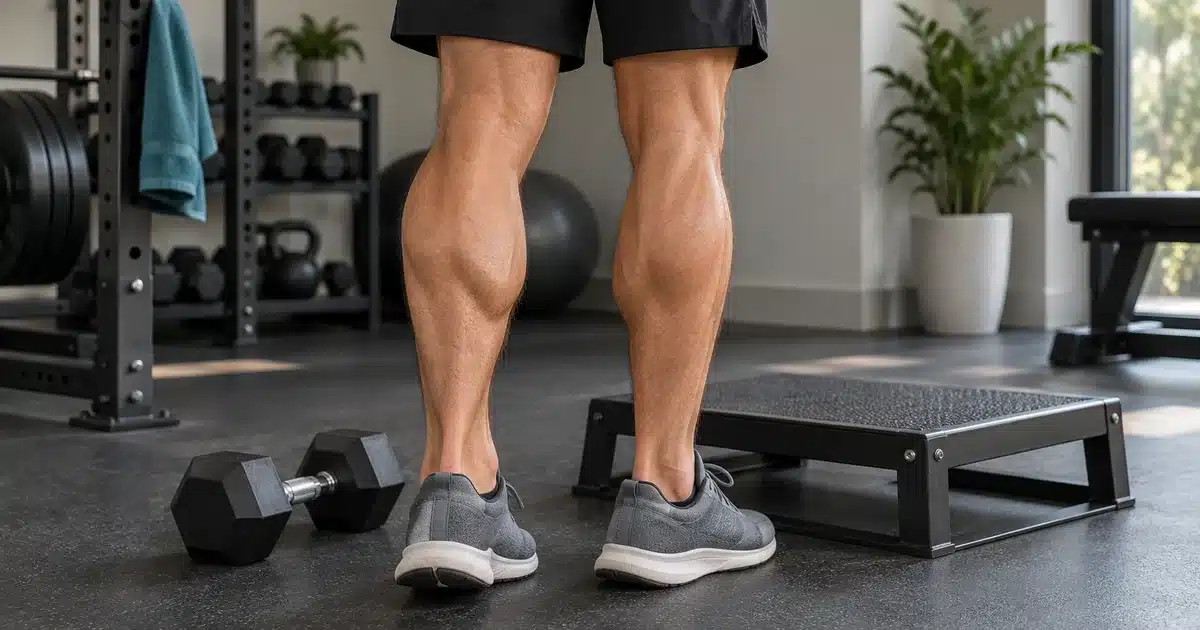
Find out why calves can lag, what to check before adding more sets, and which simple tools are worth considering before you spend.
You train your legs, finish with calf raises, and still see the same lower legs in the mirror. Meanwhile, someone who barely trains seems to have the calves you want. It is easy to wonder whether you need a better exercise, more equipment, or different genetics.
What muscle is the hardest to grow? Calves are a common topic in lifting discussions, but research has not established a single muscle as the hardest for everyone. The more useful question is whether your slow progress reflects your anatomy, your training, or how you measure change.
This guide helps you separate those possibilities. Start with the quick training check below, then use the equipment section to decide whether a workout journal or adjustable dumbbells would solve an actual problem in your routine.
Affiliate disclosure: This article contains affiliate links. If you purchase through them, we may earn a commission at no additional cost to you. As an Amazon Associate, we earn from qualifying purchases.
Research and image disclosure: This is an educational, research-based guide, not a report of personal product testing. Images are AI-generated illustrations using generic equipment. They do not show the specific products linked below.
What Muscle Is the Hardest to Grow? The Quick Answer
Calves are often described as stubborn, but there is no proven universal ranking of the hardest muscles to grow. Studies show that calf muscles can increase in size with resistance training. Your starting point, exercise selection, consistency, and individual response affect what happens next.
Forearms, rear shoulders, hamstrings, and abs can also seem slow to develop. That does not establish them as second-, third-, or fourth-place in a scientific ranking. A muscle may receive less direct training than you think.
Before buying anything, answer three questions: Are you training the area consistently? Are you recording comparable sets and repetitions? Can you make the exercise harder without shortening the movement?
Check the five training gaps before changing your program →
Why Calves Can Look Stubborn
Your shape and your progress are different things
Calf appearance includes more than muscle size. Muscle-belly length, tendon proportions, and overall leg structure help explain why two people can have different-looking calves. Training does not let you choose different attachment points.
That is different from saying your calves cannot grow. Comparing your lower legs with someone else’s is a poor way to judge whether your own training is working. Compare consistent measurements and photographs of yourself over time.
Standing and seated calf raises are not interchangeable
The gastrocnemius crosses the knee and ankle; the soleus sits underneath it and does not cross the knee. Knee position therefore changes how the calf muscles are loaded.
In a 12-week study of 14 untrained adults, standing calf raises produced greater gastrocnemius growth than seated calf raises. Soleus growth was similar between conditions. This supports including a straight-knee variation when gastrocnemius size is the goal.
The study was small, and its average results do not guarantee your results. It also does not prove that seated calf raises are useless or that calves are the hardest muscle in every person.
Walking is not the same as a progressive training plan
Your calves work during daily activities, but a step count does not tell you whether your calf exercises are becoming more challenging. Record your dedicated training separately. Someone who walks regularly can still benefit from a suitable resistance-training routine.
Nor should you choose a rep range based solely on claims about slow-twitch fibres. An eight-week study in 26 untrained young men found similar calf hypertrophy with lighter and heavier loading protocols. It does not establish one ideal rep range for everyone.
Five Checks Before You Add More Calf Work
1. Count the work you actually complete
“I train legs twice a week” does not tell you how often you train calves. Look at your last few workouts. If calf raises disappear whenever you run out of time, scheduling them earlier may be more useful than adding exercises.
Keep the rest of your leg training balanced. Giving calves attention should not mean dropping the movements that train your thighs and hips.
2. Make your repetitions comparable
Choose a comfortable range you can control. Lift and lower smoothly rather than bouncing through the bottom. If the weight increases but the movement becomes much shorter, your log may exaggerate your progress.
A stable floor is a straightforward starting point. Use an elevated platform only if it is designed for the exercise, does not move, and lets you maintain balance and a comfortable ankle position. Do not chase a deep stretch through pain.
3. Distinguish effort from discomfort
A burning sensation does not reveal how many good repetitions you could still perform. Equally, grinding until your technique falls apart is not required. A practical starting approach is to finish with roughly two controlled repetitions left, adjusting the load as you learn the movement.
If balance or grip ends the set before your calves are challenged, address that limitation. A supported variation or an appropriate gym machine may suit you better than a heavier handheld weight.
4. Change one variable at a time
Adding weight, doubling your sets, and changing exercises in the same week makes the result difficult to interpret. Start by keeping a repeatable routine. Add repetitions within your chosen range, then consider a small load increase when your technique and effort remain consistent.
ACSM’s 2026 guidance emphasizes individualization and consistent training. Its general hypertrophy guidance points toward around 10 weekly sets per muscle group, but this is not a mandatory starting dose or a calf-specific guarantee. Build toward what you can recover from.
5. Check recovery before assuming you need more
If repetitions are falling, soreness lingers into the next session, or your Achilles tendon becomes uncomfortable, adding sets is unlikely to be the sensible first move. Review your recent workload, including running and jumping.
Stop exercises that cause sharp or persistent pain and seek appropriate professional guidance. This example is intended for generally healthy adults, not injury rehabilitation.
A Simple Twice-Weekly Calf Training Example
This is an illustrative starting template, not a tested program or a promise of growth. Place sessions on nonconsecutive days and fit them around your existing routine. If direct calf work is new, begin with fewer sets.
| Session | Exercise | Starting work |
|---|---|---|
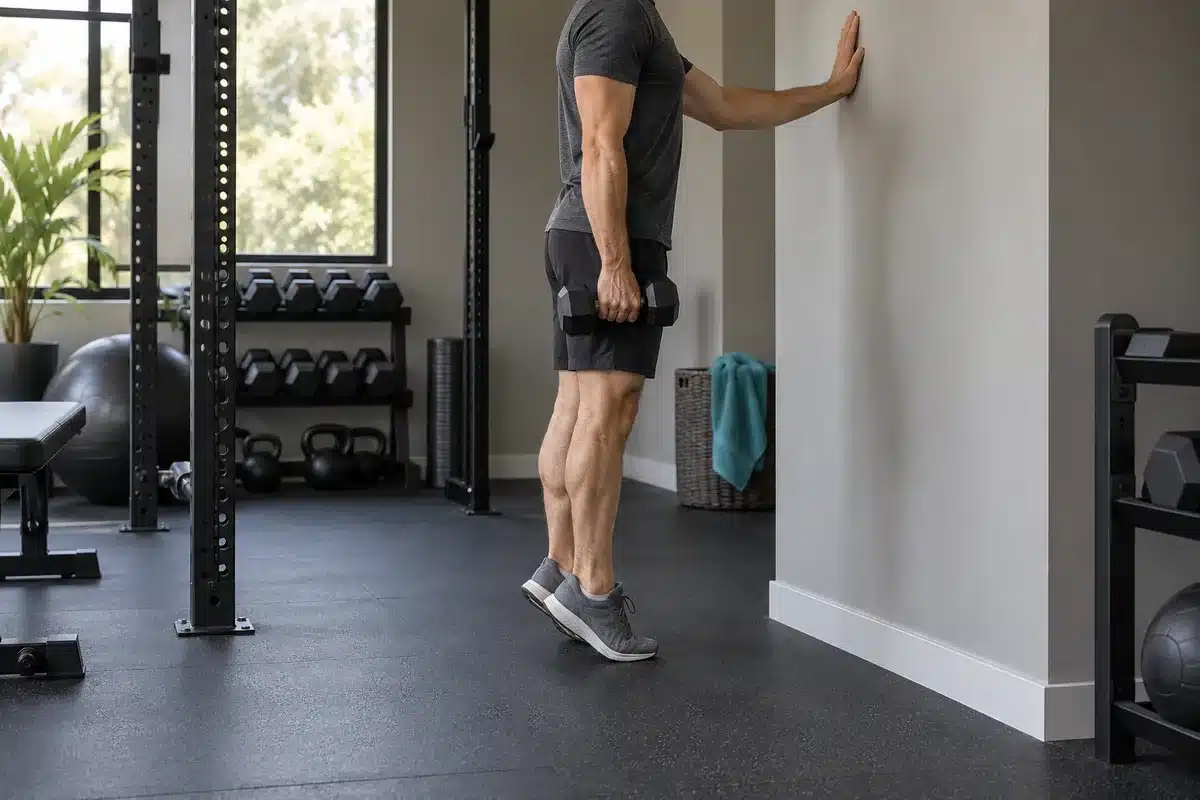
| A | Supported standing calf raise | 2–3 sets of 10–15 controlled reps |
| B | Supported standing calf raise | 2–3 sets of 12–20 controlled reps |
Warm up with easy repetitions. Rest long enough to repeat the movement with control; around two minutes is a reasonable starting point. Use body weight, a dumbbell, or an appropriate machine according to your current ability.
For example, if your target is 10–15 repetitions, keep the load steady while you work toward the top of that range across your sets. Once you can do that with the same technique and intended effort, try the smallest suitable increase. There is no requirement to progress every session.
After several consistent weeks, review performance and recovery. You could add one set to each session if the current workload feels manageable and progress has stalled. A bent-knee variation is another option, but avoid changing everything at once.
Need help fitting this into a weekly schedule? See our 3-3-3 gym rule guide and guide to choosing a bodybuilding split.
What About Forearms, Abs, Rear Delts, and Hamstrings?
These areas need an honest program check rather than a “bad genetics” label. The examples below are ways to inspect your routine, not a ranking of growth potential.
- Forearms: Review whether your pulling exercises and any direct work provide a repeatable challenge. Gripping strength and forearm appearance are related goals, but they are not identical measures.
- Abs: Separate muscle development from visibility. Body-fat distribution, lighting, and abdominal structure affect how defined your midsection looks. More crunches alone do not guarantee visible abs.
- Rear delts: Check whether your program gives the back of your shoulders direct attention, rather than assuming all pressing and rowing variations train them equally.
- Hamstrings: Look at your actual exercise selection. A program dominated by squats may benefit from appropriate hip-hinge and knee-flexion work.
If one area lags, review its exercises, progression, and consistency before rebuilding your entire routine around it.
Two Optional Tools, Ranked by the Problem They Solve
These are practical buying priorities, not laboratory-tested product rankings. Start with what you already own. Neither product changes your genetics or guarantees muscle growth.
1. NewMe Fitness Journal: For Lifters Who Cannot See a Training Trend
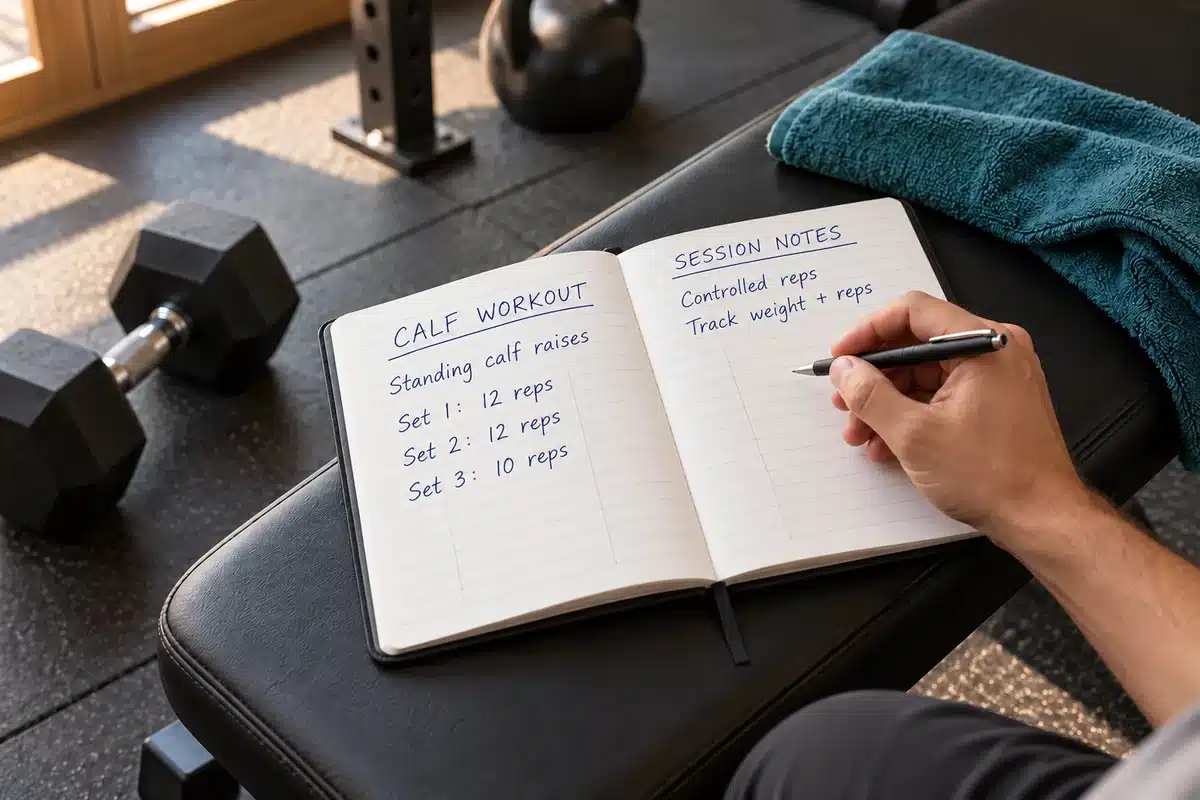
If you cannot remember last week’s repetitions, a record is the first gap to close. The linked NewMe Fitness journal combines workout and nutrition logging. Its listing describes spaces for exercises, sets, and repetitions, which can help you compare sessions.
Choose it if: You like paper and want a prepared layout. Skip it if: A notebook, spreadsheet, or phone note already keeps you consistent. Extra food-tracking sections may be unnecessary if you only want a lifting log.
Check the page layout, dimensions, and number of daily entries before ordering. You are buying an organizational tool, not a specialized calf-growth system.
See the NewMe journal layout and current Amazon price →
2. PowerBlock Elite EXP Stage 1: For Home Lifters Who Need Adjustable Resistance
A heavier weight is useful only when your current setup no longer provides a suitable challenge. Adjustable dumbbells can also be used for other exercises, which makes more sense than purchasing equipment for one small part of your routine.
The linked PowerBlock Elite EXP Stage 1 listing describes a pair of adjustable dumbbells from 5 to 50 pounds per hand, with expansion kits sold separately. Check the selected package carefully. Elite EXP and Elite USA accessories should not be assumed interchangeable.
Choose it if: You want several weights in a compact setup and will use them for more than calf raises. Skip it if: Your gym already provides suitable equipment, your current weight still challenges you, or the handle enclosure and block shape feel awkward for your exercises.
Before purchasing, compare weight increments, grip clearance, return terms, and the delivered price. Stronger lifters may reach a point where a handheld weight is limited by grip or balance. Buying adjustable dumbbells does not remove those constraints.
Check the PowerBlock weight range, package, and current price →
If you are planning a larger setup, our Rogue Fitness equipment guide covers broader space and equipment decisions.
Support Training With Consistent Meals
Food cannot target growth to your calves, but inconsistent intake can make a muscle-building routine harder to support. Start with regular meals and a protein source you enjoy at each one.
A meta-analysis of 49 studies estimated a plateau in additional fat-free mass gains at around 1.6 grams of total daily protein per kilogram of body weight during resistance training. That is a population estimate with uncertainty, not a hard individual threshold.
For a healthy 75-kilogram adult, 1.6 g/kg works out to about 120 grams per day. That total includes food. Protein powder is optional convenience, not a fix for an unproductive calf routine. If you have a condition requiring a prescribed diet, follow your clinician’s individualized advice.
For ordinary meal ideas, use our protein portions and muscle-building foods guide.
How to Check Progress Without Guessing
Record the exercise, load, repetitions, and approximate effort after each session. Include a brief note if you changed your range of motion or setup. A heavier number is less informative when the exercise itself has changed.
For size comparisons, measure at the same location and under similar conditions, without a post-workout pump. Repeat the measurement to check consistency. Use the same lighting and camera position for photographs.
Review several weeks of information rather than yesterday’s mirror check. An 8–12-week review period can help you organize observations, but it is not a deadline for visible growth. Tape measurements also include tissue other than muscle, and strength improvements do not prove a specific increase in size.
Your next step: Choose a repeatable exercise, record your starting point, and follow through. If paper tracking would help, compare the NewMe Fitness journal; otherwise, start with a notebook you already have.
Frequently Asked Questions
Are calves the hardest muscle to grow?
They are a common source of frustration, but the evidence reviewed here does not establish a universally hardest muscle. Controlled studies demonstrate that calves can grow with resistance training.
Can you grow calves if your family has small calves?
Your family resemblance does not measure your response to training. Anatomy affects appearance, but it does not tell you exactly how much muscle you can add. Assess your own progress under a consistent routine.
Should you train calves every day?
Daily training is not necessary to begin. Two nonconsecutive sessions make it easier to organize the example above and review recovery. Avoid adding daily sessions simply because another lifter recommends them.
Do you need a calf machine?
No. A supported bodyweight or dumbbell variation may suit your current ability. A machine can be useful when you need more loading or stability. Choose equipment around the movement you can perform confidently.
Should you buy supplements for stubborn muscles?
No supplement selectively fixes small calves. Check training consistency and ordinary meals first. A protein supplement can be convenient if needed, but it is not a substitute for a suitable training stimulus.
Research and Further Reading
- Kinoshita and colleagues: standing versus seated calf-raise training (2023).
- Schoenfeld and colleagues: calf responses to light and heavy loading (2020).
- ACSM: updated resistance-training guidance for healthy adults (2026).
- Morton and colleagues: protein supplementation and resistance training (2018).