Choosing between bodybuilding programs can feel more complicated than the training itself. One routine tells you to train your whole body three times per week, while another divides the week into separate sessions for your chest, back, legs, shoulders, and arms.
The best place to start is not with the most popular split. It is with the number of days you can train consistently, the equipment available to you, and the amount of training you can recover from
Quick answer:
If you are new to consistent strength training or have a busy schedule, a three-day full-body program is often the simplest starting point. If you can reliably train four days per week, an upper/lower split gives you more room for additional exercises without requiring you to be in the gym almost every day.
What Makes a Bodybuilding Program Effective?
A bodybuilding program is more than a list of exercises. It should give you a repeatable plan to train your major muscle groups and gradually increase the challenge.
An effective program normally includes:
- A weekly schedule you can follow consistently
- Exercises for the major movement patterns and muscle groups
- A manageable number of sets and repetitions
- A clear way to add weight, repetitions, or sets over time
- Enough recovery between demanding sessions
- Flexibility to substitute an exercise when equipment, comfort, or mobility requires it
No split can make up for frequently missed workouts or a lack of progression. A simple routine followed consistently is generally more useful than a complicated routine that does not fit your schedule.
How Many Days Can You Realistically Train?
Start with your normal week rather than your ideal week. If you can protect three training days most weeks, choose a program designed for three days instead of repeatedly falling behind on a five-day plan.
The following comparison provides a practical starting point.
| Training days | Common program structure | May suit you if… | Important consideration |
| 2–3 days | Full-body workouts | You are a beginner, returning after time away, or managing a busy schedule | Each session includes several major muscle groups |
| 4 days | Upper/lower split | You want more exercise variety and can recover between sessions | You need four dependable training windows each week |
| 5-6 days | Push/pull/legs or body-part split | You prefer shorter, more focused sessions and can train frequently | Missing sessions can leave some muscles untrained that week |
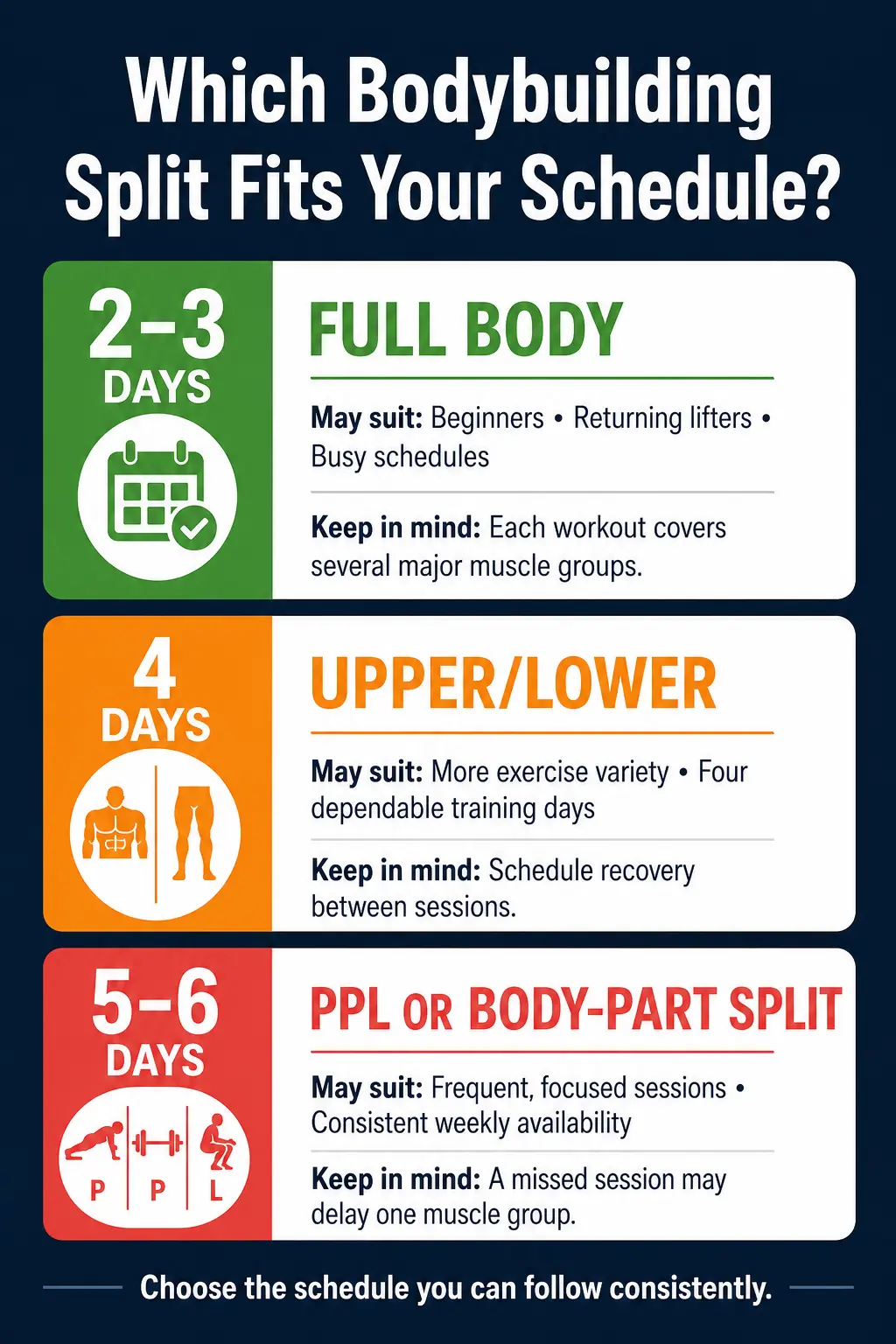
A training schedule is mainly a way to organize your weekly work. Research indicates that when total training volume is similar, training frequency alone may not meaningfully affect muscle growth. This allows you to choose a schedule based on consistency and recovery rather than assuming that more gym days are always better.
Three Day Full Body Workout Framework
A full-body program trains several major muscle groups during each workout. This structure can be useful for learning exercises, regular practice, and keeping the weekly schedule manageable.
Here is one way to organize two alternating workouts:
Workout A
Exercise or movement Sets Repetition range Squat or leg press 2-3 6-10 Bench press or dumbbell chest press 2-3 6-10 Seated row or one-arm dumbbell row 2-3 8-12 Romanian deadlift or leg curl 2 8-12 Lateral raise 2 10-15 Optional curl or triceps exercise 1-2 10-15
Workout B
| Exercise or movement | Sets | Repetition range |
| Split squat or leg press | 2-3 | 8-12 |
| Overhead press or machine shoulder press | 2-3 | 6-10 |
| Lat pulldown or assisted pull-up | 2-3 | 8-12 |
| Hip Thrust or leg curl | 2 | 8-12 |
| Calf raise | 2 | 10-15 |
| Core exercise | 2 | Controlled repetitions |
You could alternate the workouts like this:
- Week one: Workout A, Workout B, Workout A
- Week two: Workout B, Workout A, Workout B
The exercise choices are examples, not requirements. Machines, dumbbells, barbells, and bodyweight exercises can all have a place in a program when they allow you to train the intended muscles comfortably and track your progress.
Four-Day Upper/Lower Program Framework
An upper/lower split separates upper-body and lower-body training. Each area is normally trained twice a week, with rest days scheduled to fit your schedule.
One possible weekly layout is:
- Monday: Upper Body A
- Tuesday: Lower Body A
- Wednesday: Rest
- Thursday: Upper Body B
- Friday: Lower Body B
- Weekend: Rest or light recreational activity
Someone can modify and move days to fit the individual schedule. What matters is leaving reasonable recovery time before training the same muscles again.
Upper Body A
| Exercise or movement | Sets | Repetition range |
| Bench press or machine chest press | 3 | 6-10 |
| Row variation | 3 | 8-12 |
| Overhead press | 2 | 8-12 |
| Lat pulldown | 2 | 8-12 |
| Biceps curl | 2 | 10-15 |
| Triceps Extension | 2 | 10-15 |
Lower Body A
| Exercise or movement | Sets | Repetition range |
| Squat or leg press | 3 | 6-10 |
| Romanian deadlift | 2-3 | 8-12 |
| Leg Extension | 2 | 10-15 |
| Leg curl | 2 | 10-15 |
| Calf raise | 2 | 10-15 |
Upper Body B
| Exercise or movement | Sets | Repetition range |
| Incline dumbbell press | 3 | 8-12 |
| Lat pulldown or assisted pull up | 3 | 8-12 |
| Seated cable or row machine | 2 | 8-12 |
| Lateral raise | 2-3 | 10-15 |
| Bicep curl variation | 2 | 10-15 |
| Triceps exercise | 2 | 10-15 |
Lower Body B
| Exercise or movement | Sets | Repetition range |
| Hip thrust or another hip extension | 3 | 8-12 |
| Split squat or walking lunge | 2-3 | 8-12 per side |
| Leg curl | 2-3 | 10-15 |
| Leg extension | 2 | 10-15 |
| Calf raise | 2 | 10-15 |
These frameworks are examples of program structure rather than individualized prescriptions. Exercise selection, range of motion, and training load may need to be adjusted for your ability, equipment, and health history.
f you are considering a higher-frequency schedule, this 5 day split for building muscle provides a closer look at how the training week can be organized.
How Much Training Volume Do You Need?
Training volume is commonly measured by the number of challenging sets performed for a muscle group during the week. There is no single weekly number that is appropriate for every reader.
Research generally supports a relationship between weekly set volume and muscle growth, but additional sets appear to provide diminishing returns. Your training experience, exercise selection, sleep, nutrition, and recovery can all affect how much work you can usefully perform.
If you are new to structured training, begin with the lower end of the sets shown in the sample programs. Add work only after you can consistently complete the current routine, recover between sessions, and maintain good exercise technique.
More sets are not automatically better. Sets that reduce the quality of the rest of your workout or interfere with your next session may indicate that the program needs adjustment.
How Hard Should Each Set Feel?
A working set should be challenging enough that the final repetitions require concentration while your technique remains controlled. You do not need to take every set to complete muscular failure.
One practical method is to finish most sets with approximately one to three good repetitions still possible. This is often described as leaving one to three “repetitions in reserve.” The number will not always be exact, especially while you are learning, but it can help you avoid treating every set like a maximum-effort test.
If you finish a set and could easily perform many more repetitions, the resistance may be too light for the selected repetition range. If your technique breaks down before reaching the range, reduce the resistance or choose a more manageable variation.
How to Use Progressive Overload
Progressive overload means gradually increasing the training challenge. It does not require adding weight during every workout.
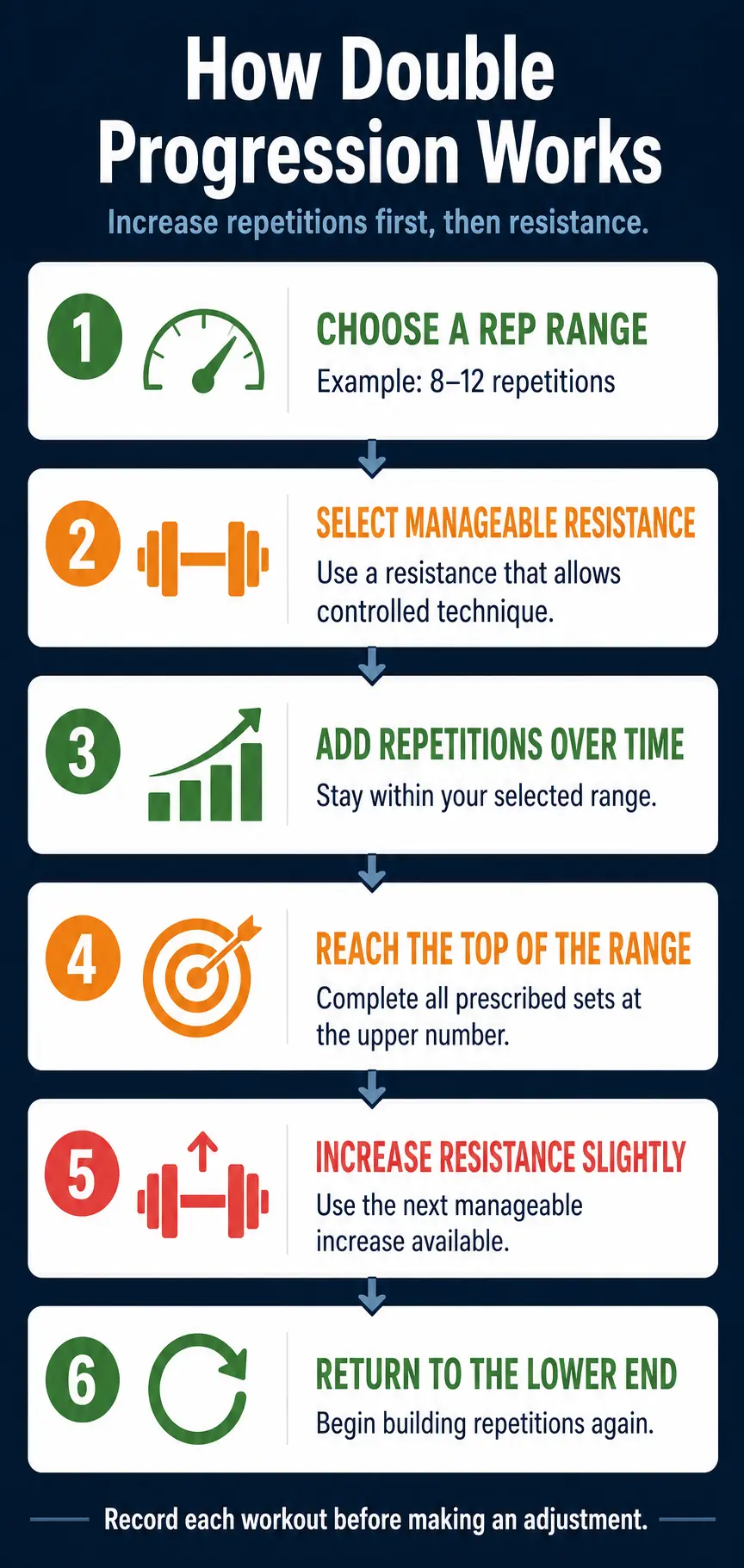
A simple method is double progression:
- Choose a repetition range, such as 8–12.
- Select a resistance that lets you complete your sets with controlled technique.
- Gradually add repetitions over future sessions.
- When you can reach 12 repetitions across all prescribed sets, make a small increase in resistance.
- Begin again near the lower end of the range.
For example, your rowing exercise might progress from three sets of 8 repetitions to three sets of 12 over several weeks. After increasing the weight, your repetitions may return to 8 or 9 as you build back up.
A training log makes this easier. Record the exercise, resistance, repetitions, and any brief note that helps explain the session.
When Should You Change Your Program?
Do not change routines simply because a new workout appears online. First, give yourself enough consistent sessions to understand how the existing program fits you.
An 8–12 week training block can provide a useful review period, but it is not an expiration date. If the program fits your schedule, you are recovering, and your performance is gradually improving, you may not need to replace it.
Consider adjusting the program when:
- The weekly schedule repeatedly conflicts with your responsibilities.
- An exercise consistently causes pain or cannot be performed comfortably.
- Fatigue continues to build and does not improve with ordinary rest.
- Your recorded repetitions or resistance have not improved after several consistent weeks.
- The program neglects a muscle group or goal that matters to you.
- Your available equipment has changed.
Sometimes a small adjustment is enough. Reducing a few sets, changing an exercise, or adding a recovery day may be more useful than replacing the entire routine.
Recovery and Nutrition Still Matter
Any training program requires recovery downtime. Your program should leave room for adequate sleep, sufficient food, and rest between demanding sessions
Protein is one part of that picture. A large research review found that total protein intake around 1.6 grams per kilogram of body weight per day supported resistance-training results for many healthy adults, with individual needs varying. A registered dietitian or qualified healthcare professional can help when medical conditions, dietary restrictions, or weight-management needs require individualized guidance.
If soreness, fatigue, or declining performance persist from one workout to the next, review the overall demands of your program. For more information about organizing training without the use of performance-enhancing drugs, read the complete guide to a natural bodybuilding training program. A lighter training period or additional rest may be appropriate, but deload weeks do not have to follow the same fixed schedule for everyone.
“As an Amazon Associate, I earn from qualifying purchases.”
If you are considering protein powder for convenience, the Gold Standard 100% Whey review explains the product and the serving information.
Common Bodybuilding Program Mistakes
Choosing a schedule that does not fit your life
A six-day routine cannot provide much value if you can only make it to the gym three times. Choose the schedule you can repeat during an ordinary week.
Adding too much volume too quickly
Starting with every exercise and every available set makes it difficult to tell how much training you actually need. Begin with a manageable amount and adjust from your recorded performance and recovery.
Changing exercises before you can measure progress
The change-up of exercises can be exciting and may be enjoyable, but frequent changes make comparisons difficult. Keep your main exercises stable long enough to track repetitions, resistance, and technique.
Taking every set to failure
Training to failure is not required on every set. Repeated maximum-effort sets can add fatigue that affects later exercises and sessions.
Assuming machines do not count
Research comparing machines with free weights has found similar muscle-growth outcomes overall. Your goals and the way strength is tested can affect which option is more specific, but both can be useful for bodybuilding.
Ignoring pain
Exercise can feel difficult without causing sharp, worsening, or unusual pain. Stop an exercise that causes pain and seek appropriate professional guidance rather than attempting to push through it.
Frequently Asked Questions About Bodybuilding Programs
What is the best bodybuilding program for a beginner?
For many beginners, a good three-day full-body program is a practical place to start. The right choice still depends on your schedule, available equipment, comfort level, and any relevant health considerations.
Is a bro split a bad bodybuilding program?
Not automatically. A body part split can organize effective training, but it usually requires a dependable weekly schedule. If missing one workout means skipping a muscle group for the entire week, a full-body or upper/lower routine may be more forgiving.
Should each muscle be trained once or twice per week?
Apply what will effectively work for you. Training a muscle twice per week is often a convenient way to spread out weekly sets, while once-weekly training may suit someone who prefers body-part sessions. Total volume, effort, recovery, and consistency matter alongside frequency.
How long should you follow the same bodybuilding program?
Eight to twelve weeks can be a useful initial review period. You do not need to change a program that remains suitable and allows gradual progress. Change should have a reason, such as schedule problems, poor recovery, discomfort, or a sustained lack of progress.
Can you follow a bodybuilding program at home?
Yes. A home program can use adjustable dumbbells, resistance bands, a bench, machines, or bodyweight movements. The program still needs a balanced selection of exercises and a way to increase the challenge gradually.
Before buying equipment, use this Rogue Fitness equipment guide to consider your available space and training needs.
Do women need different bodybuilding programs than men?
The main training principles are similar. Someone should adjust the program for individual goals, exercise preferences, experience, recovery, and the muscle groups they want to emphasize.
Readers who want a simple place to start may also find this beginner gym workout plan for women helpful.
How can you tell whether your program is working?
Track your exercises, resistance, and repetitions. Gradual improvement in one or more of those areas—along with manageable recovery—can help you evaluate the program more reliably than judging a single workout.
Choose A Program You Can Continue
A workable program needs a clear schedule, a balanced selection of exercises, a manageable starting workload, and a simple way to record your progress.
Begin with the number of training days that fits an ordinary week. Consider a full-body structure for two or three days, an upper/lower structure for four days, or a more divided split when frequent training genuinely suits your schedule.
Then follow the program consistently, record what you do, and make changes for a clear reason. The goal is not to find a routine that looks impressive on paper. Choose the appropriate program you can understand, recover from, and continue.
A four-day time frame is repetitive. I suggest:
Begin with the number of training days that fits an ordinary week. Consider a full-body structure for two or three days, an upper/lower structure for four days, or a more divided split when frequent training genuinely suits your schedule.
Stay consistent and on track with the program, record what you do, and make changes as required for the workout. The goal is not to find a routine that looks impressive on paper. Choose one you can understand, recover from, and continue consistently.
Research Sources
- Resistance training prescription for muscle strength and hypertrophy in healthy adults: a systematic review and Bayesian network meta-analysis
- How many times per week should a muscle be trained to maximize muscle hypertrophy? A systematic review and meta-analysis
- Effects of resistance training performed to repetition failure or non-failure on muscular strength and hypertrophy
- Effect of free-weight versus machine-based strength training on maximal strength, hypertrophy and jump performance
- A systematic review, meta-analysis and meta-regression of protein supplementation and resistance training
“Affiliate Disclosure: This post contains affiliate links. If you buy through these links, I earn a small commission at no extra cost to you.”
Prefer a Ready-Made Program?
If you would rather follow a prepared program than build one from scratch, Muscle Explosion! 28 Days To Maximum Mass is one option you can review. Read the program details carefully and check its schedule and equipment requirements before deciding whether it suits your situation.