
Affiliate disclosure: As an Amazon Associate, I earn from qualifying purchases. This article includes affiliate links at no extra cost to you. Product suggestions are based on their intended use and available product information, not personal testing.
Learn what early progress can look like, how to track changes you might miss, and when your training plan needs attention.
You step on the scale, hoping for instant proof; you stare in the mirror every morning, looking for an overnight transformation; and when neither delivers quickly enough, you wonder if your training is even working. To keep a clearer record, track your sets and reps with the NewMe Fitness journal, or use a notebook you already own.
How long does it take to build muscle? Small, measurable changes can occur within the first several weeks of resistance training. Visible changes are less predictable and often require months of consistent work. Use eight to twelve weeks as a practical point to review your progress, not a deadline your body must meet.
The useful question is whether your training, measurements and habits are moving in the right direction. Here is how to find out before changing your program or buying another supplement.
A realistic muscle-building timeline
Muscle growth does not switch on after a four-week waiting period. Learning a movement, developing strength and building muscle can overlap. Research measurements also detect changes that may be too small for you to notice in a mirror.
In a small study of 13 untrained men, researchers detected modest changes in muscle thickness during four weeks of specialized arm training. That establishes that early growth is possible, not that every beginner will see bigger arms by a particular day. [1]
Other research shows why the first measurements need caution: swelling after unfamiliar training can contribute to apparent increases in muscle size. A pump or a sudden jump on the scale is not a reliable count of new muscle tissue. [2]
Use these checkpoints to organize your expectations. They are an editorial tracking framework, not separate biological stages.
| Checkpoint | What to look for | What it cannot prove |
|---|---|---|
| First few weeks | More comfortable technique, repeatable sessions and improving performance | Exactly how much new muscle you have gained |
| Around weeks 4–8 | Trends in your log and consistent baseline measurements | That a change in weight or circumference is entirely muscle |
| Around weeks 8–12 | Compare photos, measurements, attendance and exercise performance together | That everyone should look visibly different by now |
| Following months | Whether your approach produces changes that matter to your goal | A fixed rate of muscle gain every month |
If you missed several weeks, treat your log honestly. Twelve weeks since joining a gym is different from twelve weeks of consistent training.
Why you can get stronger before you look bigger
Strength is partly a skill. Becoming more familiar with an exercise can help you brace, coordinate the movement and apply force more effectively. Neural changes also contribute: a four-week strength-training study documented adaptations in motor-unit recruitment and firing behavior. [3]
That does not mean early training produces zero muscle growth. It means strength and size are different outcomes, so a bigger lift is encouraging without being a precise muscle measurement.
Check how you produced the improvement. Ten controlled repetitions with the same range of motion is a more useful comparison than ten repetitions one week and shorter, faster repetitions the next. Record the setup as well as the weight.
Avoid turning every workout into a test of your heaviest possible lift. For a muscle-building goal, you need a repeatable training process you can evaluate over time.
Track progress without checking the mirror every day
A short record makes it easier to distinguish a slow week from a stalled plan. Choose a few measures you can repeat consistently instead of collecting numbers you never review.
1. Record each workout
Write down the exercise, load, repetitions and working sets. Add a brief note about technique or how difficult the sets felt. A useful entry might be: “Dumbbell row, 25 lb per hand, 12/12/10 reps. Keep the same weight next time.”
Comparisons work best when the exercise setup stays similar. Note a changed machine, a different bench angle or a revised range of motion. Those details can explain an apparent jump or drop in performance.
2. Take occasional photos under similar conditions
For this tracking plan, take a baseline photo and repeat it about every four weeks. Use similar lighting, distance, clothing and posture. Avoid comparing a relaxed morning photo with a flexed photo immediately after training.
You do not need to post the pictures. They are a private reference that helps you compare different months without relying on memory.
3. Use body measurements as supporting information
If you track circumference, use the same tape position and technique each time. Take repeated readings rather than accepting an unexpectedly large change from one attempt. Waist, arm or thigh measurements reflect more than muscle alone.
If weighing yourself is useful for your goal, compare averages from similar morning conditions rather than reacting to individual readings. Treat a home scale's “muscle mass” estimate as an estimate, not a direct tissue measurement.
An optional tool: a workout journal
A phone note, spreadsheet or ordinary notebook is enough. The NewMe Fitness journal is an option if you prefer a bound paper log that keeps workouts and nutrition entries together. Its value is convenience, not faster muscle growth.
Choose it if paper helps you record sessions consistently. Skip it if you already have a tracking system you use. Check the page layout and space for your exercises before ordering.
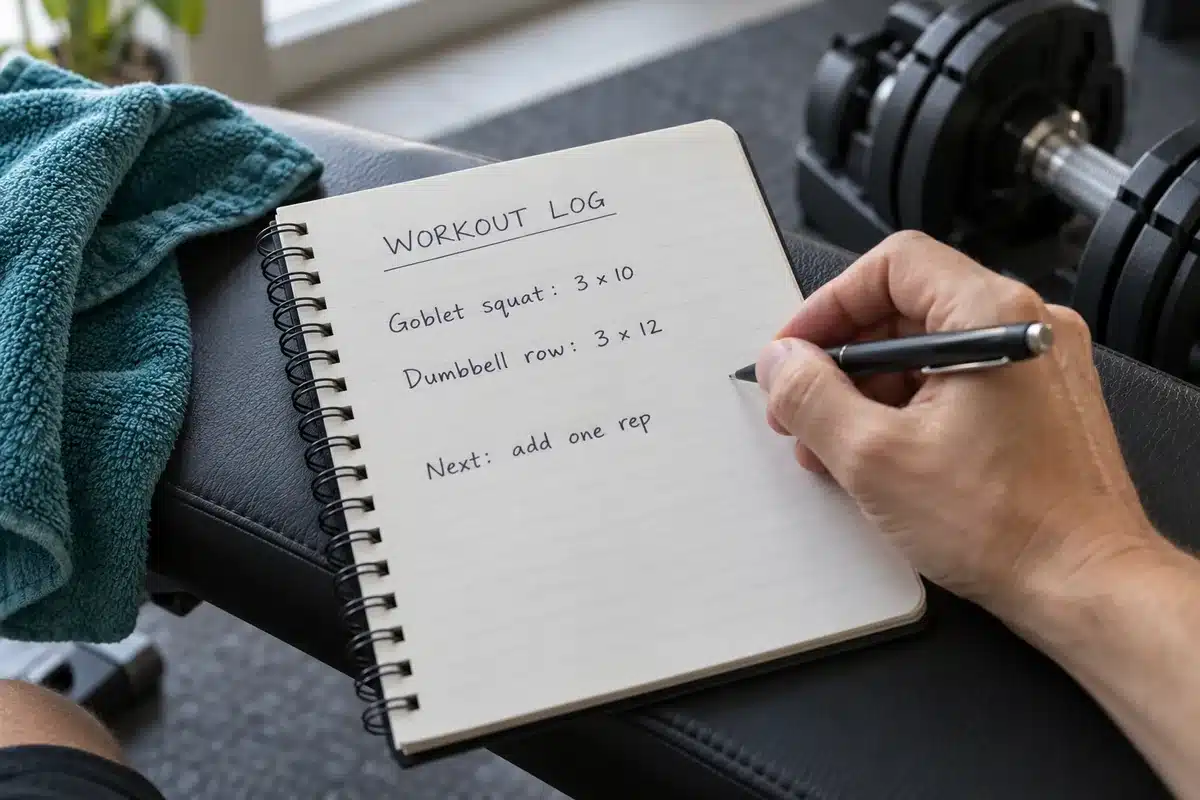
View the NewMe Fitness journal on Amazon and compare its layout with the free log below.
| Date | Exercise and setup | Load | Reps by set | Next-session note |
|---|---|---|---|---|
| Your date | Dumbbell row, same bench | 25 lb per hand | 12 / 12 / 10 | Repeat with controlled reps |
| Your date | Your exercise | Your load | Your reps | One clear target |
Give your training plan a fair chance
The 2026 ACSM guidance emphasizes training all major muscle groups at least twice weekly and tailoring the program to the individual. It identifies higher weekly volume, around ten sets per muscle group, as useful for optimizing hypertrophy. That is a general guide, not a minimum below which nothing happens. [4]
Start with a workload you can perform and recover from. Build gradually rather than jumping straight to the largest set count you see online. Training to complete failure on every set is not required, and home equipment, bands or bodyweight can also be useful. [4]
Keep the following questions in your weekly review:
- Did I complete the sessions I planned?
- Did the intended muscles receive challenging work?
- Could I repeat my exercise technique consistently?
- Do I know what I will try to improve next session?
For example, if your plan calls for three sets within a repetition range, record each set separately. Follow that program's progression rule when you reach the target with good technique. Avoid adding weight simply because another week has passed.
Choose a training split you can repeat before adding more exercises to a schedule you already struggle to finish.
If your overall progress looks good but one area seems behind, read our guide to why some muscles feel harder to grow. A lagging body part deserves its own training review.
Eat to support the work you are doing
Get enough protein without making every meal complicated
A large meta-analysis found that the estimated benefit of additional protein for resistance-training gains leveled off around 1.6 grams per kilogram of body weight per day on average. Individual needs vary, and that figure is not a precise cutoff. [5]
For an 80 kg person, 1.6 g/kg is about 128 grams daily. Use that as a planning reference, then look at the meals you actually eat. Protein powder can be convenient, but it is not a requirement.

Build a few repeatable protein meals using foods that fit your preferences and budget.
Do you have to eat in a calorie surplus?
A surplus is not an absolute requirement for everyone. In a controlled study, young men following an intensive exercise program gained lean body mass while losing fat during an energy deficit, with better lean-mass results in the higher-protein group. Lean body mass is not identical to muscle tissue, and the study's demanding routine is not a beginner prescription. [6]
If gaining size is your main goal and your current intake is not supporting progress, a modest increase in food may be useful. Avoid assuming that a larger surplus means proportionally faster muscle growth. A small eight-week trial in trained lifters linked faster body-weight gain more clearly with increased skinfold thickness than with greater muscle thickness. [7]
Choose the eating approach around your starting point and goal. Review food intake alongside training and body-weight trends before making a large change. One missed protein target does not restart a muscle-growth clock.
Recovery belongs in your progress review
Do not judge the quality of a workout by how exhausted it leaves you. Your plan also needs to fit around work, sleep and the rest of your life.
The American Academy of Sleep Medicine and Sleep Research Society recommend adults regularly get at least seven hours of sleep for health. This is general health guidance, not a formula that predicts a specific rate of muscle gain. [8]
Keep a brief note when an unusually poor night, illness or stressful week affects training. That context can explain a disappointing session and help you avoid unnecessary changes to an otherwise workable plan.
What to check if you see little change after eight to twelve weeks
Start with the record, not the assumption that your genetics are the problem. Review several indicators together and change one clear issue at a time.
| What your record shows | A useful next step |
|---|---|
| Frequent missed sessions | Simplify the schedule so it fits your actual week |
| No record of sets, repetitions or loads | Start logging before deciding the whole plan has failed |
| Better performance but unclear photos | Standardize photos and measurements; strength alone cannot quantify size |
| Falling performance and persistent fatigue | Review recovery and workload before adding training |
| Little challenging work for your target muscle | Review exercise selection and weekly work, ideally with a qualified trainer |
| Food intake varies greatly from day to day | Establish repeatable meals and assess intake against your goal |
Adding more sets is not the automatic answer to every plateau. Nor is replacing all your exercises at once. If several things change together, you will have less information about what helped.
Write down the adjustment, the reason and your next review date. If pain is changing how you move, address it instead of using it as a reason to push harder.
Common questions about muscle-growth timing
Can you build muscle in 30 days?
Small measurable changes are possible within the first month, as early training studies illustrate. That does not justify promising a set number of pounds of new muscle or an obvious transformation. Use the month to establish training consistency and a baseline. [1,2]
Is three months enough to see results?
It is a useful period for reviewing a consistent plan. You may notice changes in performance, measurements or appearance, but none is guaranteed on a fixed date. If you see little change, work through the checklist above.
How much muscle can you gain each month?
There is no dependable single number for every reader. Your training background, program and individual response matter. Studies may report changes in lean mass, muscle thickness or cross-sectional area, which are different measurements. Do not turn one study's average into your personal monthly target.
Does soreness mean my muscles are growing?
Soreness is not a measurement of muscle growth. The early-growth study discussed above detected changes without a significant increase in soreness, while other research shows that swelling can complicate early size measurements. Track the work and longer-term trends instead. [1,2]
Do I need supplements or better equipment?
Start by identifying a real limitation. If you cannot progress an exercise with your current setup, equipment may help. If you cannot remember last week's workout, a log may help. Neither purchase creates a reliable shortcut to a visible result.
Make your next month easier to evaluate
Choose a repeatable schedule, record your sessions and set one review date. Keep your baseline photos and measurements somewhere you can find them. That gives you a clearer answer than a daily mirror check.
Start with the free log above. If a dedicated paper book would make tracking easier, check the NewMe Fitness journal's current details on Amazon. The important step is recording the workout you actually complete.
Research and references
- Stock et al. (2017): Early hypertrophy during four weeks of concentric-only resistance training.
- Damas et al. (2016): Early muscle-size increases and exercise-related swelling.
- Del Vecchio et al. (2019): Neural adaptations after four weeks of strength training.
- ACSM (2026): Updated resistance-training guidance.
- Morton et al. (2018): Protein supplementation and resistance-training meta-analysis.
- Longland et al. (2016): Protein, intensive exercise and lean mass during an energy deficit.
- Helms et al. (2023): Small and large energy surpluses in resistance-trained adults.
- AASM and SRS: Adult sleep-duration recommendation.
Research checked October 7, 2026. Images are AI-generated illustrations. This article provides general fitness education.