
You want to build muscle without filling a cupboard with powders you do not need. But when protein, creatine, mass gainers and pre-workouts all promise to improve your routine, deciding what deserves your money can be harder than choosing your workout.
The useful differences are more specific than the claims on the front of a tub. Does the product fill a gap in your meals? Are the ingredients and amounts clearly listed? Is the cost reasonable for the serving you will actually use?
These muscle building reviews compare four common supplement categories around those questions. Start with the quick comparison, then follow the detailed reviews for the options that fit your situation. You may find that your next useful purchase is a simple protein powder, or that you do not need another supplement at all.
Review approach: This is a research-based buying guide, not a report of personal product testing. It draws on published research and links to more detailed product comparisons. No star ratings or personal taste-test results are claimed. The accompanying images are AI-generated editorial illustrations, not photographs of products tested by our team.
Affiliate disclosure: Some linked reviews contain affiliate links. If you purchase through them, we may earn a commission at no additional cost to you.
Quick comparison: choose around the gap you need to fill
| Option | When it may be useful | What to check before buying |
|---|---|---|
| Protein powder | Meals regularly leave you short of your intended protein intake. | Protein per serving, allergens, tolerance and cost per serving. |
| Creatine monohydrate | You want to consider a researched supplement alongside regular resistance training. | Clearly stated amount, product verification and whether it is suitable for you. |
| Mass gainer | You have identified a calorie gap that is difficult to fill with food. | Calories in the portion you will use, serving size and ingredients. |
| Pre-workout | You want to compare an optional product for a specific training need. | Caffeine, other ingredient amounts, timing and cost. |
None of these products replaces a suitable training plan, adequate food or recovery. The point of the comparison is to identify a useful role before choosing a brand.
Protein powder: convenient when food leaves a gap
Protein powder can make it easier to add protein without preparing another meal. Its value depends on what you already eat, your budget and whether you tolerate the ingredients.
The International Society of Sports Nutrition describes 1.4–2.0 grams of protein per kilogram of body weight daily as sufficient for most exercising individuals. For a 75 kg person, that equals 105–150 grams per day, including food and supplements. This is general guidance for healthy exercising adults, not an individual prescription. [1]
Meat, fish, eggs, dairy, soy and legumes can contribute to that intake. A shake is one convenient option, not a requirement.
Compare formulas by what matters to you
Whey concentrate, whey isolate, casein and plant-based powders differ in their ingredients, processing and price. An expensive formula is not automatically a better fit, and a familiar brand name does not remove the need to read the label.
Compare these details:
- Protein and calories: Check the amount in the labeled serving, including anything you mix into the shake.
- Ingredients and allergens: Look for milk, soy and any other ingredients you need to avoid. Do not judge quality by whether an ingredient is easy to pronounce.
- Tolerance: Consider your own response to the formula. A product described as low in lactose is not necessarily suitable for a milk allergy.
- Verification: If third-party testing matters to you, check the exact product and current certification listing.
- Serving cost: Divide the price by the number of labeled servings. If protein amounts differ, compare the cost of an equivalent amount of protein.
Worth considering if: a convenient serving would help fill a recurring protein gap.
You may not need it if: your meals already provide sufficient protein and you are comfortable with the routine.
For a specific comparison, read our Dymatize review of ISO100, Elite Whey and Super Mass Gainer.
Creatine monohydrate: assess the evidence and the actual serving
Creatine has research supporting its use for repeated, high-intensity efforts. It may support strength and training adaptations when used alongside an appropriate training program. Results still vary between people. [2]
Creatine monohydrate is the form most commonly studied. A typical maintenance intake used in research is 3–5 grams daily. A loading phase is not required; it changes how quickly muscle creatine stores increase. Follow the product instructions and obtain individualized advice when appropriate. [2]
An early increase in body weight can reflect water retention. It should not be interpreted as an equivalent amount of newly gained muscle.
What to look for on the label
Check the amount of creatine per serving, the form supplied, and whether other ingredients change the product’s purpose or cost. A scoop included in one container is not a universal measurement for another product.
For a plain powder with a clearly stated net weight, you can compare the cost per gram or per equivalent serving. This is more useful than comparing container prices alone.
Worth considering if: you train regularly and want to assess a supplement with evidence relevant to repeated high-intensity exercise.
Get individual advice first if: you have kidney disease, are pregnant or breastfeeding, or take medication that could affect suitability. The evidence in healthy adults should not be treated as a blanket recommendation for everyone.
Compare creatine supplements and their buying considerations.
Mass gainers: check calories before the protein headline
A mass gainer combines protein with substantial carbohydrate and sometimes additional fat. That makes it a different purchase from a regular protein powder.
The number on the front of the package may refer to a large serving of powder, or a shake prepared with milk. Read the serving definition before comparing products.
Choose a portion around the amount of food energy you intend to add. “Half a serving” is not a reliable universal starting point because serving sizes differ so much.
Consider a homemade shake too
A shake made from ingredients such as milk or a suitable alternative, oats, banana and nut butter lets you adjust the recipe. Protein powder is optional if the rest of the recipe meets your needs. Ingredient choices should account for allergies and preferences.
A homemade version is not automatically cheaper. Compare the ingredients and quantities you would actually buy, as well as preparation time and convenience.
Worth considering if: you have identified an ongoing calorie gap and a drink is a practical way to fill it.
You may not need it if: you already eat enough for your goal or are gaining weight faster than intended.
Read the Pro Gainer review for a closer label comparison.
Pre-workout: compare the formula, not the promise
Pre-workouts vary. Some contain caffeine, some are stimulant-free, and many combine several ingredients. The usefulness of one ingredient does not prove that every finished blend will improve your training. [2]
Caffeine can improve performance in some exercise settings, but effects and tolerance vary. Coffee can be an alternative for some people, although its caffeine content also varies. Neither is necessary for a productive workout. [2]
Before buying, check:
- The caffeine amount per serving, if present.
- Other caffeine you consume through coffee, tea, energy drinks or supplements.
- Whether individual ingredient amounts are disclosed.
- Whether the timing could interfere with sleep.
- The cost for the serving you plan to use.
Do not use a stimulating product to push through persistent exhaustion or symptoms that need attention. If caffeine causes troublesome effects, adding another stimulant is not a useful solution.
Worth considering if: a specific, clearly disclosed formula fits a need you have identified.
You may not need it if: you already train comfortably without it, are sensitive to stimulants, or train close to bedtime.
Read our Cellucor C4 Original review for a product-level comparison.
Check your meals and training before adding another product
Resistance training provides a stimulus for muscle adaptation. Protein supports the processes involved, but the explanation is more complex than simply damaging muscle and repairing it bigger. Muscle damage and soreness are not reliable targets for measuring a successful workout. [3]
Before buying, review three practical questions: Are your meals consistent? Does your training plan give you a manageable way to progress? Are you recovering between sessions?
Use repeatable meals
Start with foods you enjoy and can prepare consistently. The table below offers combinations rather than a prescribed meal plan. Portions determine the protein and calories supplied.

| Meal | Example combination |
|---|---|
| Breakfast | Greek yogurt, oats and fruit, or eggs with whole-grain toast. |
| Lunch | Chicken or tofu with rice and vegetables. |
| Snack | Milk or a suitable fortified alternative, fruit, or a protein shake if needed. |
| Dinner | Fish, lean beef or beans with potatoes and vegetables. |
| Optional evening meal | Cottage cheese, soy yogurt or another food that fits your preferences and daily intake. |
These are flexible ideas, not nutritionally identical substitutions. For more guidance, see protein portions and easy meal ideas.
Track your training before changing everything
A simple log can record the exercise, load, repetitions and sets, plus any notes about effort or technique. This makes it easier to assess the plan than relying on memory.
One progression method is to work within a repetition range. When you can complete the upper end with consistent technique and the intended effort, a small increase in load may be appropriate. Progress does not require adding weight every session.
If you want a manageable structure to review, start with the three-day gym framework. Adapt exercises to your experience and ability; pain is a reason to reassess rather than push harder.

Adjust food intake using trends
There is no single calorie surplus or rate of weight gain that fits every lifter. Training experience, starting point and goals all matter. Research comparing energy surpluses suggests that faster weight gain can add more body fat without a matching improvement in every measure of muscle growth. [4]
Review several weeks of body-weight averages alongside training performance and measurements. Make modest adjustments when warranted, then observe the trend. A short-term scale change can reflect water, food and digestion as well as tissue changes.
How to compare value without being distracted by the tub size
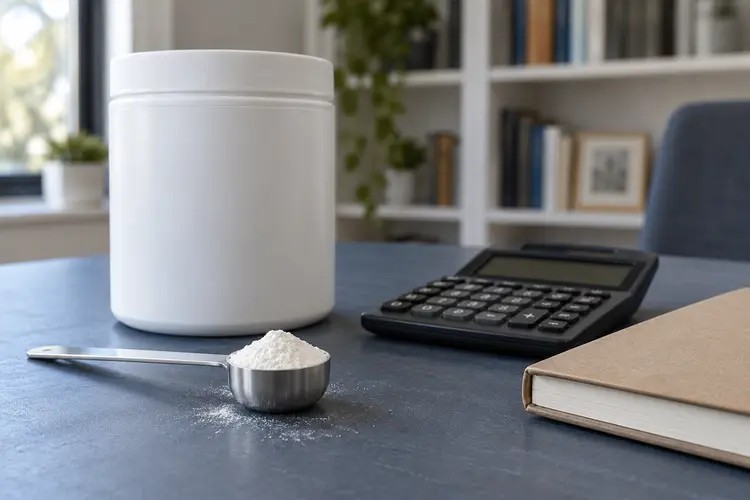
Use total purchase cost ÷ labeled servings as a starting point. Include shipping when it materially changes the comparison, and check the exact flavor and package size selected.
For example, a hypothetical $60 container with 30 servings costs $2 per serving. A hypothetical $75 container with 50 servings costs $1.50 per serving. These are arithmetic examples, not current offers.
Then check whether those servings are equivalent. A smaller protein serving, a large gainer portion and a multi-ingredient pre-workout are not interchangeable simply because each uses the word “serving.”
Also consider whether you will finish the container. A low serving cost offers little value if the flavor, ingredients or preparation make the product unsuitable for you.
Questions to ask before buying
Do I need supplements to build muscle?
No supplement is a substitute for an appropriate training and eating routine. Protein powder can offer convenience, and creatine may be useful for some people, but purchasing either is a separate decision from starting or maintaining resistance training. [1] [2]
Does a higher price mean better results?
Price alone cannot establish effectiveness. Compare the formula, serving amount, verification and how well the product fits your needs. Do not assume a premium description guarantees a better training outcome.
What if a protein powder causes digestive symptoms?
Stop and review the ingredients rather than forcing yourself to keep using it. Milk allergy and lactose intolerance are different issues, and an isolate is not automatically suitable for a milk allergy. Seek advice for persistent symptoms or an uncertain allergy; changing powders is not a diagnosis.
Is a mass gainer better than regular whey?
They serve different purposes. A gainer is designed to add substantial calories. A regular whey powder is usually considered for its protein contribution. Compare them against the gap you intend to fill, not as direct substitutes.
Can I judge progress from soreness or the scale alone?
Neither gives a complete picture. Review consistent measurements, training performance and longer-term trends together. Soreness is not a requirement for growth, and water changes can affect body weight. [2] [3]
Final verdict: buy for a clear reason
Protein powder deserves consideration when convenience helps fill a protein gap. Creatine monohydrate deserves consideration when its researched use fits your training and health circumstances. A mass gainer needs a clear calorie-related purpose, while a pre-workout should be judged by its actual formula.
If none of those products solves a problem in your routine, there is no need to buy one simply to complete a supplement stack.
Start with the quick comparison, choose the category that matches your need, and use the linked detailed reviews to compare specific products. Keep the decision tied to something useful: a manageable meal routine, a suitable formula or a cost you are comfortable paying.
Sources and editorial notes
- International Society of Sports Nutrition position stand: protein and exercise (2017).
- NIH Office of Dietary Supplements: Dietary Supplements for Exercise and Athletic Performance.
- Damas et al.: Resistance training-induced changes in integrated myofibrillar protein synthesis are related to hypertrophy only after attenuation of muscle damage (2016).
- Helms et al.: Effect of Small and Large Energy Surpluses on Strength, Muscle, and Skinfold Thickness in Resistance-Trained Individuals (2023).
Prepared October 18, 2026. This article provides general educational information. Product formulas, prices and availability can change; check the current label and listing before purchasing.