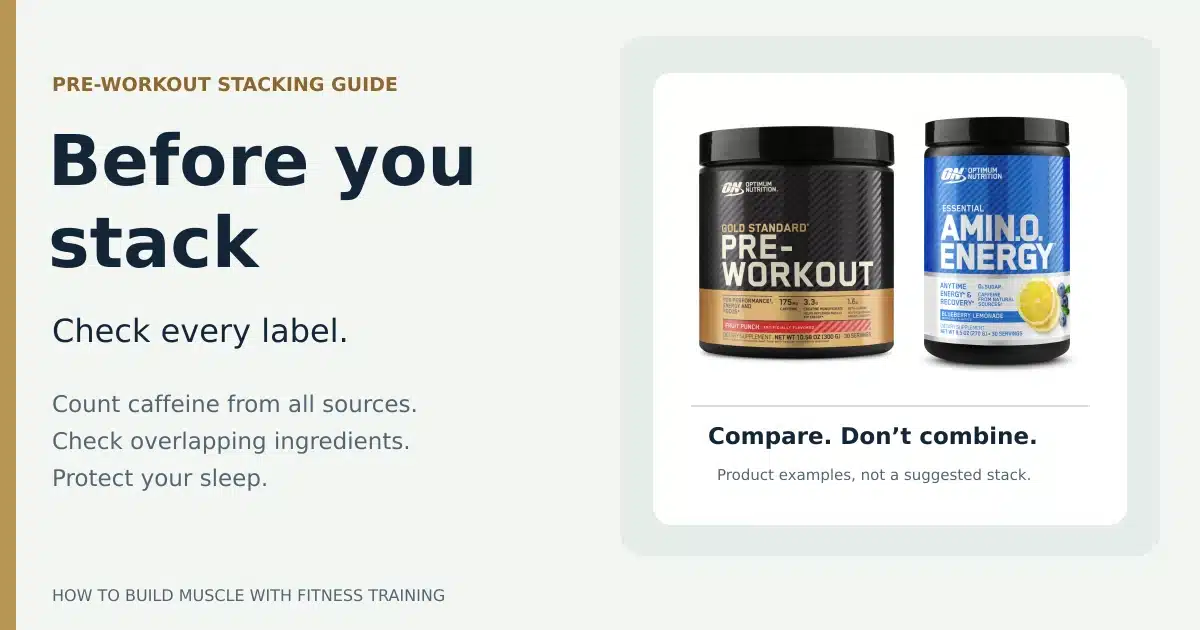
For the product-by-product comparison, see 18 pre-workout supplements compared, including Gold Standard vs Amino Energy. This guide focuses on reading labels and avoiding unnecessary overlap.
It's easy to think more is always better when it comes to pre-workout supplements.
If one scoop helps before a training session, a second scoop or another product can seem like a simple upgrade.
But combining products without checking their labels can leave you jittery or interfere with sleep.
For example, morning coffee, a pre-workout before lifting, and a caffeinated amino drink can add up to more caffeine than you intended. This is an illustrative scenario, not a personal testing account.
Stacking supplements is optional. If you choose to combine products, you need to understand what you're actually combining, why you're combining it, and what total amounts you're reaching across your entire day.
Understanding Your Caffeine Baseline
Before you even think about stacking anything, you need to know your current caffeine intake. Not what you think you're taking, but what you're actually consuming when you add up all the sources throughout the day.
Start by writing down everything that contains caffeine for three typical days. Include your morning coffee or tea, any energy drinks, pre-workout powders, amino supplements, fat burners, caffeinated gum, chocolate, certain medications, and even some protein bars.
The number you reach might surprise you.
Most research on caffeine and exercise performance examines doses of around 3-6 mg per kilogram of body weight taken before training. For someone who weighs 80 kg (about 176 pounds), that works out to roughly 240-480 mg before a workout.
That is a research range, not a safe-dose prescription. Lower doses can help some people, and the upper end can exceed general daily guidance. Count caffeine from all sources. [1, 2]
The FDA cites 400 mg per day as an amount not generally associated with negative effects for most adults. It is not a target or a guarantee of safety. Sensitivity, medications, and health conditions can change your response. [1]
Once you know your baseline, you can make informed decisions instead of accidentally pushing yourself into uncomfortable territory. If you're already at 300 mg from coffee and tea, adding a 200 mg pre-workout puts you at 500 mg total.
That exceeds the FDA's general daily reference. Choose less caffeine rather than treating a lack of immediate symptoms as proof that the amount is appropriate.
Choosing a Primary Pre-Workout Product
When you're planning a stack, one product should serve as your foundation. This is typically your main pre-workout formula, and you'll build around it by adding specific ingredients it either doesn't contain or doesn't provide in the amounts you want.
Gold Standard Pre-Workout is one example of a formula that already includes multiple ingredients. Its US product summary lists 175 mg caffeine, 3 g creatine monohydrate, and 1.6 g beta-alanine per scoop. However, the Blueberry Lemonade label image below lists 1.5 g beta-alanine; the Fruit Punch package shown in the featured image lists 3.3 g creatine and 1.6 g beta-alanine. These differences are a reason to use your exact container’s Supplement Facts, not to combine figures from different images. [3]
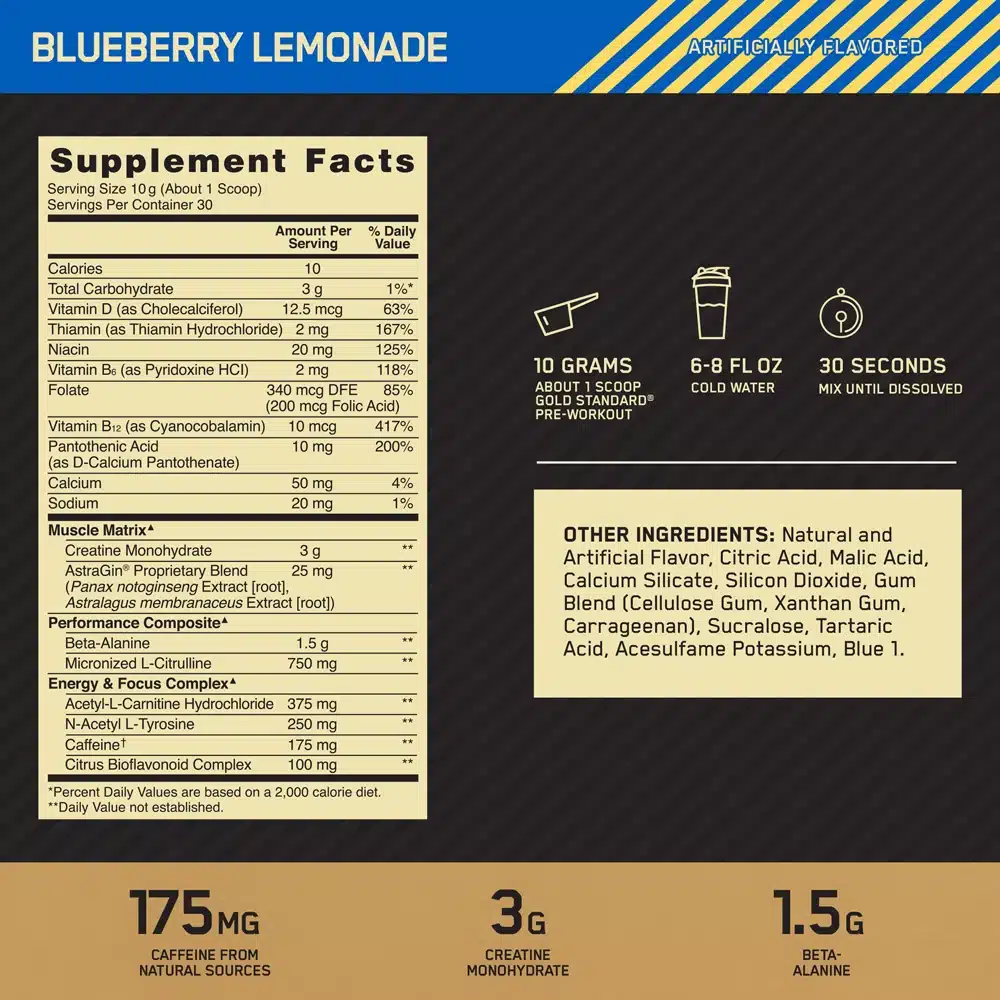
The question then becomes what's missing or insufficient for your specific goals.
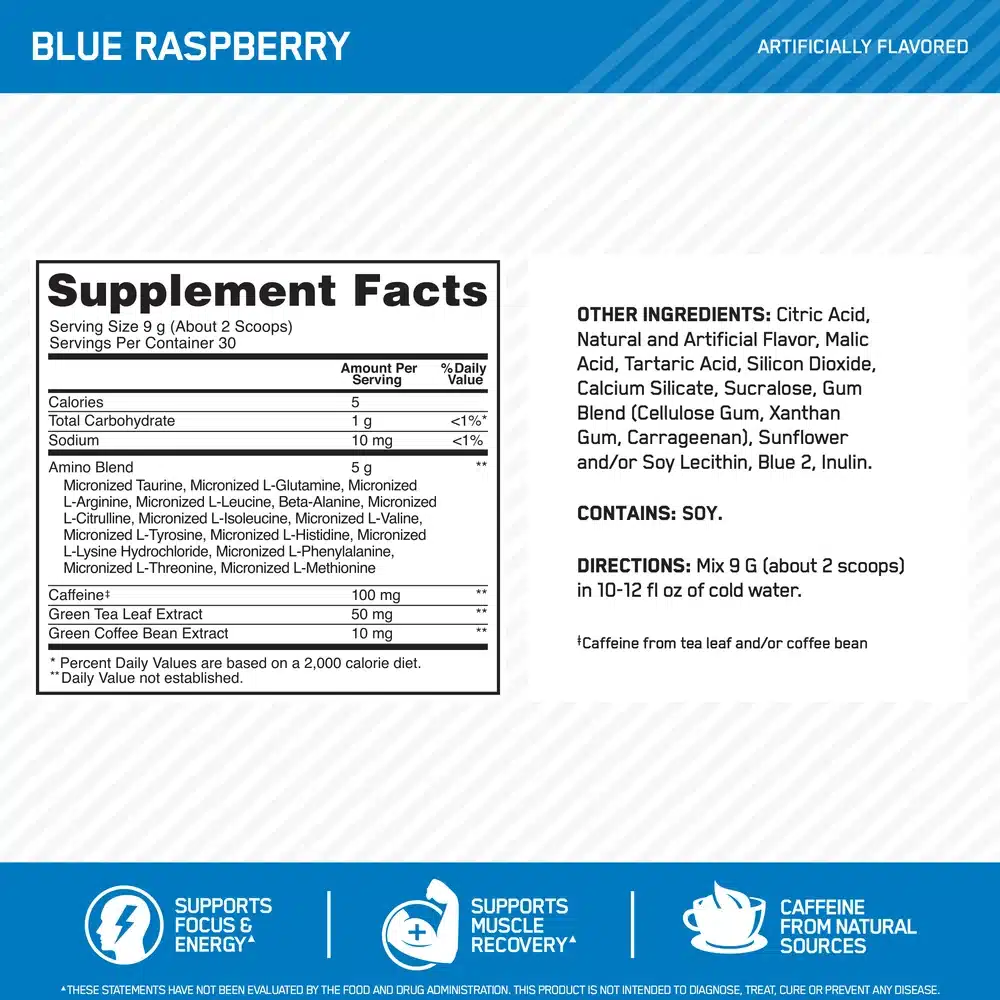
If you choose a lower-caffeine option like Amino Energy, remember that lower caffeine is not a reason to add another stimulant product. Its standard serving provides 100 mg of caffeine and 5 g of amino acids; it does not replace a measured daily creatine serving. Read the full blend label before adding standalone ingredients. [4]
The worst approach is to use two or three different pre-workout formulas together. You end up with redundant ingredients, excessive caffeine, and no real control over what you're actually taking.
This is like wearing three jackets instead of one good coat and a sweater.
Adding Standalone Ingredients Strategically
Once you've selected your primary product, look at what it provides and compare that to what research suggests might be helpful. The gaps are where standalone ingredients make sense.
Creatine monohydrate is a common addition. A typical maintenance amount is 3-5 g daily, so a pre-workout containing 3 g does not automatically need topping up. Count all sources, including on rest days. [5]
If you are comparing standalone powders, our creatine supplement comparison explains serving sizes and buying considerations.
Timing matters less than consistent daily creatine intake, so a standalone serving can be taken with breakfast or after training. Count any creatine already included in other products.
Citrulline amounts vary between formulas. Some studies use 6-8 g of citrulline malate, but evidence for exercise benefits is mixed. A smaller label amount is not, by itself, a reason to add more. [5]
L-citrulline and citrulline malate are not interchangeable gram for gram: the latter also contains malate, and ratios vary. Check the ingredient form before comparing amounts. [5]
Adding another powder also increases the total amount you consume, and citrulline malate can taste tart.
Beta-alanine works through elevated muscle carnosine levels, which build up over weeks of consistent supplementation. Research commonly uses 4-6 g daily, particularly for intense efforts lasting about 1-4 minutes. That does not mean everyone needs it or should automatically top up a pre-workout to that range. [6]
Some people prefer splitting beta-alanine across multiple servings to reduce the tingling sensation it can cause.
The key principle here is really simple. Only add what's missing or not enough, and only if you have a specific reason to think that ingredient will help your training.
Don't add something just because it exists or because you saw someone else using it.
Managing Total Stimulant Intake
Caffeine gets most of the attention, but other stimulants show up in supplements too. Some products contain compounds that can enhance the overall stimulant effect or interact with caffeine in ways that intensify your response.
If you're stacking a pre-workout with an amino energy drink, the caffeine amounts add directly. Gold Standard Pre-Workout plus Amino Energy would give you 275 mg in a single pre-workout window, and that's before accounting for your morning coffee.
That combined amount can cause problems, particularly for someone sensitive to stimulants or training in the evening. Follow product warnings against combining caffeine sources.
If you use a caffeinated pre-workout before lifting, follow its directions and choose water or a caffeine-free drink during or after training.
Some pre-workouts also include ingredients like theobromine, synephrine, yohimbine, or various plant extracts that can have stimulant-like effects. These aren't always clearly labeled for their stimulant strength, which makes stacking more complicated. If you're combining products and feeling overstimulated despite moderate caffeine intake, check for these extra ingredients.
More caffeine is not necessarily more useful. There is no benefit in chasing a stronger sensation if the amount leaves you anxious or disrupts sleep.
Do not keep adding caffeine because you cannot feel it yet. If you develop concerning symptoms, stop taking the product and seek medical advice; do not assume you should simply wait it out.
Timing Your Stack Throughout the Day
Timing matters especially for caffeine. Spacing doses does not cancel their combined total or guarantee that sleep will be unaffected.
If you train in the morning, choose between coffee and a caffeinated pre-workout rather than automatically taking both. Follow the product's timing and use directions.
The complication comes when people add an amino energy drink mid-morning, another caffeinated beverage at lunch, and maybe a second training session or activity later in the day.
For afternoon or evening training, you need to work backward from your bedtime. Caffeine's half-life averages roughly 4-6 hours, with substantial individual variation. Half-life is the time it takes for the amount in your body to fall by half. [2]
Using a six-hour half-life as an example, 200 mg at 5 PM would leave about 100 mg at 11 PM. Your own clearance may be faster or slower.
One practical approach is to reserve any caffeinated pre-workout for earlier sessions and choose a caffeine-free option, or no supplement, for evening training. Creatine and beta-alanine do not need to be taken immediately before exercise. A full serving is not automatically appropriate for everyone.
For products like creatine that don't depend on acute timing, choose a convenient daily routine. Taking it with breakfast is one option. Still include any creatine in your pre-workout when calculating the day's total.
Recognizing When You've Gone Too Far
Symptoms can warn you that a supplement is not agreeing with you, but a lack of symptoms does not prove that a dose is safe. Do not push through uncomfortable symptoms because you think they are part of "working hard."
Physical signs include a racing or irregular heartbeat at rest, hand tremors, excessive sweating unrelated to temperature or activity, headaches, nausea, and digestive discomfort. These symptoms can have other causes, so timing alone cannot establish what is wrong. An irregular heartbeat or severe symptoms warrant prompt medical attention. [7]
Mental and emotional symptoms are just as important. Feeling unusually anxious, irritable, or unable to focus despite taking something meant to improve focus suggests you've crossed into overstimulation.
If you find yourself feeling wired but simultaneously exhausted, that's another red flag.
Sleep disruption is another warning sign to watch for. If you're lying awake at night despite being physically tired, or if your sleep quality has decreased, look at your caffeine timing and total intake first.
Prioritize sleep and recovery before adding supplements.
Stop the suspect supplement and avoid further stimulants if symptoms develop. Seek urgent help for an irregular heartbeat, breathing difficulty, fainting, seizures, or other severe symptoms. For mild or recurring symptoms, speak with a healthcare professional before restarting. The pre-workout itself may be the product you need to stop. [7]
Managing Caffeine Tolerance
Regular use can change how caffeine feels. If your usual amount seems less noticeable, do not automatically increase your pre-workout dose.
You can reserve a caffeinated product for selected sessions and use a caffeine-free option, or no pre-workout, on other days.
There is no established universal schedule requiring a caffeine break every few weeks. A small controlled cycling study found a performance benefit from caffeine with or without a four-day withdrawal period, so a break should not be presented as a guaranteed performance reset. [8]
If you want to cut back, gradual reduction can make withdrawal symptoms such as headaches and fatigue easier to manage. [1]
Review your sleep, intake, and reasons for using caffeine. Needing it to feel normal is a reason to reassess your routine, not a reason to keep increasing the dose.
Hydration and Electrolytes in Your Stack
Hydration matters for training, but caffeine does not automatically cause dehydration. In a controlled study of habitual male coffee drinkers, moderate coffee intake produced hydration measures similar to water. That does not make extra caffeine a hydration strategy. [9]
Water and regular meals are often sufficient for ordinary gym sessions. Electrolyte needs depend on sweat losses, session length, heat, and diet; calorie restriction alone does not establish a need for an electrolyte supplement.
If flavor helps you drink during training, a caffeine-free drink is an option. An amino energy drink adds caffeine to your total and is not automatically an electrolyte replacement.
Follow the product's mixing instructions and drink according to your needs. Extra water does not neutralize caffeine or make an excessive dose safe.
An electrolyte product may be useful during long, sweaty sessions or training in the heat. If you are simply drinking too little, address fluid intake first. Look for options without added caffeine or stimulants, so you're not accidentally increasing your total intake.
Tracking Your Stack and Adjusting
You cannot improve what you don't measure. To stack supplements effectively, you need to actually record what you're taking, when you're taking it, how you feel, and how your training goes.
This doesn't have to be complicated. A simple note in your phone or training log works fine. Write down which products you used, the doses, the timing relative to training, and a few quick notes on energy, focus, and performance.
After a few weeks, you'll have enough information to spot patterns.
You may notice that you feel better with less caffeine, or that a later serving affects your sleep. Record the serving size as well as the time: splitting beta-alanine into smaller doses may reduce tingling, while simply moving the same dose to the morning may not. [6]
The other reason to track is safety. If you develop any concerning symptoms, having a record of exactly what you've been taking makes it much easier to identify the problem and explain the situation to a healthcare provider if needed.
Every few months, review your notes and ask yourself whether your current stack is actually helping or whether you're just going through the motions. A simple routine can be easier to evaluate than a large collection of products.
Sometimes less really is more.
Building a Stack Progressively
If you decide to use supplements, introduce one product at a time, follow its label, and track how you respond. Do not continue for a trial period if it causes adverse effects.
Only after you've established that baseline should you consider adding a second component.
If there is a specific reason to consider an additional ingredient, change only one thing at a time. Check its evidence, label directions, and suitability before trying it.
If it helps, keep it.
If it offers no clear benefit, there is no reason to keep adding cost and complexity. A training log can reveal patterns, but it cannot prove that a supplement caused a change in performance.
A simple routine might involve one caffeine source, if you choose to use caffeine at all. There is no need to progress to a larger stack.
If creatine monohydrate fits your goals, it can be considered separately from caffeine.
If you later choose a combined pre-workout, reassess everything it adds. Do not simply layer it over your existing routine or increase doses to follow a timetable.
This approach helps you evaluate a routine for your own training rather than copying someone else's stack.
Frequently Asked Questions
How much caffeine is safe before a workout?
There is no single pre-workout dose that is safe for everyone. The 3-6 mg/kg range used in exercise research is not a safety recommendation. Count all daily sources and follow the product's warnings. [1, 2]
If you've had coffee in the morning, you need to account for that when calculating your pre-workout dose.
Can I take creatine and caffeine together?
They are combined in some products, but research on their interaction is mixed. Taking creatine separately is a practical option; avoid assuming that a combined formula is suitable for everyone. [2]
What ingredients should I avoid stacking?
Avoid stacking multiple products that all contain caffeine or other stimulants, as this can lead to excessive total doses and increases the risk of side effects like anxiety, jitters, and sleep problems. Also be cautious about combining different proprietary blends where you can't see exact ingredient amounts, as you might be getting redundant or excessive doses of certain compounds without realizing it.
How do I know if my pre-workout has too much caffeine?
Signs of too much caffeine include rapid or irregular heartbeat, hand tremors, excessive sweating, difficulty focusing, anxiety, irritability, nausea, and trouble sleeping even when you're physically tired. Stop using the product if symptoms occur. An irregular heartbeat or severe symptoms need prompt medical attention, not just a lower dose next time. [7]
Can I take pre-workout every day?
Daily use is not necessary. Suitability depends on the ingredients, label directions, total caffeine intake, health, and sleep. You can skip it or choose a caffeine-free option. A fixed cycling schedule is not proven to restore everyone's performance response. [1, 8]
Should I take beta-alanine before or after a workout?
Timing doesn't really matter for beta-alanine because it works by building up muscle carnosine levels over weeks of consistent use. It is not an immediate pre-workout boost.
The total daily dose over time is what matters.
Some people prefer taking it separately from their pre-workout to minimize the tingling sensation.
How long before bed should I stop taking caffeine?
Avoiding caffeine for at least 6-8 hours before bed is a starting point, not a guarantee. A controlled study found that 400 mg still disrupted sleep when taken six hours before bedtime. Some people need an earlier cutoff or no afternoon caffeine. [10]
Is citrulline better than arginine for pre-workout?
Citrulline can raise circulating arginine, but that does not establish better workout results for everyone. Evidence for exercise benefits remains mixed, and L-citrulline and citrulline malate doses should not be treated as equivalent. [5]
Can I mix different brands of supplements?
You can mix different brands, but you need to carefully track what you're getting from each product to avoid excessive or redundant doses. The main risk is stacking multiple caffeinated products from different brands and ending up with way more stimulants than you intended. Always read labels and add up total amounts of each ingredient.
What should I do if I feel sick from pre-workout?
Stop taking it and avoid more caffeine or stimulants. If overdose is possible, contact poison control or seek medical help immediately. Call emergency services for severe symptoms such as breathing trouble, fainting, seizures, or an irregular heartbeat. Keep the container available so clinicians can check its ingredients. Do not assume extra water will resolve the problem. [7]
Sources
Product information checked October 9, 2026; manufacturer label images and version differences checked October 11, 2026. This guide provides general information, not an individualized supplement plan. Check with a healthcare professional before combining supplements if you take medication, have a health condition, are pregnant, or are breastfeeding.
1. FDA: Spilling the Beans, How Much Caffeine Is Too Much?
2. ISSN position stand: Caffeine and exercise performance
3. Optimum Nutrition: Gold Standard Pre-Workout, US formula
4. Optimum Nutrition: Essential Amin.O. Energy
5. NIH Office of Dietary Supplements: Exercise and Athletic Performance
6. ISSN position stand: Beta-alanine
7. MedlinePlus: Caffeine overdose
8. Irwin et al.: Caffeine withdrawal and high-intensity endurance cycling performance
9. Killer et al.: No Evidence of Dehydration with Moderate Daily Coffee Intake
10. Drake et al.: Caffeine effects on sleep taken 0, 3, or 6 hours before bedtime