
The biggest thing that kills muscle gains is actually a combo of weak training and crappy recovery. When you train too easy, eat all over the place, sleep like garbage, and stress stays high, your body has zero reason or ability to build muscle.
Most people think they need some secret workout or special supplement, but the truth is way more boring than that.
Quick Answer
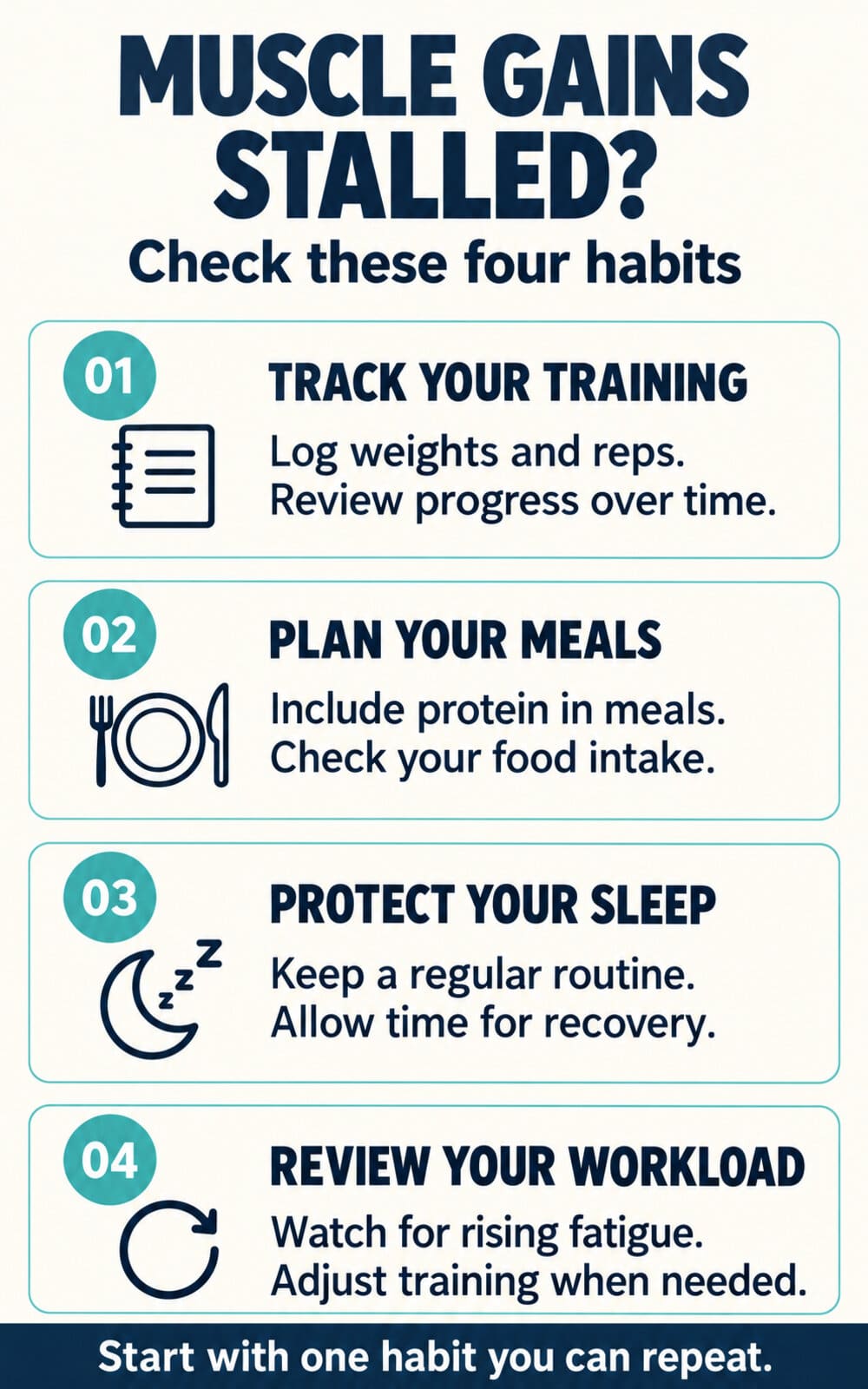
So what kills muscle gains the most? Here’s the short version:
Training that’s too far from failure. If you never push close to actual muscle fatigue, you’re leaving most of your gains on the table. Your body adapts to what you force it to get used to, and comfortable workouts don’t force much.
Low protein and inconsistent calories. You can hammer away at the gym six days a week, but if your eating looks different every day and protein stays low, muscle doesn’t happen.
Terrible sleep and constant stress. Recovery is where growth actually happens. Training creates the signal.
Sleep and low stress let your body respond to that signal.
Someone can follow a “perfect” program from some influencer and still stall hard if these three things keep lining up wrong.
Understanding the Question
Most people searching for what kills muscle gains the most are already putting in work. They show up, they do their sets, they watch videos, they feel like they’re doing everything right.
But the mirror doesn’t change much. Progress photos from three months ago look basically the same as today.
The frustration usually comes from three spots:
- Training feels hard, but the weights on the bar barely move, and muscle size stays flat.
- Eating “healthy” or “clean” doesn’t seem to translate into actual visible muscle.
- Sleep and stress feel like minor details compared to training, but they quietly wreck everything behind the scenes.
Plateaus happen to everyone over a long lifting career, but most of the stalls people complain about online come from fixable errors. It’s not bad genetics.
It’s usually one of the big three above.
Detailed Explanation
Training That Never Actually Pushes Hard Enough
Many coaches point to soft training as the most underrated killer of progress. Training too far from failure, always picking weights that feel “comfortable,” and repeating the same loads for months will pretty hard block growth.
Muscle grows in response to progressive overload. That just means gradually increasing the stress on the muscle over time.
You can do that with more weight at the same reps. Or more reps at the same weight.
Or more total sets per week, as long as you don’t go overboard.
Even better technique with a longer range of motion at a similar load counts.
When you lift the same weight for the same reps every single week, your body has already adapted to that demand. There’s no reason to build more muscle because the challenge isn’t growing.
Repeating light circuits or “pump” work that stays way far from failure keeps effort high in your head but low in terms of actual stimulus. You feel tired, sure, but tired doesn’t always mean productive.
On the flip side, pushing volume way past what you can actually recover from adds fatigue. Performance on every set drops, and growth stalls.
That’s how people end up training “hard” but spinning their wheels.
Nutrition That Can’t Support Growth
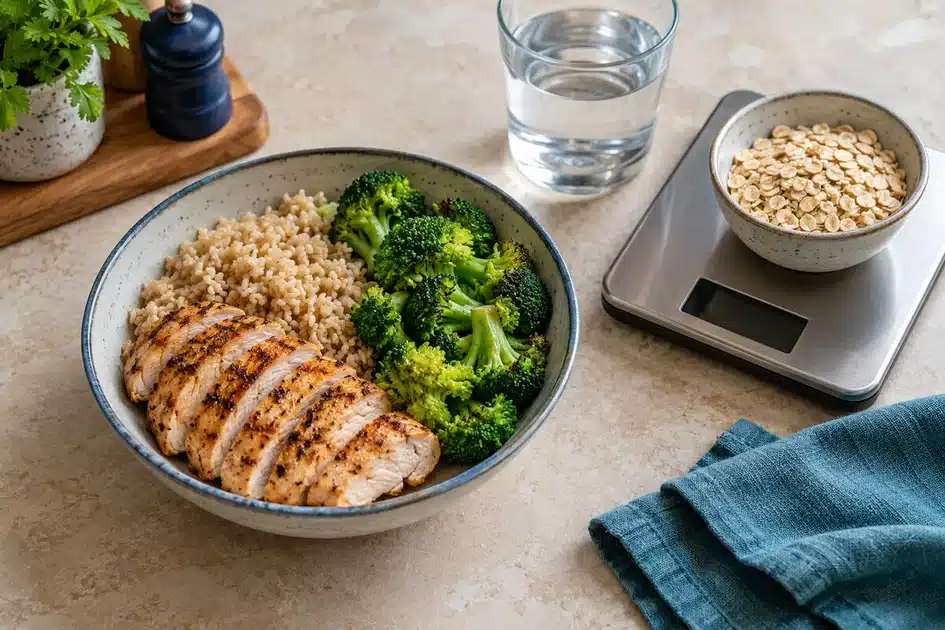
Even a well-designed training program plateaus when nutrition can’t support restoration and growth.
Low protein, inconsistent calories, and poor food quality show up as primary blockers over and over.
Low protein intake is a big one. Intakes below roughly 0.7 to 1.0 grams per pound of body weight per day make it way harder to build or even keep muscle.
Oh, and you should use a scale to help track consistent portion sizes. A small, inexpensive scale to help track consistent portion sizes.
As an Amazon Associate, I earn from qualifying purchases.
Some people go even lower without realizing it, especially if they eat the same few meals on repeat.
Chronic calorie deficits are another killer. If you’re 30 to 40 percent below maintenance calories for weeks on end, muscle protein synthesis drops.
Your body has to pull energy from somewhere, and muscle tissue isn’t protected.
Low carbs reduce training intensity and slow recovery. You can still lift, but the quality of each session drops, and you feel flat all the time.
Dehydration and heavily processed food make training feel harder and recovery less effective. Over weeks and months, that adds up.
Alcohol gets called out a lot in research summaries as a particularly strong saboteur. It messes with protein synthesis, lowers testosterone, raises cortisol, and wrecks sleep.
Even when protein intake looks fine on paper, alcohol can still tank progress.
If you’re struggling to consistently hit your protein intake, a simple whey- or plant-based protein powder can help fill the gaps. There are a bunch of solid options on Amazon or at most supplement stores.
Just read the label and pick one without a ton of added junk.
Recovery, Sleep, and Stress
Recovery outside the gym decides whether training actually works. Growth happens when your body has enough raw material and time to rebuild tissue after the stress of lifting.
Consistently sleeping under seven hours per night correlates with halted progress and higher fatigue. A single night of total sleep loss can noticeably reduce muscle protein synthesis.
High stress and chronically elevated cortisol tilt the balance toward muscle breakdown, especially when combined with low calories. Your body focuses on survival over building new tissue.
Lifestyle habits like excessive drinking, smoking, and irregular eating sabotage recovery even when the training program looks solid. Ask lifters about their worst plateaus, and many will admit the same thing: they were ignoring sleep and stress.
If sleep is a struggle, some people find value in a basic magnesium supplement or a simple sleep tracking app to at least get a clearer picture of what’s going on. You can grab affordable options on most health retailer sites.
Overtraining and Never Deloading
Then some people go in the opposite direction and keep pushing harder without structured rest. Overtraining occurs when exercise stress exceeds the body’s recovery capacity for long enough that performance, mood, and muscle gain all decline.
Common contributors include high training volume with many hard sessions per week, frequent sets taken to true failure, rare rest days, no planned deloads, and inadequate food and sleep, all paired with high training stress.
In this state, breakdown processes outweigh building processes, and repair stalls. Several coaches recommend planned lighter weeks with reduced volume and intensity to let fatigue dissipate and reveal true performance again.
Deload weeks feel weird at first because you’re deliberately doing less, but they work.
Long-Term Biological Limits
On the more advanced end, there’s discussion about plateaus that appear after many years of consistent training. At some point, you get closer to your personal muscle ceiling.
Some reviews suggest that muscle cells gradually grow less responsive to the signals that typically trigger growth, such as mechanical tension and nutrition. There are hypotheses about increased anabolic resistance, changes in hormone profiles with age, and internal mechanisms that regulate how large muscle cells can get relative to their nuclei.
These long-term limits matter, but they don’t explain the typical early and mid-stage stalls most lifters complain about online. Those are mostly behavior-driven.
Key Points
Training too light and too far from failure is one of the strongest gain killers. If sets never get hard, growth stalls.
Lack of progressive overload keeps muscle growth flat even with consistent effort. You have to give your body a reason to adapt.
Low protein and chronic calorie deficits push your body toward muscle breakdown instead of growth.
Poor sleep, high stress, and excessive alcohol blunt muscle protein synthesis and wreck recovery.
Too much training volume or intensity without deloads causes fatigue to pile up and performance to drop.
Long-term plateaus after many years of training can reflect biological limits, but most common stalls stem from fixable problems with training, nutrition, and recovery.
Examples and Case Studies
The “Always Busy, Always Training” Lifter
A bunch of forum threads describe lifters who train five or six days per week at high volume, sleep five to six hours per night, and grab whatever food fits between meetings.
Strength inches up, but visible muscle gain stalls for months.
In these stories, once training volume is trimmed slightly, sleep is brought closer to seven to eight hours, and protein intake is raised, progress resumes without changing exercises. The problem wasn’t a missing “secret” exercise.
The problem was an overloaded schedule and under-recovery.
If you need help turning these principles into a routine, our simple muscle-building plan for busy lifters covers training, nutrition, and recovery in one place.
The “Clean Eating but Losing Size” Phase
People attempting aggressive fat loss while lifting often report losing muscle size or fullness even when they continue lifting hard.
Short-term studies on calorie cuts of 30 to 40 percent below maintenance show diminished muscle protein synthesis and difficulty maintaining muscle mass.
In practice, this looks like dropping calories too quickly, keeping training intensity high, and then wondering why arms and legs look flatter instead of leaner and fuller.
Moderating the deficit, increasing protein intake, and keeping some heavier work in the plan tend to stabilize things, as reported in case reports and personal stories shared online.
The “Same Weights for Months” Routine
Lots of posts from frustrated lifters show a pattern of repeating the same 3×10 weights for months because the sessions feel “hard enough.”
Programs that track load, reps, and total volume highlight that a multi-week stall in these metrics is a true plateau.
When lifters begin logging their sessions and deliberately aim to increase either load, reps, or total sets over time, progress resumes in strength and muscle size. The body finally sees a reason to adapt again.
A simple training log or app makes a huge difference here. You don’t want anything fancy.
Even a basic spreadsheet or a cheap notebook works.
Some people prefer apps like Strong or Hevy. Pick whatever you’ll actually use.
Get yourself a workout journal to track progress.
Professional Perspectives
Several coaching articles and scientific reviews point to the same idea. The main drivers of stalled muscle gain fall into two categories: inadequate stimulus and inadequate recovery.
Stimulus issues include undertraining, insufficient or excessive volume, training far from failure, and stale exercise selection.
Recovery issues include poor sleep, low protein, inconsistent calories, high stress, and unhealthy lifestyle habits.
A recent paper on muscle growth plateaus suggests that with chronic training, anabolic signaling pathways grow more resistant to loading. Catabolic processes controlled by energy balance may constrain growth.
This adds nuance, but the practical advice still centers on giving muscles a reason to grow and the resources to do it.
Fitness writers also note that combining heavy resistance training with frequent high-intensity interval cardio can significantly reduce lower-body lean mass growth compared to resistance training alone. This doesn’t mean cardio always kills gains, but high-intensity cardio can compete with hypertrophy in the lower body.
Additional Resources
The main obstacles are planning, tracking, and sticking to habits when life gets busy. A few tools can make that more manageable.
None of these are required, and they don’t guarantee results, but they can support the process when used sensibly.
A structured hypertrophy program from a reputable coach or training platform can remove confusion around exercise selection, weekly volume, and progressive overload. These programs frequently include built-in progression rules so you don’t have to constantly rethink sets and reps.
There are solid options from Renaissance Periodization, Stronger by Science, or Jeff Nippard’s programs if you want a planned approach.
A food-tracking app or a simple template can help keep protein and calories within a consistent range. Many lifters use these tools during phases when they want more control and then back off once they understand their usual intake.
MyFitnessPal or Cronometer are popular for this.
Ready-made meal services focused on balanced macros can reduce the time and stress of planning and preparing muscle-building meals. If you choose to use a meal service promoted on this page, treat it as a convenience tool and still read the nutritional labels carefully.
Recovery-focused tools like sleep-tracking apps or guided relaxation programs can help deliver a clearer picture of sleep duration and tension patterns. Use them as feedback, not as an assurance of better gains.
Responsible supplementation, such as Optimum Nutrition 100 % Whey Chocolate Gold Standard protein powder or creatine from trusted brands, can make it easier to hit protein targets or support training performance. If you decide to buy any supplement through affiliate recommendations, read product information and consider speaking with a health specialist before use.
Before choosing a product, explore our creatine supplement comparison for a closer look at the options and what to check before buying.
Conclusion
The honest answer to what kills muscle gains the most? isn’t one single villain. It’s a cluster of common habits.
- Soft training without real progression. Inconsistent protein and calories.
- Poor sleep.
- High stress. And for some people, too much training volume with no rest.
- The fix starts with simple steps that aren’t very exciting:
- Train hard enough that key sets approach failure within an organized plan.
- Track your core lifts and aim to improve load, reps, or total volume over time.
- Bring protein intake and calories into a consistent, sustainable range.
- Protect sleep, manage stress, and reduce alcohol and other habits that wreck recovery.
- Pull back training volume or intensity, and use deloads when fatigue builds.
- Once these are handled with some discipline, most plateaus people complain about online loosen up, and progress appears steady again.
For help deciding what to focus on next, read our guide to the fastest way to build muscle, including what helps and what wastes time.
Frequently Asked Questions
What are the common signs your muscle gains are stalling?
Typical signs include repeating the same weights and reps for several weeks, no visible change in muscle size, and training that feels harder without any performance improvement.
People often report persistent soreness, low motivation, and feeling “flat” or less pumped despite regular training.
How often do true plateaus actually happen?
Short stalls over a few weeks are common and commonly indicate either lack of progressive overload or temporary life stress.
Longer plateaus of several months tend to show up when training, nutrition, and recovery are mismatched or when someone is close to their personal ceiling after many years of consistent lifting.
Does cardio kill muscle gains?
Cardio doesn’t automatically kill gains, but high volumes of intense cardio alongside hard resistance training can reduce lower-body lean mass gains relative to lifting alone.
Moderate cardio, sensible scheduling, and adequate food generally fit well with muscle-building goals.
How does alcohol affect muscle gain?
Analyses of daily habits point to alcohol as a strong negative influence on muscle growth.
Alcohol intake is able to disrupt protein synthesis, lower testosterone, raise cortisol, and wreck sleep. Each of those works against muscle gain over time.
When should you consider a deload week?
If performance has stalled for several weeks, fatigue feels high, and motivation drops despite consistent training, many coaches suggest a planned week with reduced volume or intensity.
This gives accumulated fatigue a chance to dissipate so training can feel productive again.