
Written for the person who is looking for the fastest way to build muscle, who has maybe 3-4 hours a week to train, doesn’t have time to meal-prep like a bodybuilder, and is tired of feeling stuck at the same weights month after month.
1. Quick Answer
The fastest way to build muscle is to consistently lift weights with progressive overload (gradually increasing the load over time), eat enough protein and total calories to support growth, and get enough sleep to recover.
No shortcut beats this combination. Supplements, fancy routines, and “hacks” only speed things up by a small margin; the training and eating basics do 90% of the work.
If you only remember three things from this article, remember these:
- Lift with intent. Track your workouts and try to beat last week’s numbers, even slightly.
- Eat enough protein. Roughly 0.7- 1 g per pound of bodyweight, spread across the day.
- Sleep 7+ hours. Muscle is repaired and built while you rest, not while you train.
Keep reading for the “why” behind each of these, plus how to fit it into a busy, real-life schedule.
2. Understanding the Question
When people ask “what is the fastest way to build muscle,” they’re usually asking one of three different things:
- “What’s the minimum I need to do to see real results?”
- “Why am I working out but not growing?”
- “Is there a trick or product that speeds this up?”
If that’s you, you’re not alone. Muscle building gets confusing fast because there’s so much conflicting advice online about different splits, different rep ranges, and different supplements, all claiming to be “the answer.”
Here’s the truth: muscle growth follows a fairly simple biological process. The confusion usually isn’t about what works — it’s about sticking with it long enough and doing it consistently, especially when life is busy.
3. Detailed Explanation
How muscle actually grows
Muscle grows through a process called muscle protein synthesis. In plain language: you stress a muscle (usually through resistance training), the muscle fibers experience tiny amounts of damage, and your body repairs them slightly stronger and larger than before — as long as it has the protein and energy to do so.
That’s the entire mechanism. Everything else, like sets, reps, supplements, and routines, exists to support that one process.
The three non-negotiables
1. Progressive overload
This is the single biggest driver of muscle growth. It simply means gradually increasing the demand on your muscles over time by applying more weight, more reps, more sets, or better form, week over week.
If you lift the same weights for the same reps every single week, your body has no reason to keep adapting. This is the most common cause of a plateau.
2. Enough protein and calories
Your body can’t build new tissue out of nothing. You need:
- Enough protein to supply the raw materials (amino acids)
- Enough total calories so your body isn’t focused on just surviving
A useful, simple protein target is 0.7 to 1 gram per pound of bodyweight per day, spread across 3-4 meals or snacks rather than one huge serving.
3. Recovery
Muscles don’t grow during your workout — they grow afterward, while you rest. Sleep is when most of this repair happens. Getting less than 6 hours of sleep chronically undermines even a perfect training and eating plan.
Where most people go wrong
Based on the most common frustrations people run into:
- Not tracking workouts, so they unknowingly repeat the same weights for months.
- Undereating protein, especially on busy days when meals get skipped
- Overtraining without enough rest, which slows recovery instead of speeding it up
- Switching routines too often, never giving one program enough time to work
Check out the six foods for muscle recovery.
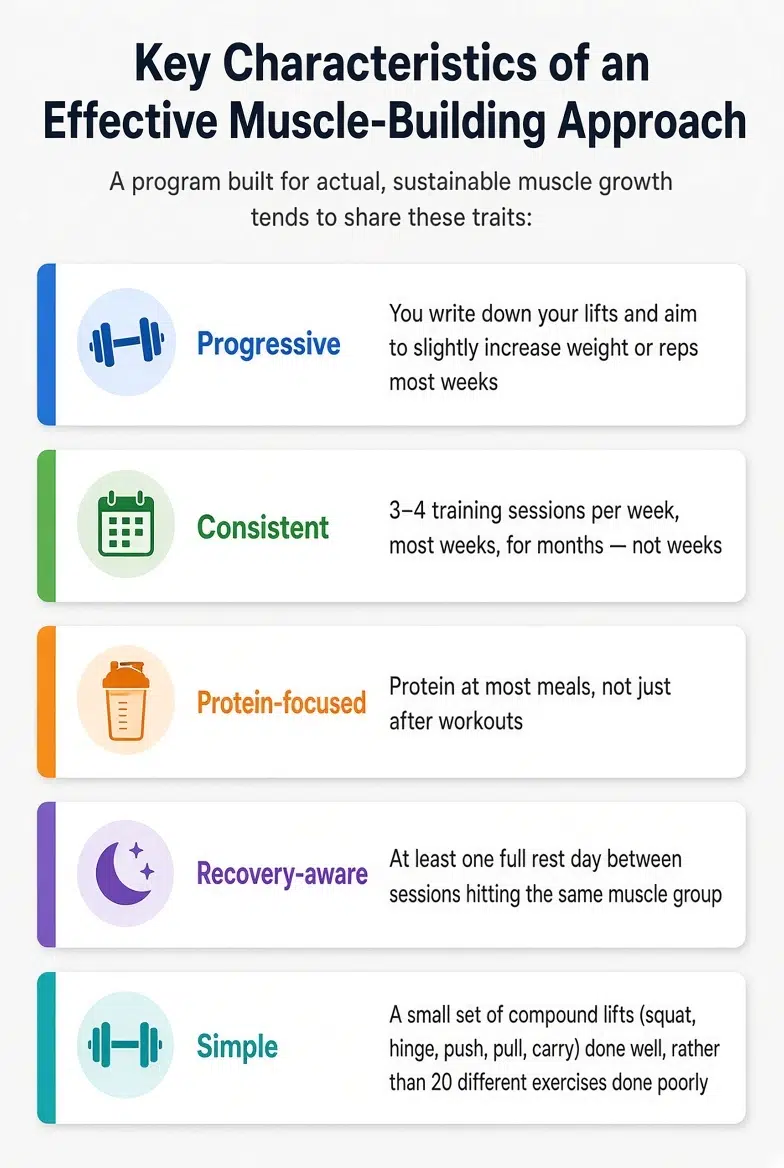
4. Key Characteristics of an Effective Muscle-Building Approach
5. Real-World Examples
Example 1: The busy professional (limited time)
Someone with 45 minutes, 3 days a week, can build muscle effectively using full-body workouts built around 5-6 compound exercises. The key isn’t more time — it’s using that time for exercises that target multiple muscle groups at once (squats, rows, presses) rather than isolation moves.
Example 2: The person who plateaued
Someone stuck at the same bench press weight for three months usually isn’t lifting too little, and they’re not tracking their lifts. Once they start writing down weights and reps and deliberately try to add 2.5-5lbs every 1-2 weeks, progress typically resumes.
Example 3: The meal-prep-avoidant eater
Someone who doesn’t have time to cook elaborate meals can still hit protein targets with simple, repeatable choices: eggs, Greek yogurt, canned tuna, a rotisserie chicken, or a protein shake between meals. Muscle doesn’t care whether the protein came from a fancy recipe or a scoop of powder.
6. Benefits and Advantages of This Approach
Focusing on the fundamentals (progressive overload, protein, recovery) instead of chasing shortcuts has real advantages:
- It’s sustainable. You’re not relying on a product or trend that stops working once you stop using it.
- It’s time-efficient. A focused 3-4 day routine with compound lifts fits into a busy schedule.
- It prevents plateaus. Tracking and progressively overloading means you’re always giving your body a reason to adapt.
- It’s measurable. You can see progress in numbers (weights, reps) rather than guessing.
To make this easier day-to-day, a few tools genuinely will help, not because they’re magic, but because they remove friction:
As an Amazon Associate, I earn from qualifying purchases. This website may contain affiliate links, which means we may earn a commission if you click through and make a purchase — at no additional cost to you.
🛒 Helpful tool: A simple workout tracking app or notebook makes progressive overload almost automatic; you always know exactly what to beat next session. Go the cheap route first with a notebook or a popular cool smart watch with built-in workout tracking.
🛒 Helpful tool: A whey or plant-based protein powder is one of the easiest ways to close the gap between what you eat and your daily protein target, especially on busy days. Start with a small container of vanilla protein powder and fill the gap.
7. Related Concepts Worth Understanding
Progressive overload vs. just “working hard:
Working hard matters, but doing the same weights forever doesn’t create new adaptations. Overload is about the trend over weeks and months, not how hard any single session feels.
Bulking vs. body recomposition:
A calorie surplus (“bulking”) makes muscle building somewhat faster, especially for beginners. Body recomposition (building muscle while roughly maintaining weight) is slower but keeps fat gain to a minimum — better suited to people who don’t want to “bulk and cut.”
Training volume vs. training frequency:
Volume (total sets/reps) and frequency (how often you train a muscle) both matter, but consistency across weeks matters more than optimizing either one perfectly.
A couple of tools that support this without adding complexity:
Helpful tool: A kitchen scale takes the guesswork out of portion sizes, making it much easier to consistently hit protein and calorie targets.
8. Conclusion
The fastest way to build muscle isn’t a secret; it’s progressive overload, sufficient protein, and real recovery, done consistently over months. Anyone selling a faster shortcut is usually selling something that works at the margins, not the core.
If you’re short on time, focus your limited hours on compound lifts and track them. If you’re short on meal-prep energy, focus on simple, repeatable protein sources instead of perfect recipes. If you’ve plateaued, the fix is almost always more tracked, gradual overload and not a totally new program.
Your next step:
Pick one thing from this article and start tracking your lifts, hitting your protein number, or getting to bed 30 minutes earlier and commit to it for the next two weeks before adding anything else.
🛒 Helpful tool: If cooking protein-rich meals feels like the biggest barrier, a meal-prep container set makes batch-cooking 3-4 days of meals at once far less time-consuming.
9. Frequently Asked Questions
How fast can you actually build muscle?
Beginners can often gain noticeable muscle within 8-12 weeks of consistent training. The rate slows down over time as you get closer to your body’s natural potential; this is normal, not a sign that something’s wrong.
Do I need to bulk (eat in a calorie surplus) to build muscle?
No, especially for beginners. A slight calorie surplus can speed things up, but many people can build muscle at maintenance calories through body recomposition, particularly early on.
How much protein do I really need per day?
A practical range is 0.7-1 g per pound of body weight per day. Going higher than that generally doesn’t add extra benefit for muscle growth.
Is it possible to build muscle with only 3 workouts a week?
Yes. Three well-structured, full-body sessions per week using compound lifts are enough for most people to build muscle steadily, especially outside of advanced/competitive lifting.
Why have I stopped seeing progress even though I train consistently?
The most common cause is a lack of progressive overload: repeating the same weights and reps without gradually increasing the challenge. Tracking your workouts is the simplest fix.
Do supplements make a big difference?
Supplements like protein powder or creatine can help you hit your targets more easily, but they support the fundamentals — they don’t replace training, eating enough, or sleeping enough.
If your missing piece is a step-by-step training plan, see whether Muscle Explosion! 28 Days to Maximum Mass is right for you. Keep the fundamentals in place regardless of which program you choose.