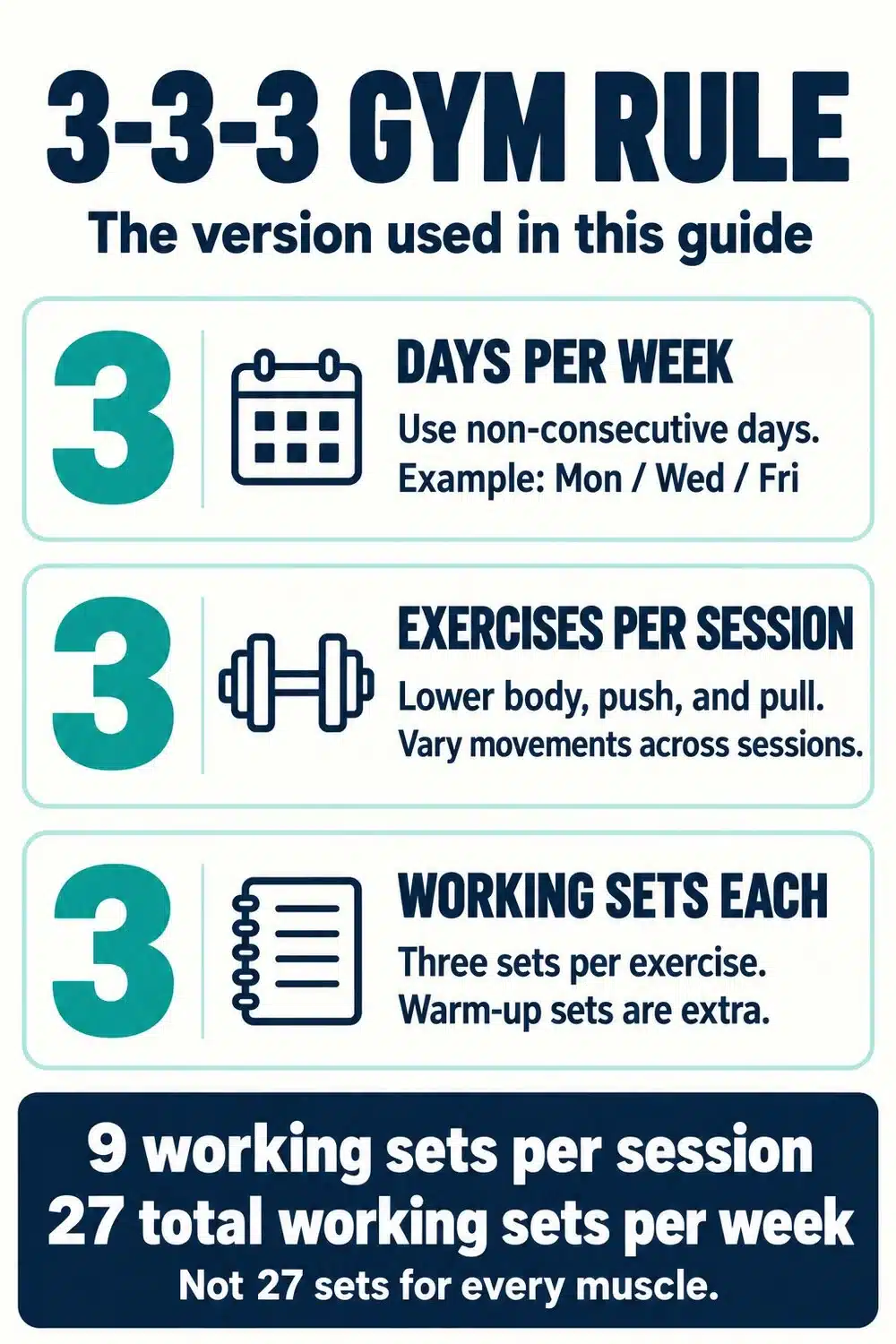
The 3-3-3 gym rule uses the following definition:
- Three training days per week: Choose non-consecutive days, such as Monday, Wednesday, and Friday.
- Three exercises per session: Include a lower-body movement, an upper-body push, and an upper-body pull.
- Three working sets per exercise: Warm-up sets are additional and do not count toward the nine working sets.
That adds up to nine working sets per session and 27 total working sets per week. Those sets are spread across exercises and muscle groups. They are not 27 sets for each muscle.
You can repeat some movements and rotate others. Three exercises per session do not mean you must use the same three exercises forever.
If you are comparing this approach with other routines, our guide to choosing a bodybuilding program and workout split provides additional context.
This approach, often referred to as the 3-3-3 gym rule, emphasizes consistency in your workouts.
Why Do Different Sources Describe Different 3-3-3 Rules?
Numbered workout names are shorthand. The label alone does not tell you the exercises, effort, rest periods, or progression method.
For example, your PT describes a three-exercise, three-set, three-day version. You may also encounter articles that use numbers to denote strength sessions, cardio sessions, and recovery days.
Those are different planning approaches. Three strength days, three separate cardio days, and three separate rest days would require nine days. A seven-day version needs overlap, such as strength and cardio on the same day.
There is also 3 × 3, which means three sets of three repetitions. It is a set-and-repetition prescription, not another name for every three-day workout.
For this article, keep the meaning straightforward: three days, three exercises, three working sets.
Is the 3-3-3 Gym Rule Enough to Build Muscle?
It can provide a starting structure, especially when your main difficulty is following a consistent plan. Whether it supplies enough work depends on the movements, their difficulty, your experience, and the muscles you want to develop.
The 2026 American College of Sports Medicine position stand supports progressive resistance training and finds that higher weekly training volume can enhance muscle growth. It does not establish this named 3-3-3 template as an optimal program.
Consider the arithmetic. If you bench press for three sets on three days, that is nine weekly bench-press sets. Adding squat and row sets does not turn it into 27 chest sets.
Compound exercises involve several muscles, but not every involved muscle receives the same training stimulus. A limited exercise menu can also leave gaps, such as direct calf work or knee-flexion work for the hamstrings.
Treat the framework as a starting point you can evaluate. If a muscle needs more attention, changing the plan is more useful than protecting the number three.
A Simple 3-3-3 Weekly Schedule
The example below alternates Workout A and Workout B over two weeks. This provides room for both a squat pattern and a hip-hinge pattern, as well as various pushing and pulling movements.
| Monday | Workout A | Workout B |
| Wednesday | Workout B | Workout A |
| Friday | Workout A | Workout B |
Tuesday, Thursday, and Saturday are an alternative if they fit your schedule better.
A day between sessions provides space for recovery, but it does not guarantee that you will be fully recovered. Adjust if soreness, fatigue, or other activities affect your ability to train with control.
This example is for generally healthy adults who can comfortably perform the listed movements. If an exercise is unfamiliar, get help learning it and begin with manageable resistance.
Workout A: Squat, Horizontal Push, and Row
| Exercise | Working sets | Repetitions |
| Goblet squat | 3 | 8-12 |
| Dumbbell floor press | 8 | 8-12 |
| One-arm dumbbell row with stable support | 12 | 8-12 per side |
For the row, complete the prescribed work on both sides. Each side receives three sets. In this article’s session totals, one left-plus-right round counts as one row set. Keep the support stable and choose a setup you can control.
A leg press can replace the goblet squat if it suits you better. A machine chest press is another option for the pressing movement.
Workout B: Hip Hinge, Overhead Push, and Pulldown
| Dumbbell Romanian deadlift | 3 | 8-12 |
| Seated dumbbell overhead press | 3 | 8-12 |
| Lat pull down | 3 | 8-12 |
The Romanian deadlift requires learning the hip hinge. Practice that movement before adding challenging weight. If it is not suitable, ask a qualified trainer for an alternative that addresses the same training need.
The overhead press is also optional. Use a comfortable pressing variation if an overhead position does not suit you. Stop a movement that causes pain rather than forcing the planned repetitions.
These are example workouts, not a claim that six exercises cover every training need. The A/B rotation is a practical way to broaden a small exercise menu.
How Heavy Should You Lift?
Begin with a load you can control throughout the planned repetition range. The last few repetitions can feel challenging without requiring a failed repetition.
For this example, aim to finish a working set with roughly two or three good repetitions left. This is an estimate, not a precision test. If you are learning the movement, use easier sets while you establish technique.
The ACSM review notes that taking every set to momentary failure is not necessary for training benefits. You do not need to test a one-repetition maximum to begin this routine.
Avoid treating a fixed weight increase as mandatory. Five or ten pounds can be a small change for one exercise and a large jump for another.
Warm-Up, Rest Periods, and Workout Length
Start with a few minutes of comfortable movement. Before the first challenging set of an exercise, perform lighter practice sets to check your range of motion and prepare for the working load.
The number of warm-up sets depends on the exercise, working weight, and how you feel. There is no need to force every exercise into an identical percentage-based warm-up.
For the sample workouts, begin with roughly two to three minutes between working sets. Take longer if needed to maintain your technique and intended effort. Rest is part of the session, not wasted time.
Allow approximately 35–60 minutes as a planning estimate. Equipment availability, warm-up needs, and rest periods can change that considerably. Do not rush a lift to meet a promised finish time.How to Progress Without Forcing a Personal Best
How to Progress Without Forcing a Personal Best
Use a repetition range rather than requiring more weight at every workout. For the sample plan, the range is 8-12 repetitions.
Here is an illustrative progression using the same weight:
| First session | 10 reps | 9 reps | 8 reps |
| Later session | 11 reps | 10 reps | 9 reps |
| Later session | 12 reps | 12 reps | 12 reps |
These numbers show the method, not an expected rate of improvement. Progress may take several sessions, and on some days you may repeat or regress from your previous performance.
When all three sets reach the upper end with controlled technique and your intended effort, consider the smallest suitable increase in weight. Your repetitions may then return toward the lower end.
The principle of increasing resistance after exceeding a repetition target is also described in ACSM’s earlier progression guidance. The specific change should fit the exercise and available equipment.
If you prefer paper records, the NewMe Fitness workout journal is one option to compare. An ordinary notebook can do the same basic job: record the exercise, weight, repetitions, and how the session felt.
Can You Use This Plan at Home?
Yes, although your exercise choices will depend on what you have and can use safely.
Goblet squats, dumbbell floor presses, supported rows, and dumbbell hip hinges can fit a home setup. If you have no pulldown machine, use an appropriate pulling exercise available to you, such as another row variation. This will change the movement coverage of the gym version.
Avoid improvised inverted rows under a household table. Furniture that looks sturdy may not be designed for that load or direction of force. Use equipment intended for the exercise.
f you need a range of weights in a smaller space, PowerBlock Elite EXP Stage 1 dumbbells are a good option. The linked listing describes a pair adjustable from 5 to 50 pounds per hand. Confirm the model, adjustment steps, selected package, and whether its shape suits your exercises. Expansion kits are separate purchases.
You do not need to buy that model or build a full home gym to use a short workout plan. Start with equipment you can use confidently.
For a broader equipment overview, see our Rogue Fitness equipment guide.
Common Mistakes to Avoid
Counting Every Set as Work for Every Muscle
The weekly total describes the whole routine—review which muscles each exercise targets before deciding whether a particular muscle needs more work.
Keeping the Same Three Movements Regardless of Your Needs
Repeating familiar exercises helps you track them, but the exercise menu should still reflect your goals. The A/B example includes a squat and a hinge rather than relying on squats alone for all lower-body work.
Adding Weight Before You Can Control It
An extra repetition is useful only if you can perform it with the intended technique. Keep the current load, use a smaller increase, or reduce it when needed.
Treating Cardio as a Replacement for Missed Lifting
A walk or cycle can be a worthwhile activity, but it is not a direct substitute for the resistance-training work you missed. Resume your schedule without cramming several hard sessions together.
Adding More Work Whenever Progress Slows
Review your records first. Sleep, food intake, exercise technique, and accumulated fatigue can all be worth examining before adding sets.
Our article on what can stall muscle gains offers a broader checklist for that review.
Food, Recovery, and Adjustments
Keep the supporting habits practical. Plan meals you can repeat, include protein sources, and leave time in your schedule for sleep and recovery.
or meal examples, see our guide to foods for muscle growth, protein portions, and easy meals.
If three working sets are too much while you are learning, start with fewer. If a muscle or movement needs additional attention later, add it thoughtfully. Either change moves away from the strict label, and that is fine.
Age alone does not determine the right load or exercise. Your experience, current capacity, comfort, and health needs matter when adjusting a routine.
For a plan that brings the broader pieces together, read our simple muscle-building plan for busy lifters.
Frequently Asked Questions
What does the 3-3-3 gym rule mean?
In this guide, this means three training days per week, three exercises per session, and three working sets per exercise. Other sources may use the phrase differently, so check the definition before copying a routine.
Does 3-3-3 mean three repetitions?
Not in this version. The sample workouts use eight to twelve repetitions per set. A prescription written as 3 × 3 means three sets of three repetitions and is a separate programming choice.
Can beginners use this structure?
It can be a manageable structure to learn, provided the exercises and loads suit the person. A beginner may need easier variations, fewer initial sets, or coaching rather than trying to meet every number immediately.
Are three exercises enough for every muscle?
Not necessarily. Three well-chosen exercises can cover several muscles, but a small exercise menu can leave gaps. Rotate movements and review your needs rather than assuming the label guarantees complete coverage.
How many sets does the plan include?
Three exercises multiplied by three working sets gives nine working sets per session. Three sessions give 27 across the week. Warm-up sets are extra, and each muscle does not receive all 27 sets.
Should I add weight every session?
No. Use your planned repetition range, technique, and effort to judge when to progress. Repeating the same weight while improving control or gradually adding repetitions can be part of the process.
What if I can only train twice in a week?
Complete the sessions you can manage and resume the A/B sequence afterward. Do not double the workload to satisfy the name of the plan.
Your Next Step
Choose three realistic training days and write down the exercises for your first session. Start with manageable loads and keep a record of what you actually complete.
After several weeks, use that record to review the routine. Keep what fits your schedule and goals, and adjust what does not. The numbers are there to help you organize training, not to prevent useful changes.