
You want to rebuild muscle, but the workouts you remember from years ago may no longer fit your schedule, joints, or energy. Is age holding you back, or does your training need a different starting point?
There is no single birthday when muscle building suddenly becomes difficult. However, understanding at what age is it harder to gain muscle can help in planning your training. Age-related muscle loss can begin in adulthood and becomes more of a concern later in life, but that is distinct from the loss of the ability to gain muscle through training. Adults in their 60s, 70s and beyond can still respond to resistance exercise.
After 50, the useful question is what you can consistently train, recover from, and gradually improve. Your recent activity, health, food intake and training history help determine that answer. Comparing yourself with your younger self rarely tells you what to do next.
This guide explains what changes with age, what the research can actually tell us, and how to approach your first weeks back. Start with the quick comparison below, then use the training and food sections to build a manageable plan.
Table of contents: jump to a section
The Quick Answer: Age Matters, but It Is Not a Cutoff
The National Institute on Aging describes muscle mass and strength as typically peaking around ages 30–35, with performance declining more rapidly later in life. Those are broad population patterns, not a prediction of your results or a time limit for starting. [1]
| Life stage | What to keep in perspective | Useful priority |
|---|---|---|
| 30s and 40s | Early age-related changes do not mean growth stops. | Build a repeatable training habit. |
| 50s and 60s | Health, symptoms and training history vary widely. | Match workouts to current capacity. |
| 70s and beyond | Strength, mobility and muscle size can still respond. | Adapt exercises and support as needed. |
This is a practical orientation, not a biological timetable. A beginner of 60 and a lifelong lifter of 60 may need very different programs.
Also separate muscle size, strength, and everyday function. They are related, but they do not improve in identical amounts. Becoming better at a lift does not tell you precisely how much muscle you have gained.
Why Gaining Muscle Can Become Harder
Several changes can overlap. Older muscle may show a reduced response to a given protein intake, often called anabolic resistance. Illness, inactivity, and inadequate nutrition can add to the problem. The practical response is to assess training and meals together, rather than assuming a supplement will compensate for missed workouts. [3] [4]
Hormonal changes can also affect body composition. Menopause, for example, may coincide with symptoms that make sleep or training harder. However, a meta-analysis of exercise studies in postmenopausal women found benefits for muscle mass from resistance and combined training. Menopause does not make strength work pointless. [5]
Then there are ordinary changes in circumstances. A desk job, caregiving responsibilities, an old injury, or a long break from exercise can alter what you can tolerate. These deserve attention without being dismissed as the unavoidable effects of aging.
You do not need to identify one biological cause before making a useful change. Begin with what you can observe: how often you train, what you lift, whether you eat regularly, and how you feel between sessions.
Can You Still Build Muscle After 60 or 70?
Yes, research supports the possibility. A systematic review of randomized trials in very elderly adults found that resistance training can improve muscle strength and size. That supports offering appropriate training at advanced ages, while recognizing that individual results vary. [2]
It does not justify pledging a certain number of pounds of muscle in a month. Studies use different exercises, supervision, durations, and measurements, and their participants may not share your medical history.
If you are restarting, judge the early weeks partly by whether you can repeat the routine comfortably and perform the movements more confidently. Visible changes may take longer to assess.
Previous lifting experience may make familiar exercises easier to relearn. However, it is not a reason to resume your old working weights immediately or promise that muscle will return on a fixed schedule. Treat your first sessions as an assessment of current ability.
What to Change in Your Training After 50
Start With a Schedule You Can Repeat
For a generally healthy beginner or returning lifter, two nonconsecutive full-body sessions are a practical starting option. ACSM’s 2026 guidance emphasizes training the major muscle groups at least twice weekly. It does not require a complicated split or six gym visits. [6]
If you already train successfully, turning 50 is not a reason to discard your routine. Adjust it when your performance, comfort, or recovery calls for it.
Our comparison of muscle-building training options can help you choose among full-body, upper/lower, and equipment-based approaches.
Choose Exercises You Can Control
The following is an example menu, not a prescription. Choose an appropriate variation for each pattern rather than doing every option.
| Movement | Example option | Adaptation to consider |
|---|---|---|
| Knee-dominant | Sit-to-stand or leg press | Adjust seat height or movement depth. |
| Hip-dominant | Glute bridge or light hip hinge | Learn a comfortable, controlled pattern. |
| Push | Wall push-up or chest press | Adjust angle, grip or resistance. |
| Pull | Supported row or pulldown | Choose a stable position and suitable range. |
An introductory session might use one or two working sets per exercise, with a reasonable repetition range such as 8–12. Warm up first, use lighter practice repetitions, and rest long enough to maintain control. A qualified trainer can help select loads and exercises if these movements are unfamiliar. Older-adult training guidance supports individualizing the starting workload. [7]
Machines, dumbbells, and bands are options, not requirements to climb. A deep squat is not compulsory for everyone. If one movement hurts, do not force it to meet an arbitrary standard; get help finding a suitable alternative.
Progress Without Making Every Workout a Test
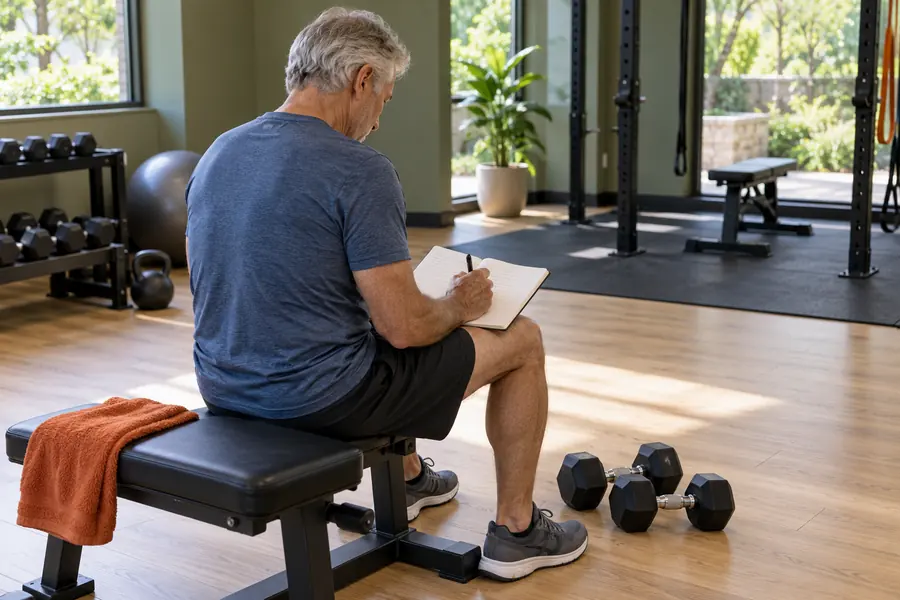
Record the exercise, resistance, repetitions, and how demanding the set felt. For example, if you complete two sets of eight controlled rows, your next goal could be nine repetitions at the same resistance.
Affiliate disclosure: As an Amazon Associate, we earn from qualifying purchases.
If you prefer a structured paper log, the Nextnoid Hardcover Fitness Journal on Amazon is an optional way to keep your workout records together. A plain notebook works too; choose whichever you will use consistently.
When you can comfortably reach the top of your chosen range with consistent technique, consider a small increase in load. Change one variable at a time so you can tell what affected the next session.
You do not need to take every set to complete muscular failure. ACSM reports that failure training does not consistently improve outcomes for the average healthy adult. Finishing with a few controlled repetitions still available is a reasonable way to begin. [6]
Shortening rest periods is not automatically better progression. It may simply make you more winded and reduce the quality of your next set. Likewise, soreness is not a score for workout effectiveness.
Add Work Only When It Is Useful
A large review of trials in adults aged 60 and older found benefits from relatively low-volume resistance training, particularly in healthy participants. More work was not universally better for every outcome, and evidence was more limited for physically impaired adults. [8]
Use that as permission to start with a reasonable amount, not proof that two sets are ideal for everyone. Add work gradually when attendance is reliable, technique is stable, and you are recovering well.
Protein After 50: Start With Your Actual Meals
There is no single protein target for everyone over 50. Guidance for older adults commonly discusses people over 65, and needs depend on activity, nutritional status, and health.
The PROT-AGE group recommends 1.0–1.2 g/kg of body weight daily for older adults, with at least 1.2 g/kg for those who exercise. ESPEN likewise recommends individualizing intake rather than applying a single number to everyone. [3] [4]
For context, 1.2 g/kg equals 90 grams daily for someone weighing 75 kg, or about 165 lb. This is an illustration of the calculation, not a maximum or a personalized muscle-growth target. If you have kidney disease or a prescribed protein restriction, discuss changes with your clinician or dietitian.
Look at the meals from an ordinary day before buying anything. Does breakfast contain a useful protein source, or is nearly everything saved for dinner? Yogurt, eggs, fish, poultry, tofu, beans and lentils provide different ways to build meals around protein. Check portions and labels rather than assuming all servings are equivalent.
If estimating portions is difficult, the Etekcity Food Kitchen Scale on Amazon measures food in grams and ounces and has a tare function for subtracting the container’s weight. It weighs food, not protein: use the food label or a nutrition reference to estimate protein from the measured portion.
Spreading protein across meals can make a daily target easier to meet. But 30 grams is not a hard limit on what your body can use. Research in healthy young men found a larger and longer post-exercise anabolic response to 100 grams than to 25 grams. That does not prescribe 100-gram meals for older adults; it shows why the simple “anything above 30 grams is wasted” rule is misleading. [9]
For practical meal combinations, use our foods-for-muscle-growth guide. A shake is optional convenience when food alone is difficult, not a requirement for starting.

Recovery: Adjust to Your Return
There is no universal rule that everyone over 50 needs exactly 72 hours between workouts. Start with recovery days between demanding sessions for the same muscles, then assess your response.
Ask whether your normal energy has returned, whether the discomfort is settling, and whether you can repeat the exercises with control. If performance continues to worsen, consider reducing sets or adjusting the schedule before adding more work.
The National Institute on Aging recommends roughly seven to nine hours of sleep for older adults. Persistent sleep difficulties deserve attention, especially if you are regularly exhausted despite allowing enough time in bed. [10]
Keep ordinary activity in the week too. For adults 65 and older, CDC guidance includes aerobic activity, muscle strengthening, and balance work. Walking can complement your lifting; it does not replace every kind of strength exercise. [11]
A Simple Return-to-Training Checklist
Use this as a planning aid for your first weeks back. The aim is to learn what you can repeat, rather than force progress by a deadline.
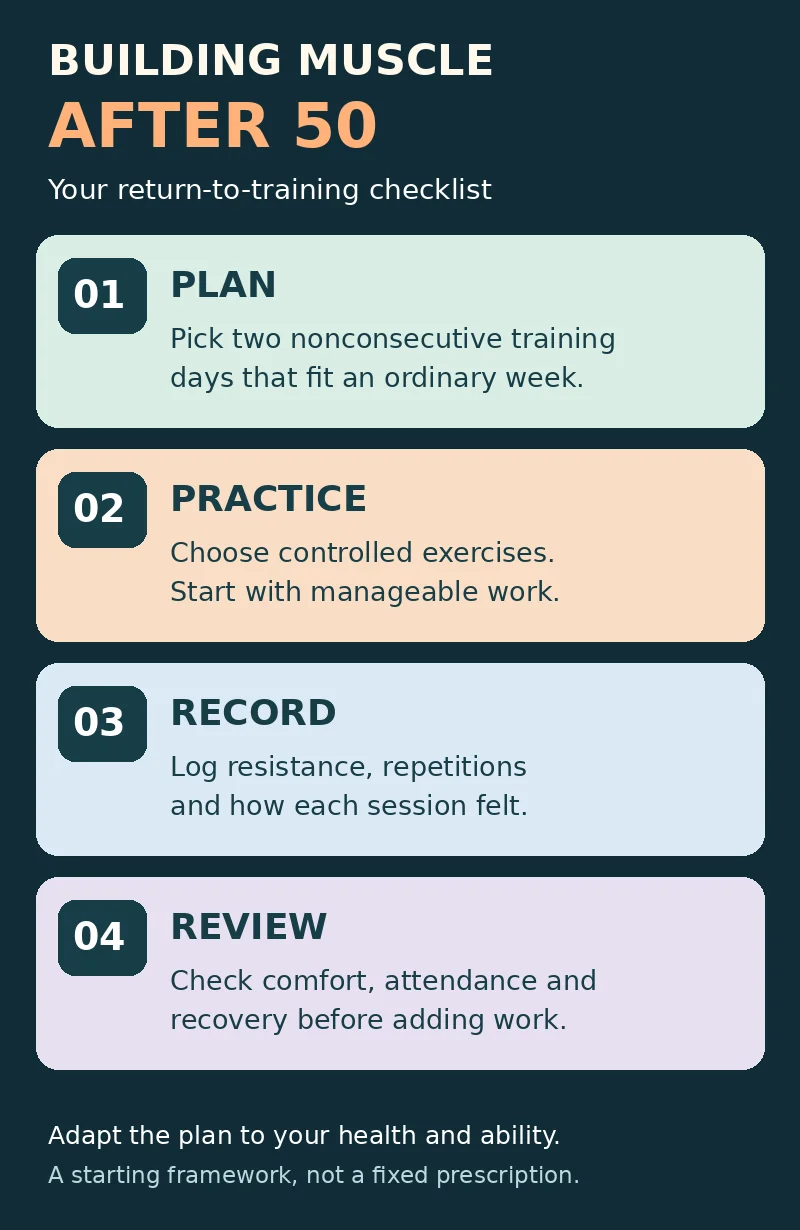
Infographic text:
- Plan: Pick two nonconsecutive training days that fit an ordinary week.
- Practice: Choose controlled exercises and begin with a moderate workload.
- Record: Log resistance, repetitions, and how each session felt.
- Review: Check comfort, attendance, and recovery before adding more work.
If a week goes badly, record why. A missed session because of travel calls for a scheduling adjustment. Persistent pain calls for assessment. Those are different problems, and neither is solved by blaming your age.
When Progress Halts or You Need Help
Before changing everything, compare several weeks of records. Did you attend consistently? Were your repetitions and technique comparable? Did meals or sleep change? Pick one plausible issue and adjust it, rather than increasing training and changing your diet simultaneously.
Preserving strength can also be a worthwhile outcome during illness, weight loss or a demanding period of life. You do not need a personal record every week to justify training.
Do not assume unexplained weakness, unintended weight loss, repeated falls, or persistent exercise-related pain are normal signs of aging. Seek medical advice. If you have a condition that affects exercise safety, recent surgery or substantial mobility limitations, get an individualized starting plan.
Frequently Asked Questions
Is 50 Too Old to Start Building Muscle?
No. Being 50 does not rule out gaining muscle. Start from your present fitness and health, not the routine or weights you used years ago. A suitable plan matters more than matching someone else’s age-based program.
Can Women Build Muscle After Menopause?
Yes. Research supports the muscle mass benefits of resistance training in postmenopausal women. Symptoms, health, and training history may affect how a routine should be adapted; menopause alone is not a reason to avoid strength work. [5]
How Long Before You See Results?
There is no reliable deadline for an individual. Early improvements in exercise performance do not necessarily equal visible muscle growth. Track attendance and controlled repetitions, and compare body measurements under similar conditions over longer periods.
Do You Need Supplements or Heavy Barbells?
Neither is a starting requirement. Choose a suitable resistance and a workable meal first. Equipment and supplements should solve a specific problem, as with limited training resistance or difficulty meeting your nutritional needs, rather than be purchased solely because of your age.
Your Next Step
Choose two realistic training days, write down a short exercise menu, and identify one meal you could improve. Keep a record, then adjust from what you observe.
Age matters, but it cannot tell you your next working weight, ideal routine, or future result. Those decisions need your current starting point. For the broader structure, see our complete guide to muscle building.
Sources
- National Institute on Aging: Strength training and aging
- Grgic et al.: Resistance training in very elderly adults
- PROT-AGE: Dietary protein recommendations for older adults
- ESPEN practical guideline: Clinical nutrition and hydration in geriatrics
- Khalafi et al.: Exercise and body composition in postmenopausal women
- ACSM: 2026 resistance-training guidance
- ACSM: Strength training for older adults
- Radaelli et al.: Training volume in older adults
- Trommelen et al.: Protein dose and the post-exercise anabolic response
- National Institute on Aging: Sleep
- CDC: Older adult physical activity