
You fit the gym around work, show up a few times a week, and still wonder whether your effort is making a difference. Should you change your routine, eat more protein, or give your current plan more time?
Start by making those questions easier to answer. A repeatable training schedule, a simple workout log and a manageable approach to food and recovery give you something concrete to review.
This complete guide to muscle building brings those pieces together. You will find an example three-day routine, a clear way to progress your exercises, practical meal-prep ideas and a checklist for investigating stalled progress. Links throughout the guide take you to more detailed articles when you need them.
You do not need to buy supplements or tracking equipment to use this guide.
This is general educational information for healthy adults, not an individualized training or nutrition prescription. If you have an injury, symptoms or a medical condition that affects exercise or diet, seek advice suited to your circumstances.
How muscle building works
Resistance training gives your muscles a reason to adapt. Food supplies energy and nutrients, while recovery helps you return ready for the next session. The useful starting point is to consider all three together.
| Part of the plan | What to focus on |
|---|---|
| Training | Repeat challenging exercises and track what you do. |
| Nutrition | Eat enough overall and include protein-containing foods regularly. |
| Recovery | Allow time between demanding sessions and make sleep a priority. |
Progressive overload means increasing the demands of training over time as your ability improves. That might mean more repetitions with the same weight, a heavier weight, or another carefully chosen adjustment. It does not mean you must beat your previous workout every time.
Current American College of Sports Medicine guidance emphasizes regular resistance training, appropriate effort and a plan that fits the individual. You do not need an elaborate routine to begin.
Choose a training schedule you can maintain
Plan around an ordinary week, including work, family commitments and travel. A schedule you can usually follow is more useful than one that depends on everything going perfectly.
| Available training days | A possible starting structure |
|---|---|
| Two days | Two full-body sessions on separate days |
| Three days | Three full-body sessions with recovery days between |
| Four days | An upper-body/lower-body split |
These are options, not rankings. More training days do not automatically make a program better. Session length depends on your exercise choices, rest periods, warm-up and equipment availability.
For help comparing schedules, read how to choose a bodybuilding program and training split.
Match the plan to your experience
If you are new to lifting, learning controlled, repeatable technique is part of the process. Early improvements in a lift do not all represent new muscle.
If you already train consistently, review your records before adding exercises or training days. You may need a more specific adjustment rather than a completely new routine. Our natural bodybuilding training guide explores planning for lifters with more experience.
Use the equipment you can access
A gym offers plenty of choices, but home training can also be useful. Dumbbells, resistance bands and suitable bodyweight exercises can provide ways to increase the challenge over time.
Before buying equipment, identify the movement you cannot currently train and the space you have available. A bench or pull-up bar may help some routines, but neither is a requirement for everyone.
Affiliate disclosure: As an Amazon Associate, we earn from qualifying purchases.
If you need adjustable weights for home training, the Core Fitness Adjustable Dumbbell Pair is one option to compare. Each dumbbell adjusts from 5 to 50 lb in 5 lb increments. Check that the starting weight, increments and maximum weight suit your exercises. A 5 lb increase may be too large for some movements, so build repetitions before increasing the load when appropriate.
An example three-day muscle-building routine
The following A/B routine illustrates how a full-body schedule can work. Adapt the exercises, loads and workload to your experience and available equipment. It is an example, not a personalized program.
Train on three nonconsecutive days, such as Monday, Wednesday and Friday. Alternate the sessions:
- Week one: A, B, A.
- Week two: B, A, B.
Warm up before working sets, including lighter practice sets where appropriate. Use a controlled range of motion you can manage comfortably. If an exercise causes pain, stop and reassess rather than pushing through it.
Workout A
| Exercise | Example working sets and repetitions |
|---|---|
| Goblet squat or another suitable squat | 2–3 × 6–10 |
| Dumbbell bench press or push-up variation | 2–3 × 6–10 |
| Dumbbell row or cable row | 2–3 × 8–12 |
| Reverse lunge or supported split squat | 2 × 8–10 per side |
| Plank variation | 2 × 20–40 seconds |
Workout B
| Exercise | Example working sets and repetitions |
|---|---|
| Romanian deadlift or another suitable hip hinge | 2–3 × 8–12 |
| Dumbbell overhead press | 2–3 × 8–12 |
| Lat pulldown or assisted pull-up | 2–3 × 6–10 |
| Supported split squat or step-up | 2 × 8–10 per side |
| Dead bug | 2 × 6–10 per side |
Use the lower end of the suggested set range while learning the routine. Choose manageable loads and adjust the workload if it is more than you can recover from.
Rest enough between sets to repeat the movement with good control. Around two to three minutes can be a practical starting point for demanding lifts, with adjustments based on the exercise and how ready you feel. Avoid rushing simply to finish within a fixed time.
For a different, more compact framework, see our 3-3-3 gym rule guide. That framework uses three exercises per session; it is not the same routine as this A/B example.
Use double progression to track improvements
Double progression gives you a simple sequence: build repetitions within a chosen range, then increase the weight when you are ready.
For an exercise using three sets of 8–12 repetitions:
- Choose a weight you can control across all three sets without having to reach failure.
- Record the repetitions in each set.
- At later sessions, aim for an extra repetition where you can maintain technique and a similar level of effort.
- Once you can complete all three sets at the top of the range with control and some repetitions in reserve, consider a small load increase.
- With the heavier weight, repetitions may return toward the lower end of the range. If the increase is too large, keep the previous load or use a smaller increment if available.
An illustrative progression log
This example is for a one-arm dumbbell row. Weight refers to one dumbbell, and the repetitions are recorded for each side. The entries represent selected sessions, not a promised weekly rate of improvement.
| Log entry | Weight | Repetitions across three sets |
|---|---|---|
| 1 | 20 kg | 8, 8, 8 |
| 2 | 20 kg | 9, 8, 8 |
| 3 | 20 kg | 10, 9, 9 |
| 4 | 20 kg | 12, 11, 10 |
| 5 | 20 kg | 12, 12, 12 |
| 6 | 22 kg | 8, 8, 8 |
Your available weights may differ. Progress may take several sessions, and repeating the same numbers is normal. A heavier load only counts as a useful progression if you can still perform the exercise appropriately.
Keep a short workout log
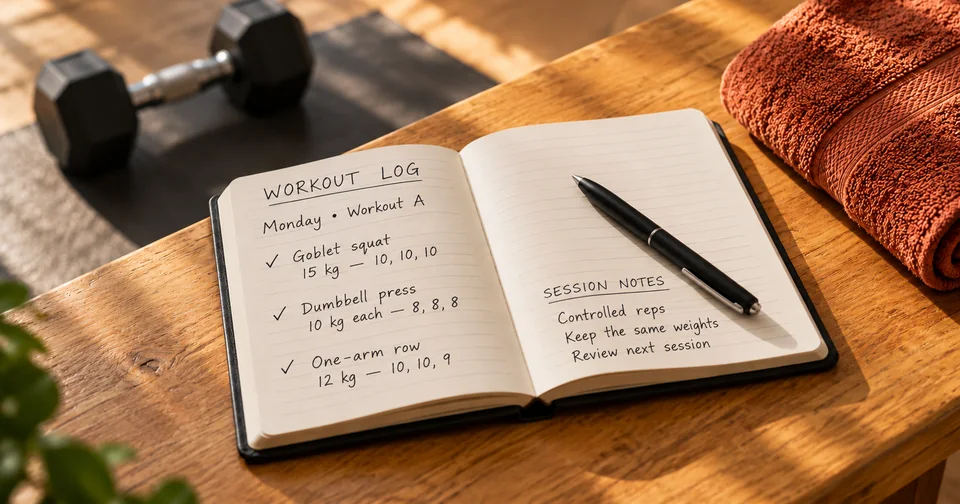
Record the exercise, load, repetitions and working sets. A brief note about effort or technique can make the numbers more useful.
A notebook, spreadsheet or app can all do the job. Choose the one you will actually use. You do not need to pay for an app to track progress.
If you prefer a dedicated paper log, the Nextnoid Hardcover Fitness Journal & Workout Planner is an optional way to keep your gym or home-workout records together. Use it to record your sessions and compare your notes as you work through the progression example above. A plain notebook remains a suitable alternative.
Eat to support training and recovery
Start with meals you can repeat. Protein matters, but it is not the whole diet. Overall food intake, carbohydrate-containing foods, dietary fats, fruit and vegetables also belong in the picture.
If you regularly skip meals or arrive at training underfed, a more consistent eating routine may be the first issue to address. Exact energy needs vary, so avoid treating one calorie target as suitable for everyone.
Put protein intake in context
A meta-analysis of resistance-training studies found that average additional gains in fat-free mass from protein supplementation levelled off around a total daily protein intake of 1.6 grams per kilogram of body weight in the studied healthy adults.
That is a research estimate, not an exact requirement or ceiling for every person. It refers to total protein from food and supplements combined. For context, 1.6 g/kg works out to 128 grams for someone weighing 80 kilograms; that calculation is not a personalized prescription.
An easier first step is to identify the protein source in your usual meals. Eggs, dairy foods, fish, meat, tofu, beans and lentils offer different ways to build a varied diet. For practical examples, see protein portions and easy meal ideas for muscle growth.
If a medical condition affects your diet, get individualized advice before substantially changing protein intake.
If you want to understand your usual portions, the Etekcity Digital Kitchen Scale is an optional tool for weighing ingredients in grams or ounces. Its tare function subtracts the weight of the bowl or container. Remember that food weight is not the same as protein content: use the food's nutrition information to interpret the portion you weigh. You do not need to weigh every meal to use this guide.
Prepare a few meals ahead

Set aside a manageable preparation block, perhaps around an hour, to make ingredients for several meals. The actual time depends on your recipes, quantities and kitchen setup.
A simple batch might include:
- Rice, potatoes or another carbohydrate base.
- Chicken, tofu, beans or another protein source.
- Cooked vegetables or washed ingredients for a salad.
- Containers for the next few days, with extra portions frozen where suitable.
| Meal | Example combination |
|---|---|
| Breakfast | Greek yogurt, oats and berries |
| Lunch | Chicken or tofu, rice and vegetables |
| Snack, if wanted | Cottage cheese and fruit, or another convenient option |
| Dinner | Fish or beans, potatoes and a salad |
Adjust portions to your needs and include suitable sources of dietary fat, such as olive oil, nuts or seeds. You can also use our foods for muscle recovery guide for more meal ideas.
For storing prepared meals, Rubbermaid Brilliance Glass Food Storage Containers are one option to consider. Choose a container size and set quantity that fit the meals you prepare, and follow the manufacturer's instructions for the glass bases and lids. Containers you already own may be sufficient if they are suitable for the intended storage and reheating method.
Store and reheat prepared food safely
Oven settings do not tell you whether meat or poultry has reached a safe internal temperature. Use a food thermometer and follow the USDA safe minimum internal temperature chart for the food you are cooking.
If you need a food thermometer for your meal-prep routine, the TempPro TempSwift is an option for checking internal temperatures. Follow its instructions for probe placement, cleaning and use, and compare the reading with the guidance for the food you are preparing.
According to USDA leftover-handling guidance:
- Refrigerate perishable cooked food within two hours, or within one hour in temperatures above 32°C/90°F.
- Divide larger batches into shallow containers so they cool promptly.
- Keep the refrigerator at 4°C/40°F or below.
- Use refrigerated leftovers within three to four days, or freeze portions for later.
- Reheat leftovers to 74°C/165°F.
One preparation session can cover several days. For later in the week, plan a second small batch or use appropriately frozen portions.
Make recovery part of the plan
Leave recovery time between demanding sessions and pay attention to how you feel over several workouts. A consistent sleep schedule is a useful starting habit.
Try a bedtime you can maintain, a quieter wind-down period and a review of late-day caffeine if it interferes with sleep. Your routine should make it easier to return ready to train, rather than repeatedly working around exhaustion.
You do not need to take every set to failure
For many exercises, finishing a set while you could still perform a few more controlled repetitions is a practical way to manage effort. Estimating repetitions in reserve takes practice, especially when you are new to lifting.
ACSM's evidence review found that training to momentary failure did not consistently improve outcomes for the average healthy adult. It also did not establish a need for complex programming for everyone. See the ACSM resistance-training summary.
Use lighter weeks when they serve a purpose
A lighter training period can be one option when fatigue is accumulating. It is not something every beginner must schedule at a fixed six- or eight-week interval.
Review your recovery, performance and other demands before deciding whether to reduce workload. Avoid responding to every difficult session by adding more training.
Track progress beyond the mirror
Look for patterns across several weeks. Useful records include:
- Repetitions and loads performed with comparable technique.
- Consistency in completing planned sessions.
- Measurements taken under similar conditions, if useful to you.
- Optional progress photos taken with consistent lighting and positioning.
- How manageable your routine feels alongside the rest of your life.
A better workout log does not automatically mean the same rate of visible muscle growth. Changes in strength, technique, body weight and appearance can happen on different timelines. Our guide to how long it takes to build muscle explores those differences.
What to review when progress slows
There is no single number of stalled weeks that defines a plateau for everyone. If several comparable sessions show no improvement, use that as a reason to investigate rather than immediately replace your routine.
| Check | Question to ask |
|---|---|
| Attendance | Have you completed the sessions you planned? |
| Tracking | Are you comparing the same exercise, load and technique? |
| Effort | Are your sets challenging without repeatedly sacrificing form? |
| Recovery | Has sleep, stress or fatigue changed? |
| Nutrition | Have meals and overall food intake been consistent? |
| Workload | Is the routine manageable, or are you struggling to recover? |
Address the clearest issue first. That might mean restoring regular meals, allowing more rest between sets, reducing excessive workload or adjusting an exercise you cannot perform comfortably.
Do not automatically add a set every week when a lift stalls. More work is only useful if it fits the problem and your ability to recover. Change one relevant variable at a time, then review several comparable sessions.
For a wider troubleshooting checklist, read what can interfere with muscle gains.
Decide whether a supplement fills a real need
You can begin with ordinary food and a repeatable training routine. Protein powder is a convenience option if it helps you meet your food plan; it is not a requirement for using this guide.
Before buying anything, identify the problem you want it to solve. A product comparison is more useful when you already know whether you need convenience, a particular ingredient or simply a lower-cost option.
Our muscle-building supplement buying guide compares product categories and their purposes. If you are specifically considering creatine, use the creatine supplement comparison to examine the options and buying considerations.
Frequently asked questions
How many days a week should I train?
Two or three full-body sessions can provide a manageable structure. The right schedule depends on your experience, workload and recovery. The example in this guide uses three nonconsecutive days, but that is not the only workable arrangement.
How long does it take to see results?
It varies. Your exercise technique or training numbers may improve before you notice a visible change. Review trends over time rather than expecting a particular result by a fixed deadline.
Can I build muscle at home?
Home-based resistance training can be effective. Choose movements and equipment that let you train consistently and adjust the challenge as your ability improves. You do not need to copy every exercise from a gym routine.
Do I need protein powder?
No. It can be a convenient food supplement, but ordinary foods can supply protein. Consider whether it solves a practical problem in your diet before buying it.
Should I keep doing cardio?
Aerobic activity can remain part of your overall routine. Plan its amount and intensity alongside lifting so the combined schedule is manageable. If recovery becomes difficult, review the total workload rather than judging either activity in isolation.
What if I miss a workout?
Resume the next planned session when practical, keeping suitable recovery time between demanding workouts. Avoid cramming several missed sessions together. One missed day is a scheduling issue to manage, not a reason to abandon the plan.
Your starting checklist for this week
- Choose two or three realistic training days.
- Select suitable exercises and record your starting loads and repetitions.
- Plan a few meals you can prepare and store safely.
- Identify one recovery habit you can make more consistent.
- Set a time to review your log after several weeks.
Start with a routine you can repeat and records you can learn from. Those give you a clearer basis for deciding what to keep, what to adjust and which detailed guide to read next.