Rogue Fitness makes solid equipment. That’s pretty much undisputed at this point.
The real question is whether you actually need to spend that much when you’re cramming a home gym into a one-bedroom apartment or a garage that still needs to fit your car.
This review is specifically for people dealing with tight spaces and real budgets who want equipment that won’t fold in half when you’re squatting with heavy weights.
Brand Overview and History
Rogue started in Columbus, Ohio, and basically grew up alongside the CrossFit boom. They supply equipment for the CrossFit Games and a bunch of college strength programs.
Most of their flagship stuff gets made in-house in Ohio. Heavy steel, thick welds, built to survive a commercial gym where people drop bars all day.
The brand has a reputation for three things:
Really solid construction and finishes that don’t chip off after a month.
A huge catalog of compatible attachments and accessories (which is great until you realize you’re spending $80 on a dip attachment you’ll use twice).
Premium pricing compared to brands like Titan or REP.
So you’re dealing with equipment aimed at serious, long-term training. Not the stuff you buy on Amazon and replace in six months.
Product Range Analysis (For Small Spaces)
Rogue sells basically everything—racks, bars, plates, benches, weird strongman stuff, conditioning equipment.
You don’t need all of it. You need the pieces that actually fit your space and training style.
Racks and Stands
This is where Rogue made their name.
S-Series Squat Stands are compact, have a lighter footprint, and are good if you can’t bolt into the floor (like most apartment dwellers).
R-Series Power Racks are more traditional and very stable, but they need floor mounting or substantial weight to stay put.
Monster and Monster Lite Racks are overbuilt, with thicker uprights and compatibility with endless attachments. Perhaps this is overkill for most home gym people, but they look cool.
For small spaces, most people go with either a squat stand with solid spotter arms or a wall-mounted fold-back rack (if your landlord allows it and your wall can handle the load).
The trade-off is real though. Rogue racks are deep, heavy, and built like commercial equipment.
Great for safety and stability, terrible if you’re trying to preserve walking space in your bedroom.
Practical tip: Measure your ceiling height and add at least 12-18 inches above the pull-up bar. I learned this the hard way when I smacked my head doing kipping pull-ups in my garage.
Also measure barbell clearance when you’re rotating it to load plates. Nothing worse than hitting your TV every time you change weight.
Barbells and Plates
This is where Rogue actually justifies the price (imo).
The bars are legitimately good. Strong shafts with high tensile strength, knurling that grips without shredding your hands, and bushings or bearings matched to what the bar is designed for (powerlifting vs Olympic lifting vs general use).
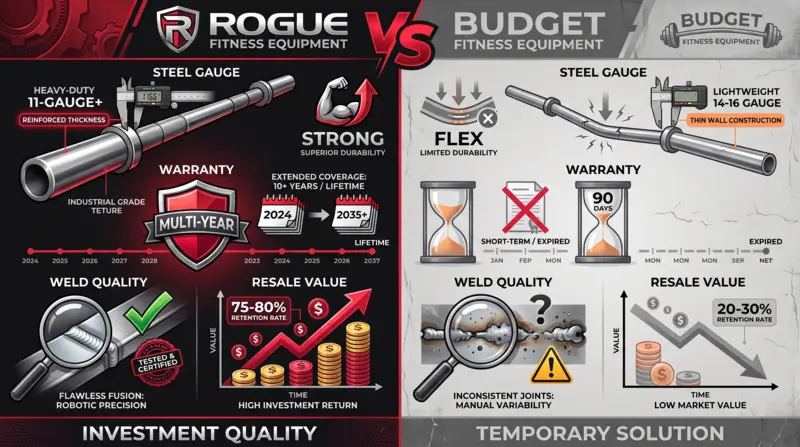
A lot of people describe Rogue bars as “buy once, use for ten years” type purchases. I’ve seen used Rogue bars sell for like 70-80% of retail even after years of heavy use.
That’s pretty unusual for fitness equipment.
Plates are similar quality. They offer bumpers (training, competition, and economy styles) as well as iron and calibrated powerlifting plates.
For small spaces, bumpers help protect floors and reduce noise, but they take up way more storage space than iron plates. You’ll need to balance thickness against how many plates you can actually store.
Worth mentioning: Rogue bumpers hold up extremely well over time. Cheaper bumpers start looking rough after a year of drops.
Conditioning Equipment (Echo Bike and More)
The Echo Bike gets a ton of attention for good reason.
It’s incredibly sturdy. Heavy frame that doesn’t wobble even when you’re going all-out.
Low maintenance because of the belt drive and simple design.
Loud as he’ll because it’s a fan bike, but smooth and reliable.
A 2026 review rated it among the most durable options for home and commercial use.
Rogue also sells sleds, rowers, and specialty conditioning tools, but in a small apartment, an Echo Bike or just a jump rope plus bands makes way more sense than trying to fit a giant sled.
Small-Space Friendly Accessories
A few Rogue categories actually work really well for compact living:
Monster Bands (resistance bands) hold tension way longer than cheap Amazon bands and don’t snap under heavy use. I’ve had the same set for three years.
Kettlebells are cast with smooth handles and consistent finishes, and are easy to store in a corner or closet.
Rogue Plate Carrier is decent for loaded conditioning if you can’t fit big machines, though some people complain about the shoulder straps and Velcro during explosive movements like burpees.
These pieces tuck away easily. You can train hard without filling your entire living room with equipment.
Quality and Performance: What Real Users Report
Rogue’s whole thing is quality. Pretty much every review site, Reddit thread, and garage gym blog lands on the same conclusion.
Build Quality and Durability
Most long-term users describe Rogue equipment as overbuilt. Thick steel, clean welds, powder coat that actually resists chipping.
People are still using racks and bars they bought five or ten years ago with only cosmetic wear. That’s pretty impressive.
One detailed review said the welds and finish are “incredible” and that buyers rarely complain about build quality even after years of daily use.
Are There Weak Spots?
Even good gear has trade-offs.
The Rogue Plate Carrier receives complaints about shoulder-strap comfort and Velcro security during dynamic movement.
Some attachments feel overpriced for what they actually add to your training (looking at you, $40 J-cups that are basically the same as $20 versions from other brands).
A comparison between Rogue and REP Fitness found that Rogue has slightly higher overall quality but costs more for almost every item.
On Reddit, one experienced lifter rated Rogue’s overall quality around “6.5 out of 10” compared to every brand worldwide, but still called them solid and reliable for typical home gym owners.
The pattern is clear. Rogue gear is basically never described as flimsy or poorly made.
The debate is about whether the extra quality is worth the premium over other good mid- to high-tier brands.
Customer Service Experience
This is where things get mixed, and tbh, it matters a lot when you’re ordering heavy racks and bars.
The Positive Side
Several garage gym reviewers praise Rogue’s customer service. Fast shipping, quick resolution of quality issues, responsive support when something goes wrong.
Plenty of Reddit posts share stories of replacement parts, quick refunds for damaged items, and helpful responses.
When you’re ordering a $700 rack, good support actually matters.
The Negative Side
Third-party review sites tell a different story, though.
Context matters here. Big companies generate negative reviews because unhappy customers are louder than happy ones…
But you can’t totally ignore patterns around shipping damage, backorders, or restocking fees if you need to return something.
My take: Look for recurring issues with the specific product you want, not just general complaints about the brand.
Check out Reddit or other trusted forums and ask users what they think.
Some people complain period.
“DO your own Due Dilligence”
Pricing and Value Assessment
Rogue is expensive. That’s just the reality.
How Rogue Prices Compare
Across independent comparisons, the pattern is consistent:
Rogue costs more than budget brands like Titan and most Amazon sellers.
Rogue and REP Fitness are in a similar tier, though Rogue usually costs a bit more item-for-item.
The direction is clear. You pay a premium for the logo, US manufacturing, and the track record.
Is That Premium Worth It?
Depends on the product and your goals, honestly.
For a small-space home gym, overpaying for accessories you rarely use is dumb. Paying for a rock-solid rack and bar that keep you safe makes total sense.
What to Buy from Rogue vs Buy Elsewhere
Here’s my honest breakdown.
Buy from Rogue (worth premium):
Your main power rack or squat stand with good spotter arms. Safety matters when you’re lifting alone.
A solid multipurpose barbell for heavy lifting. This is where quality really shows up.
Long-term conditioning tools like the Echo Bike if you actually use it multiple times per week.
Heavy-use bands if you rely on them for serious resistance work.
Consider other brands:
Dumbbells, light kettlebells, and simple accessories where the risk of failure is low.
Certain attachments (cup holders, basic storage, landmine bases) where cheaper clones work fine.
Extra specialty bars or machines if you’re still learning basic lifts.
Decorative or niche items you “kind of want” but won’t actually use often.
Action step: List your top three priorities. For example: “squat safely, press safely, deadlift without wrecking floors.” Spend most of your budget on the pieces that protect you and your home.
Rack, barbell, suitable plates or mats.
You can always upgrade attachments later.
Before locking in a cheaper option you’ll replace within a year, check Rogue’s current barbell and rack pricing to see the real cost difference.
Pros and Cons Summary
Pros
High build quality and durability—strong steel, clean welds, finishes that hold up under heavy use.
Trusted brand. Used in CrossFit Games and serious strength facilities worldwide.
Huge ecosystem. Racks, attachments, bars, plates designed to work together.
Excellent performance. Bars, racks, and bikes perform reliably for beginners and advanced lifters.
Strong resale value. Used Rogue gear commands good prices, softening long-term cost.
Cons
High upfront price. More expensive than many competitors, especially budget brands.
Shipping costs. Heavy gear leads to noticeable freight fees. (same for any competitor’s heavy items)
Overbuilt for some users. Beginners and lighter lifters: this commercial-grade construction equipment may not be for you.
Space demands. Many racks and machines are deep and tall, making them challenging to fit in small apartments unless you choose carefully. Oh, and don’t forget about the weight of the equipment if you’re on the 2nd or higher floors of an apartment building.
Final Recommendation: Is Rogue Worth It for Your Small Home Gym?
Here’s my honest take on this whole Rogue fitness review: Rogue makes sense if you care more about long-term safety, stability, and reliable performance than shaving every dollar off the bill.
For someone lifting in a small apartment or shared garage with a real budget, here’s a straightforward plan.
When Rogue Is a Smart Investment
I always think resale pricing before I purchase anything. So ask yourself.
Is Rogue worth it if:
You plan to lift seriously for years, not just until New Year’s motivation fades.
You want a rack or stand and barbell you never second-guess under heavy loads.
You value resale options because you might move, upgrade, or reconfigure your space later.
You’re okay paying more upfront to avoid worrying about welds, stability, or bar spin forever.
Now, if you answered yes to most of the above, perhaps a Rogue rack or stand plus one good Rogue barbell is a smart place to put most of your budget.
Add plates (Rogue or another solid brand), a flat bench, and some bands or kettlebells. That setup covers almost everything strength-related in a compact footprint.
Quite often, you can find Rogue bundles some of its equipment together while adding a reasonable sale price, making this even a better buy for most anyone on a budget.
When You Should Hold Back or Mix Brands
Rogue doesn’t make sense if:
You’re still figuring out whether you even like lifting consistently (give it six months first).
Your budget is so tight that going full Rogue would force you to skip key pieces like enough plates or a bench.
You live somewhere where Rogue’s shipping and import costs push prices 50-70% above good local brands.
In those cases, a mixed setup works well:
Rogue for core safety-critical items (rack or stand, barbell).
Mid-range or budget brands for smaller accessories, storage, extras.
You keep stability and reliability where it matters and free up cash for more weights, better flooring, or a compact conditioning tool.
A Simple Guidance Plan before you buy
1. Measure your space. Ceiling height, usable wall width, floor area around parking or furniture.
Decide whether a squat stand or foldable rack fits better for your space.
2. Set a clear budget. Decide how much you can spend now without stress.
Reserve 60-70% for rack/stand, bar, and plates.
3. Pick your anchor Rogue items. Usually the rack/stand and barbells.
Add the Echo Bike or heavy-use accessories only if you’ll truly use them weekly.
4. Fill in gaps with value picks. The bench, storage, and some attachments can come from cheaper brands if needed.
5. Check used listings and deals. Many people resell Rogue gear locally at reasonable prices.
Don’t be ashamed to buy used; it can get you great value for your money.
Before you buy, compare Rogue’s current pricing on racks and barbells alongside one or two competitors. Seeing the numbers side by side makes the decision much clearer.
If you treat training as a long-term habit and want your small home gym to feel solid, safe, and satisfying every time you lift, a carefully chosen Rogue setup is a pretty strong bet.
The stuff works. And it keeps working for years without babying it or worrying whether a weld is gonna fail mid-squat.
That peace of mind is worth something when you’re lifting heavy weights over your own head in a small space. Safety First.