You’ve been lifting for a while. You eat clean, you show up, you put in the work. But somewhere along the way, progress slowed down — and every article you read seems to contradict the last one.
Suppose you’re an intermediate natural lifter who’s hit a wall, not a beginner or an advanced competitor, training hard, drug-free, and ready to build a smarter plan instead of a harder one. Then this may be for you.
By the end, you’ll know exactly how to structure a natural bodybuilding training program that fits your recovery capacity, cuts through the noise of competing “expert” advice, and keeps you accountable long enough to actually see results.
Understanding the Basics
What Makes Natural Bodybuilding Different
Natural lifters recover more slowly and build muscle more slowly than enhanced athletes. Somebody should build your program.
Higher training volumes and frequent high-intensity sessions that work for enhanced lifters often lead natural trainees straight into overtraining. Your body can’t recover from the same workload, no matter how disciplined you are. A great read here is a guide to natural bodybuilding.
Quick takeaway: If a program was designed by or for enhanced athletes, it’s probably too much volume for you. Scale it down before you start.
The Three Pillars of Progress
For a natural bodybuilding training program to be effective, it comes down to three things:
- Progressive overload: gradually increasing weight, reps, or volume over time.
- Recovery management: sleep, nutrition, and rest days that match your actual training stress
- Consistency: showing up on a schedule you can sustain for months, not weeks
The key to success is not to skip any of the above three.
Key Considerations Before You Start
Solve the Plateau Problem Early
Plateaus usually aren’t a training problem — they’re a tracking problem. If you’re not logging your lifts, you can’t tell whether you’re actually progressing or just repeating the same workout on autopilot.
Start with a simple training log. Write down the exercise, weight, reps, and how it felt (using a 1–10 effort scale). Review it every two weeks and look for stalled lifts.
A fitness tracker or a dedicated training app can automate this for you and flag stalled lifts before you even notice them.
Cut Through Conflicting Advice
This is where everyone else will tell you different ways to do your split: Push/pull/legs, bro splits, upper/lower, full body- they can all work. The confusion stems from treating them as competing religions rather than tools.
Ask yourself what works for your schedule regarding training and recovery: A busy professional training three days a week needs a different structure than someone training six days a week.
Quick action step: Pick one split, commit to it for 8–12 weeks, and don’t switch just because you saw a new video. Consistency beats optimization.
Build in Accountability From Day One
Motivation fades. Everyone’s does. The lifters who stay consistent for years aren’t more disciplined — they’ve built systems that don’t depend on motivation.
That might mean a training partner, a coach, an online community, or simply a calendar that tracks your streak. Whatever it is, set it up before you start your program, not after you’ve already missed two weeks.
A structured coaching or programming app can provide the check-ins and accountability that willpower alone won’t.
Step-by-Step Guide to Building Your Program
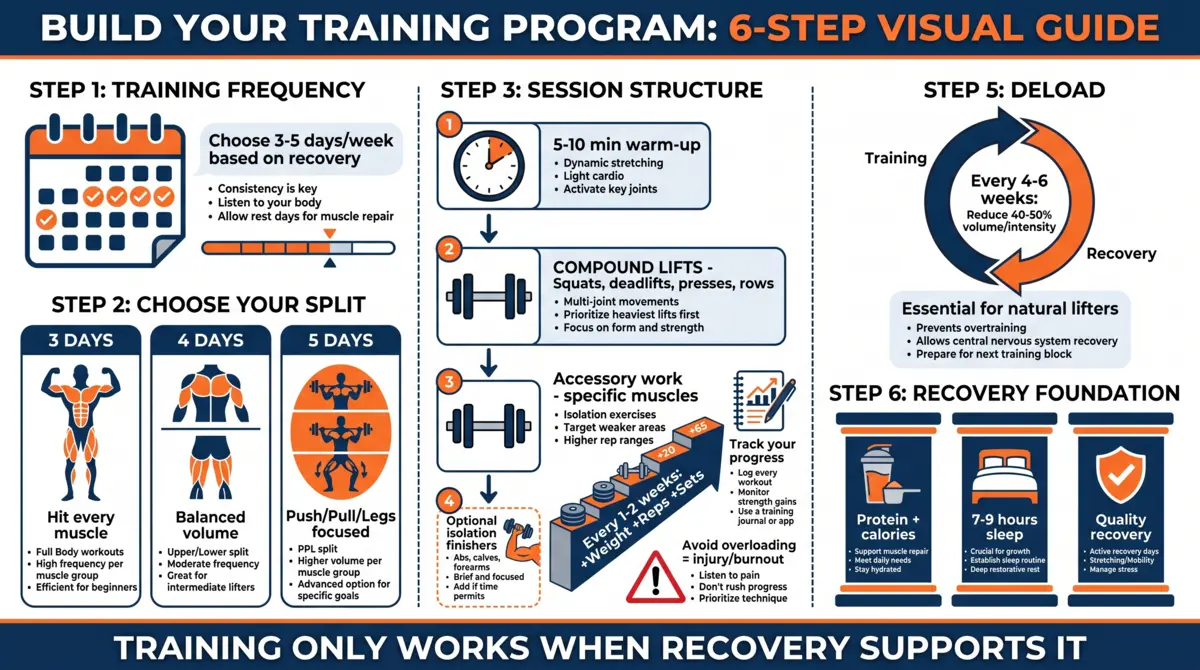
Step 1: Set a Realistic Training Frequency
Choose 3–5 training days per week based on your recovery capacity and schedule. What’s important here is to remember that you need quality time for recovery.
Step 2: Choose Your Split
- 3 days/week: Full body training hits every muscle group efficiently
- 4 days/week: Upper/lower split balances volume and recovery
- 5 days/week: Push/pull/legs allows more focused volume per muscle group
You are the one in control, so you choose what’s best for you.
Step 3: Structure Each Session
A well-designed session includes:
- A short 5-10 minute warm-up
- Compound lifts first. These would be squats, deadlifts, presses, and rows.
- Accessory work targeting specific muscles
- Optional finisher or isolation work
Quick example: A typical upper-body workout begins with compound movements like the bench press, rows, and overhead press, then finishes with targeted isolation exercises like curls and lateral raises.
Step 4: Apply Progressive Overload
Every 1–2 weeks, the goal is to add a small amount of weight, an extra rep, or an extra set to your key lifts. Overloading will only lead to injury, fatigue & burnout.
Track this in your training log so you can see the trend line, not just individual workouts.
Step 5: Program Deload Weeks
Every 4–6 weeks, reduce your training volume or intensity by roughly 40–50% for a week. This isn’t a break from progress — it’s what makes continued progress possible for a natural lifter.
If you can train consistently and recover well, see this 5-day split for building muscle for a sample weekly schedule.
Step 6: Dial In Nutrition and Recovery
Your training program only works if your recovery supports it. Prioritize protein intake, adequate calories, and 7–9 hours of sleep.
A quality whey or plant-based protein supplement can make it easier to hit your daily protein target without overeating. See top-rated protein powders for natural lifters. Yum
Expert Tips for Long-Term Success
Train the Same Movements Long Enough to Measure Progress
Switching exercises every week makes it impossible to know if you’re getting stronger. Stick with your main lifts for at least 6–8 weeks before rotating them out.
Switching exercises every week makes it impossible to know if you’re getting stronger. Stick with your main lifts for at least 6–8 weeks before rotating them out.
Use RPE, Not Just Weight on the Bar
Rate of Perceived Exertion (RPE) helps you adjust training intensity day to day, since recovery fluctuates with sleep, stress, and nutrition. A “hard” set should feel hard — not maximal — most weeks.
Photograph and Measure, Don’t Just Weigh Yourself
The scale doesn’t capture fat loss and muscle gain. Progress photos and tape measurements every 4 weeks give you a fuller picture than daily weigh-ins.
Invest in Proper Equipment
Poor form due to inadequate equipment (worn-out shoes, no belt for heavy lifts, no straps for pulling movements) can limit your progress or increase your risk of injury.
Common Mistakes to Avoid
Mistake 1: Copying Someone Else’s Program Exactly
A program built for someone else’s recovery capacity, schedule, and training age often won’t fit yours. Use programs as templates, then adjust volume and frequency to your situation.
Mistake 2: Chasing Every New Training Trend
Jumping between methodologies every few weeks prevents you from gathering enough data on any single approach to know if it’s working.
Mistake 3: Ignoring Recovery Signals
Persistent fatigue, declining performance, and poor sleep are signs you need a deload — not signs to push harder.
Mistake 4: Training Without Any Accountability System
Those lifters who track their workouts, often join a community of other lifters, or check in with a coach are far more likely to stay consistent through the low-motivation weeks.
Mistake 5: Neglecting Nutrition Tracking
A basic food-tracking app is an essential must-have tool that removes the guesswork when your protein and calorie intake don’t match your training demands. One may have a good, well-designed natural bodybuilding training program, but if it doesn’t align with their protein & calorie intake, why have one at all?
Conclusion
A good natural bodybuilding training program isn’t about finding the “perfect” split or copying an online influencer’s routine. It’s about matching training volume to your recovery, tracking progress, and maintaining accountability.
Start simple: pick a split that fits your schedule, log every session, add small amounts of progress each week, and don’t forget to build in a volume reduction before fatigue sets in and it’s too late. Follow your training schedule for 12 weeks before you judge the results.
Ready to put this into action? The first things you may need are an app or a journal to track your lifts and a quality supplement to dial in your protein intake. A coaching community is another way to build the accountability that keeps most lifters consistent long after motivation fades.