I can recall the first time I walked into a proper gym. Not the tiny apartment complex fitness room with two treadmills and a broken elliptical, but a real gym with clanking weights, grunting bodybuilders, and rows of machines that looked like medieval torture devices.
While I stood there holding my water bottle like a shield, watching everyone move with purpose while I had absolutely no clue where even to begin. Should I hop on a treadmill and stay safe? Try one of those intimidating cable machines?
Wander into the free weights section where everyone seemed to know the hidden greeting already?
That overwhelming feeling of being completely out of your depth explains why so many women join gyms in January and quietly stop going by February. The heavy weight of not knowing what you’re supposed to be doing, combined with the fear of looking stupid while you figure it out, becomes too much.
The difference between women who stick with strength training and those who fade back to occasional treadmill sessions comes down to having a clear and explicit confidence-building plan that tells you exactly what to do when you walk through those doors.
Why Most Beginner Plans Fail Women
Most beginner workout plans are written by trainers who’ve been lifting for fifteen years and have completely forgotten what it actually feels like to be new. They throw around expressions like “hypertrophy protocol” and “time under tension” without realizing that a true beginner wants to know which machine does what and how not to embarrass herself.
The plans designed specifically “for women” often swing too far in the other direction, treating you like you’re made of glass and can only handle pink dumbbells and endless bodyweight squats.
They avoid the weight room entirely, keeping you trapped in a cardio-and-abs loop that never delivers the strength or body changes you’re actually after.
What works is something right in the middle. You need a program built on the same basic movement patterns that make anyone stronger, male or female, but presented in a way that starts where you are.
This means respecting that you might feel anxious about trying new equipment, that you’re working around a demanding job and limited energy, and that you need visible progress relatively quickly or your motivation will tank.
A well-designed strength program works because it is simple and is designed for a beginner. You’ll learn just six or seven foundational movement patterns, practice them with gradually increasing weight, and watch your body respond in ways that months of incorrect workouts never delivered the results you were hoping for.
Understanding Movement Patterns Over Exercises
There are thousands of possible exercises you could do, but they all fall into just a handful of basic movement categories: squat, hinge, push, pull, and carry.
When you squat, you bend at the knees and hips to lower your body down and then stand back up. That pattern shows up in goblet squats, barbell back squats, leg presses, and even simple bodyweight squats.
They all train the same basic movement.
A hinge happens when you bend primarily at the hips while keeping your back straight, like picking something heavy up off the floor. Deadlifts, Romanian deadlifts, kettlebell swings, and good mornings are all hinge variations.
Pushes involve pressing weight away from your body, whether that’s a bench press, shoulder press, or a push-up. Pulls bring weight toward you, like rows and pulldowns.
Understanding this completely changes how you approach building a workout plan. Instead of stressing about whether you should do Exercise A or Exercise B from some influencer’s latest post, you make sure you’re covering all the major patterns each week.
If you squat, hinge, push, pull, and do some core work across three gym sessions, you’ve hit everything that matters.
This system also removes the intimidation around equipment.
Start with dumbbells or a machine version that will provide the same movement pattern.
Once you gain confidence, you can try different variations without feeling like you’re starting from scratch each time.
The Three-Day Full Body Foundation
The structure that consistently works best for women who are genuinely new to strength training involves three full-body sessions per week on non-consecutive days. That usually looks like Monday, Wednesday, Friday, or Tuesday, Thursday, Saturday, depending on your schedule.
Each session covers all the major movement patterns with relatively moderate volume so you’re not destroying yourself and needing four days to recover. You’ll do maybe four to six exercises per workout, usually two to three sets of eight to twelve reps each, using weights that feel challenging but manageable.
This approach has several massive advantages over the split routines you see advanced lifters doing. First, you practice each movement pattern three times per week instead of once, which means you learn proper form much faster.
Second, you build strength and muscle across your entire body consistently, avoiding the awkward situation where your upper body progresses but your legs get ignored.
Third, if life gets crazy and you miss a workout, you haven’t completely skipped training a particular body part for the entire week.
The recovery time between sessions matters just as much as the workouts themselves. Your muscles don’t actually get stronger while you’re lifting.
They get stronger during the 24 to 48 hours afterward when your body repairs and adapts to the stress you placed on it.
Training full body three days per week with rest or light activity in between gives you that adaptation time without leaving you undertrained.
Your First Month: Building the Habit Before Chasing Numbers
Your primary goal for the first four weeks is to show up consistently, learn the movements, you must commit to the plan, and stop negotiating with yourself. Setting personal records or dramatically reshaping your physique can wait.
Week one should feel almost easy. You use weights light enough that you could probably do five more reps if you had to, and that’s exactly right.
You’re teaching your nervous system how these movements feel, where your body is in space, and what proper form actually means for your specific proportions and mobility.
By the second week, you’ll start adding a little bit of weight or doing an extra rep or two per set. It still shouldn’t feel crushing.
You’re looking for the optimal point where the last couple reps of each set feel genuinely challenging, but you’re not grimacing or losing control of the movement.
Week three is where things start getting interesting. The movements that appeared awkward and unfamiliar three weeks ago now feel almost natural.
You’re no longer mentally rehearsing every step of a squat before you do it.
Your body knows. The weights that felt heavy at first now feel manageable, so you’re ready to progress again.
By week four, you’ve officially established a routine. Your body expects to be in the gym on those three days.
You’ve probably noticed changes in how your clothes fit, how your energy levels feel throughout the day, and how much more confident you are moving around the gym floor.
Sample Week One Workout Structure
Day One: Lower Body Emphasis
Start off with five to eight minutes of easy movement to raise your body temperature and get your joints ready. Walk on the treadmill at a comfortable pace, pedal gently on a bike, or do dynamic stretches like leg swings and hip circles.
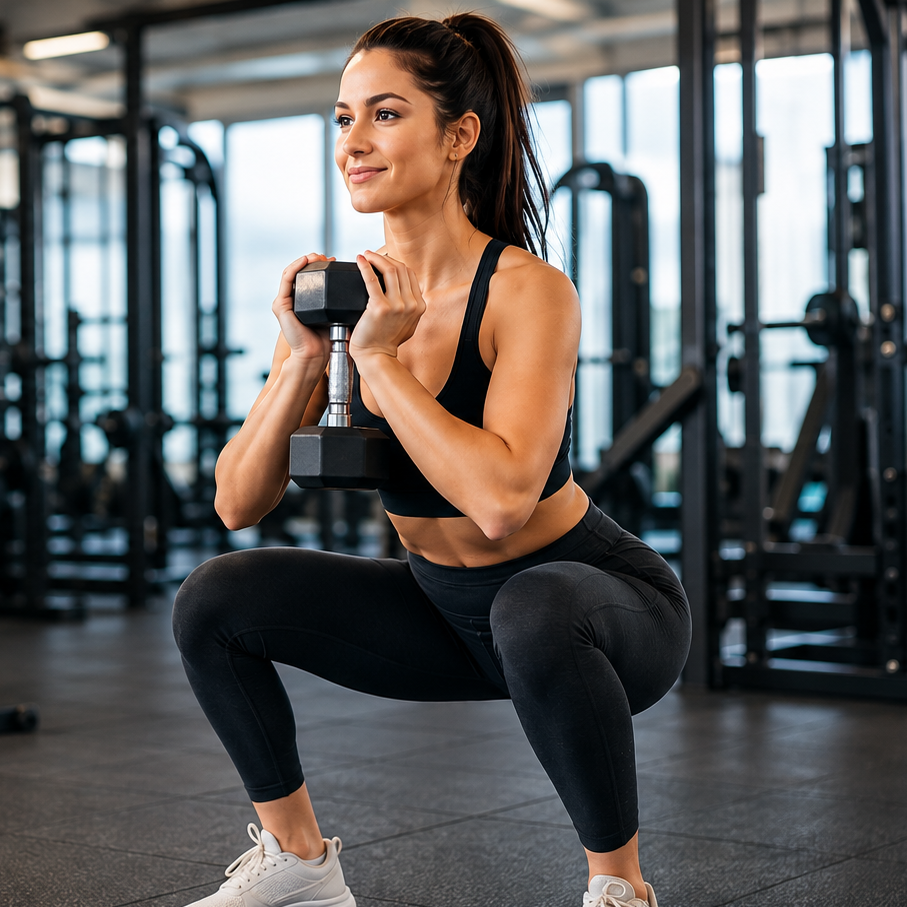
Your first working exercise would be a goblet squat. Stand with your feet about shoulder-width apart, hold a single dumbbell vertically against your chest, and squat down until your thighs are roughly parallel to the floor before standing back up.
You do two or three sets of ten to twelve reps with a weight that feels moderately challenging.
Next comes a hip hinge movement, probably a dumbbell Romanian deadlift. Hold a dumbbell in each hand in front of your thighs, hinge forward at the hips while keeping your back flat and your knees slightly bent, feel a stretch in your hamstrings, and then squeeze your glutes to return to standing. Again, two to three sets of eight to twelve reps.
After that, add an upper-body push, maybe a machine chest press or dumbbell bench press if the bench doesn’t feel too intimidating yet. Lie back on the bench, press the dumbbells up from chest height until your arms are extended, and lower them back down with control.
Then do a pull movement like a lat pulldown on the cable machine. Grab the wide bar overhead, pull it down toward your upper chest while keeping your torso mostly upright, and slowly release it back up.
Finish with some core work, perhaps a plank held for 20 to 30 seconds for two sets, and then spend five minutes walking slowly and doing gentle stretches for your hips, hamstrings, chest, and back.
The entire session takes about 35 to 45 minutes, and you leave feeling worked but not wrecked.
Day Two: Upper Body Emphasis
Same warm-up approach. Easy cardio and active movement for five to eight minutes.
Start with a leg press on the machine instead of squats, giving your lower body work with a slightly different stimulus. Press the platform away from you by extending your knees and hips, and control it back down without letting your lower back round.
Then move to a seated cable row or a machine row. Pull the handle toward your torso, squeezing your shoulder blades together at the end of the movement, and release with control.
Add a dumbbell shoulder press, sitting or standing, pressing dumbbells from shoulder height up overhead until your arms are extended.
Include some isolation work like dumbbell bicep curls and triceps pushdowns on the cable machine, since your arms probably haven’t gotten much direct attention yet.
Finish with glute bridges. Lie on your back with your knees bent and feet flat on the floor, and lift your hips toward the ceiling by squeezing your glutes, holding briefly at the top before lowering back down.
Do two to three sets of twelve to fifteen reps.
Cool down the same way with gentle walking and stretching.
Day Three: Full Body Balance
By the third workout of your week, you’ve already hit most major movements twice so that this session can be a bit more flexible. You might do bodyweight or goblet squats again, another hinge variation like a cable pull-through or light deadlift, some push-ups from your knees or against an incline, another rowing movement, and some dedicated core work like bicycle crunches.
The key is that you’re reinforcing all those movement patterns one more time before you take a full rest weekend.
Progression Strategy: Small Wins Compound Into Big Changes
A lot of beginners sabotage themselves here. They stick with the same weights for months because they’re scared of doing it wrong, or they try to jump ten pounds heavier because they’re impatient.
Both approaches stall your progress.
Real progression happens in tiny, almost boring increments. If you did three sets of ten reps with a fifteen-pound dumbbell last week, this week you might try to aim for three sets of eleven reps with that same weight.
Or you keep it at ten reps but pick up the seventeen-and-a-half-pound dumbbell instead.
You’re looking for just enough added challenge that your body has to adapt, but not so much that your form falls apart or you can’t complete your sets. When you can hit the top end of your target rep range across all sets with solid technique, that’s your signal to add a small amount of weight.
This is where tracking your workouts becomes non-negotiable. You cannot remember what you lifted two weeks ago with any accuracy.
You’ll either underestimate and spin your wheels, or overestimate and hurt yourself.
Get a small notebook, use the notes app on your phone, or grab one of those beginner-friendly workout tracking apps that let you log weights and reps for each exercise. Every session, you glance at what you did last time and aim to do just slightly more this time.
It feels almost comically simple, but it drives long-term progress more powerfully than anything else.
Managing Energy Across Your Menstrual Cycle
This seldom appears in generic beginner plans, but it makes a huge difference in how sustainable your routine feels. Your hormonal variations throughout the month genuinely affect your energy, strength, and recovery capacity.
During the follicular phase, roughly the first two weeks after your period starts, most women feel stronger and more energetic. This is a great time to push for new personal records, add an extra set, or try a slightly heavier weight than you think you can handle.
As you move into the luteal stage, the two weeks before your period, energy often dips and recovery feels slower. This doesn’t mean you skip the gym.
It means you might stick with the same weights instead of trying to add load, or you shorten your workout by one exercise if you’re genuinely dragging.
During your actual period, listen to your body. Some women feel totally fine and train normally.
Others feel better doing a lighter version of their planned workout or swapping a heavy strength day for gentle movement and stretching.
Both approaches are completely valid.
Stop fighting your natural rhythm and work with it instead. You’re not weak or lazy for feeling different energy levels at different times of the month.
You’re human.
The Cardio Question
You’ll see a lot of conflicting advice about cardio for women who want to build strength and change their body composition. Some camps insist you need tons of it for fat loss.
Some believe it’ll kill your gains and should be minimized.
The reality sits comfortably in the middle. Moderate amounts of cardiovascular exercise support your overall health, help with recovery by increasing blood flow, and contribute to the calorie deficit needed if fat loss is one of your goals.
But excessive cardio, especially high-intensity intervals done too often, can interfere with your recovery from strength training and leave you perpetually tired.
For most beginner women, adding two or three short cardio sessions per week on your non-lifting days works really well. These could be 15 to 20 minutes of brisk walking, easy cycling, swimming, or even a beginner-friendly intervals session like 30 seconds of slightly harder effort followed by 90 seconds of easy movement, repeated for ten to fifteen minutes total.
The keyword is moderate. You should be able to hold a conversation during most of your cardio work.
If you’re gasping for air and dreading every session, you’re going too hard too often, and it will eventually undermine your strength progress.
Nutrition Foundations
I’m not going to prescribe a specific meal plan because your food preferences, schedule, and goals are personal. But there are a few non-negotiable principles that will decide whether your training actually produces visible results.
First, you need adequate protein. Strength training breaks down muscle tissue, and protein provides the building blocks your body needs to repair it stronger than before. Most research suggests somewhere around 0.7 to 1.0 grams of protein per pound of your goal body weight per day.
If that seems overwhelming, start by including a good protein source at every meal: eggs, chicken, fish, Greek yogurt, tofu, legumes, whatever fits your eating style.
Second, don’t under-eat. A lot of women start strength training while simultaneously slashing their calories to speed up fat loss.
This backfires spectacularly.
Your body needs energy to fuel your workouts, recover afterward, and build new muscle tissue. Severe calorie restriction will leave you weak, exhausted, and unable to progress in the gym.
If fat loss is your goal, aim for a small to moderate calorie deficit, maybe 300 to 500 calories below your maintenance level, and be patient. You should still feel energized enough to complete your workouts without feeling like you’re dragging through them.
Third, stay hydrated and get enough sleep. These sound boring and obvious, but they’re the two recovery factors that most beginners completely ignore.
You won’t build strength if you’re chronically dehydrated or sleeping five hours a night.
Overcoming Gym Anxiety and Intimidation
Most people in the gym are far too focused on their own workout to notice or judge what you’re doing. The guy grunting through deadlifts is not watching you figure out the leg press.
The woman doing hip thrusts in the corner is thinking about her own form, not critiquing yours.
Everyone in that gym was new once. Every single person who now confidently loads a barbell had a first day where they didn’t know how to adjust the seat height on a machine.
You’re not uniquely clueless.
You’re just at an earlier point on the same learning curve everyone travels.
If you genuinely feel too anxious to explore the free weights area right away, there’s zero shame in spending your first few weeks primarily on machines. They’re designed to guide your movement path, which makes them more forgiving for beginners.
As your confidence grows, you’ll naturally become more curious about trying other equipment.
Consider going during off-peak hours for your first few sessions. Early mornings, mid-afternoons, or late evenings tend to be quieter than the post-work rush.
A less crowded gym floor gives you space to experiment without feeling monitored.
If you have the budget, even two or three sessions with a personal trainer can fast-track your confidence. They’ll teach you how to set up and use the equipment properly, which eliminates that terrifying feeling of standing in front of a machine with absolutely no idea what to do with it.
Common Mistakes That Stall Beginner Progress
The first big mistake is program-hopping. You see a new routine on social media, try it for a week, see another one that looks better, switch again, and never stick with anything long enough to actually progress.
Consistency beats novelty every single time.
Pick a solid beginner program and commit to it for at least six to eight weeks before you even think about changing.
The second mistake is training too hard too often. You think more is always better, so you add extra workouts, extra sets, extra exercises until you’re exhausted and your performance starts declining.
Beginners need less volume than you think.
Three focused full-body sessions per week will deliver excellent results if you’re actually recovering between them.
The third mistake is avoiding progressive overload. You do the same weights for the same reps for months on end because it feels comfortable and safe.
But your body has no reason to adapt if you never give it a new challenge.
You must gradually increase either the weight, the reps, or the number of sets over time.
The fourth mistake is neglecting form in favor of lifting heavier. Swinging weights around with momentum might let you use bigger dumbbells, but it shifts the work away from the target muscles and dramatically increases your injury risk.
Perfect your technique with lighter loads first.
The heavy weights can wait.
The fifth mistake is comparing your week-two self to someone’s Instagram highlight reel from year five of their training. You’re on completely different timelines, and that comparison will only make you feel inadequate.
Focus on being slightly better than you were last week, not trying to match someone else’s current level.
Frequently Asked Questions
How many times a week should a woman go to the gym as a beginner?
Three times per week on non-consecutive days works best for most beginner women. This gives you enough training stimulus to build strength while allowing adequate recovery time between sessions.
Monday, Wednesday, Friday or Tuesday, Thursday, Saturday are common schedules that fit this pattern.
Should beginners do full body or split workouts?
Full body workouts are better for beginners because you practice each movement pattern many times per week, which accelerates learning and strength development. Split routines where you train different body parts on different days work better for more advanced lifters who need higher volume per muscle group.
How heavy should a woman lift as a beginner?
Start with weights that allow you to complete your target reps with good form while feeling moderately challenged on the last few reps. If you’re aiming for ten reps, you should feel like you could maybe do two more, but not five more.
This usually means starting lighter than you think you need to.
Can you build muscle with just dumbbells?
Yes, dumbbells are excellent for building muscle as a beginner. You can perform all the major movement patterns with dumbbells, including squats, hinges, presses, and rows.
As you get stronger, you’ll eventually need access to heavier weights, but dumbbells will serve you well for months.
How long should a beginner workout at the gym?
A good beginner strength training session takes about 35 to 50 minutes, including your warm-up and cool-down. If you’re spending more than an hour in the gym as a beginner, you’re probably doing too many exercises or taking excessively long rest periods between sets.
Do women need different workouts than men?
The basic movement patterns and principles of strength training are the same regardless of gender. Women and men both benefit from squats, hinges, pushes, and pulls.
The main differences come down to personal goals, preferences, and how you might manage training around your menstrual cycle.
Should I do cardio before or after weights?
Do your strength training first when you’re fresh, and your energy is highest. If you do cardio first, you’ll be partially fatigued during your lifting, which compromises your form and limits how much you can lift. Save cardio for after your strength work or do it on separate days.
How long before I see results from strength training?
You’ll typically notice strength improvements within two to three weeks as your nervous system changes. Visual changes in muscle tone usually become noticeable around the six to eight-week mark.
Significant body composition changes generally take three to six months of consistent training and proper nutrition.
Key Takeaways
Your first gym program should be simple, focused on basic movement patterns, and designed to build consistency before chasing intensity. Three full-body workouts per week give you enough stimulus to build strength without burying you in fatigue.
Progress comes from small, incremental increases in weight or reps, not from completely overhauling your program every two weeks.
Track your workouts, so you actually know what you did last time and can plan to do slightly more this time. Moderate cardio supports your goals whereas excessive cardio undermines your recovery.
Eat enough protein and total calories to fuel your training, and don’t sabotage your strength work with severe dieting.
Give yourself at least four to six weeks on a consistent program before you judge whether it works. Your energy and performance will fluctuate across your menstrual cycle, and that’s completely normal.
Most people in the gym are too focused on their own workout to notice or judge yours.
Form always comes before load. Perfect your technique with lighter weights before you chase heavier ones.
Sustainability matters more than intensity.
A routine you can maintain for months will always beat a grueling program you quit after three weeks.