You want a routine that helps you build muscle without taking over your week. But should you train your whole body three times, divide workouts into upper and lower days, or follow the six-day split you keep seeing online?
The useful differences are practical: how many sessions you can attend, which equipment you have, and whether you can recover before repeating demanding work. A routine that looks impressive on paper becomes less useful when you regularly miss half of it.
This guide compares 13 muscle-building training options by those decisions. Some organise your week; others describe equipment or training methods. You can combine them, for example by using dumbbells for a full-body routine. The numbers are for navigation, not a scientific ranking.
If you are new, start by considering full-body training. If four weekly sessions fit comfortably, compare upper/lower. Then use the short entries below to check the trade-offs before committing. The goal is muscle growth, with strength tracked as one useful sign of progress rather than the only result that matters.
Table of contents: jump to a section
Compare the options at a glance.
Weekly sessions below are example schedules, not minimum requirements. Equipment-based approaches can fit several splits. These are starting points for choosing a structure, not complete individualised programs. For a deeper explanation of scheduling, see our guide to choosing a bodybuilding split.
| Training option | Example days/week | Useful fit |
|---|---|---|
| Upper/lower | 4 | Regular gym schedule |
| Full-body | 3 | Beginners |
| Push/pull/legs | 6 | Frequent training |
| Body-part split | 5 | Focused sessions |
| Torso/limbs | 4 | Separate arm work |
| Full-body emphasis | 3 | Planned variety |
| Machine-based | 3 | Stable exercises |
| Free-weight compounds | 3 | Practising main lifts |
| Home dumbbells | 3 | Home training |
| Resistance bands | 3 | Travel or small spaces |
| Calisthenics | 3 | Bodyweight preference |
| Low-volume training | 2–3 | Shorter sessions |
| Strength/hypertrophy hybrid | 4 | Strength and size |
What the evidence tells us: A 2024 review comparing split and full-body routines found similar strength and muscle-growth outcomes when training volume was matched. That supports choosing a manageable schedule rather than assuming more gym days automatically means more muscle.
1. Four-Day Upper/Lower Split
Best fit: Lifters who can reliably train four days.
Why it fits: Separating upper and lower sessions makes room for several exercises without putting your entire body into every workout. You can repeat each region twice weekly while keeping the schedule predictable.
How to use it:
- Schedule upper, lower, rest, upper, lower, then recovery days.
- Include a press and pull on upper days; a squat pattern and hip hinge across lower days.
- Keep the main exercises consistent enough to compare performance.
- Add repetitions within your chosen range before increasing the load.
Watch for: Upper days becoming crowded with arm exercises. Start with manageable sessions rather than copying an advanced lifter’s total workload.
2. Three-Day Full-Body Training
Best fit: Beginners and people with three dependable training days.
Why it fits: Full-body sessions let you practise basic movements regularly and spread work across the week. Missing one session does not automatically leave an entire body region untrained.
How to use it:
- Choose three nonconsecutive days, such as Monday, Wednesday and Friday.
- Build each session around lower-body work, a push and a pull.
- Alternate two simple workouts instead of making every session completely different.
- Add a small amount of arm, calf or core work when time permits.
Watch for: Trying to exhaust every muscle at every workout. Leave room to recover and repeat good-quality work at your next session.
3. Six-Day Push/Pull/Legs
Best fit: Experienced lifters who enjoy frequent gym visits.
Why it fits: Push sessions target the chest, shoulders, and triceps; pull sessions target the back and biceps; leg sessions target the lower body. Repeating that rotation distributes training across focused workouts.
How to use it:
- Arrange two push, two pull and two leg sessions around recovery needs.
- Divide your intended weekly workload across those sessions rather than doubling it.
- Track each exercise separately so progress stays visible.
- Reduce frequency if attendance or recovery becomes inconsistent.
Watch for: Choosing six days because it sounds more advanced. A shorter schedule may suit your life better. Three-day PPL is possible, but its weekly distribution differs from the six-day version.
4. Five-Day Body-Part Split
Best fit: Lifters who prefer concentrating on one region per visit.
Why it fits: Dedicated chest, back, leg, shoulder and arm sessions allow focused exercise selection. This is a scheduling preference, not evidence that each muscle needs its own day.
How to use it:
- Map out the whole week before choosing exercises for each day.
- Account for overlap, including triceps during pressing and biceps during pulling.
- Put priority exercises early, before fatigue reduces performance.
- Redistribute sets if a session becomes too long to complete well.
Watch for: A missed leg or back day becoming a missed week for that area. Avoid cramming extra sets into one session to make it feel productive.
5. Four-Day Torso/Limbs Split
Best fit: Lifters wanting arm work outside their main torso sessions.
Why it fits: Torso sessions include chest, back and shoulders, while limb sessions combine legs and arms. This changes how you allocate time compared with a conventional upper/lower split.
How to use it:
- Alternate torso and limb sessions across four weekly visits.
- Place demanding leg exercises before arm accessories on limb days.
- Allow for arm fatigue carried over from the previous day’s presses and pulls.
- Record sets by muscle group so overlap does not quietly inflate workload.
Watch for: Assuming separate labels mean separate recovery demands. Your arms still contribute to torso exercises, so adjust session order and effort when needed.
6. Full-Body Training With Emphasis Rotation
Best fit: Lifters who want variety within a repeatable structure.
Why it fits: You train the whole body while changing which movement receives priority. This gives important exercises an earlier place in different sessions without abandoning a consistent weekly plan.
How to use it:
- Use a squat emphasis on one day, a press emphasis on another and a pull emphasis on the third.
- Keep supporting exercises shorter and manageable.
- Repeat the same weekly pattern to track each session accurately.
- Compare like-for-like workouts rather than unrelated exercises.
Watch for: Turning planned variation into constant novelty. The purpose is to distribute effort, not invent a completely new workout every time you enter the gym.
7. Machine-Based Training
Best fit: People who prefer supported positions and simple setup.
Why it fits: Machines can reduce balance demands and make resistance changes convenient. A 2023 research review found no significant difference in muscle growth between machine and free-weight training overall.
How to use it:
- Select comfortable presses, rows, pulldowns and lower-body machines.
- Adjust the seat, pads and range before adding challenging resistance.
- Record machine settings alongside weight and repetitions.
- Increase the load only while continuing controlled movement.
Watch for: Assuming a fixed movement path fits everyone or guarantees safety. A machine that feels awkward may need a different setup or an alternative exercise. Ask the gym staff for help learning to use unfamiliar equipment.
8. Free-Weight Compound Training
Best fit: Lifters who enjoy practising multi-joint movements.
Why it fits: Squats, presses, rows, and hip hinges work numerous muscles in a single exercise. They offer a sound foundation, while smaller exercises can address areas that receive less direct attention.
How to use it:
- Choose variations you can perform confidently with available equipment.
- Practise technique with lighter warm-up sets before demanding work.
- Add accessories for priority areas such as calves, arms, or side delts.
- Use appropriate rack safeties or assistance for lifts where getting stuck could be a problem.
Watch for: Treating every session as a maximum-strength test. Progress can mean another controlled repetition at the same weight, not just a heavier bar or a personal record.
9. Home Dumbbell Training
Best fit: People who prefer exercising at home.
Why it fits: Dumbbells accommodate presses, rows, squats, hinges and smaller-muscle exercises without requiring a full gym. Their usefulness depends partly on whether the available weights remain challenging as you improve.
How to use it:
- Organise three full-body sessions around the equipment you actually own.
- Include a lower-body movement, press and row, then selected accessories.
- Use unilateral variations when comfortable and appropriate for your ability.
- Increase repetitions or resistance while keeping technique consistent.
Watch for: Outgrowing the resistance available for some movements. Slower repetitions can change difficulty, but they do not make every light dumbbell a permanent substitute for heavier equipment. A bench is helpful, not mandatory.
10. Resistance-Band Training
Best fit: Travel, limited storage and adaptable home workouts.
Why it fits: Bands provide portable resistance for presses, rows and accessory work. Their resistance changes with stretch, so recording setup details is especially useful when comparing sessions.
How to use it:
- Select bands and anchors designed for the exercises you intend to perform.
- Follow the manufacturer’s anchoring and maximum-stretch instructions.
- Record band type, stance, anchor position and repetitions.
- Progress through controlled repetitions or by appropriately increasing resistance.
Watch for: Damaged bands, improvised anchors and inconsistent positioning. Inspect equipment before use. If your setup cannot comfortably challenge a movement, choose a different exercise rather than stretching the band beyond its intended range.
11. Callisthenics for Muscle Building
Best fit: People who enjoy bodyweight movements.
Why it fits: Push-ups, rows, pull-ups, and their variations let you alter difficulty by varying leverage and assistance. This approach still needs a progression plan and enough suitable lower-body work.
How to use it:
- Choose variations that match your current ability, including assisted versions.
- Balance pushing with pulling rather than doing only push-ups.
- Include squats, step-ups or split squats suited to your control and balance.
- Progress repetitions before moving to a harder variation or adding resistance.
Watch for: Progression jumps that are too large. An intermediate variation may be more useful than repeatedly failing a difficult movement. Use properly installed equipment for hanging and supported exercises.
12. Low-Volume Resistance Training
Best fit: People building a manageable habit or working with short sessions.
Why it fits: Fewer working sets can make a routine easier to complete consistently. Low volume is a trade-off to assess through progress, not a guarantee of maximum growth with minimum work.
How to use it:
- Choose a small set of exercises covering your major muscle groups.
- Allow adequate warm-up time even when working sets are limited.
- Record repetitions, load and how demanding the sets felt.
- Add work gradually if progress slows and recovery allows it.
Watch for: Making every repetition an all-out struggle to compensate for fewer sets. ACSM’s 2026 guidance does not make training to momentary failure a requirement for results.
13. Strength and Hypertrophy Hybrid
Best fit: Lifters interested in both lifting performance and muscle size.
Why it fits: A blended approach allocates time to more intensive practice on selected lifts and to additional work for muscle development. It gives two goals a place in the same plan without requiring every exercise to serve both equally.
How to use it:
- Choose a few main lifts whose strength progress matters to you.
- Perform those lifts while fresh, using appropriate rest between sets.
- Follow with manageable accessory work for your target muscles.
- Track lift performance and longer-term body measurements separately.
Watch for: Increasing heavy work and accessory volume simultaneously. If sessions become difficult to recover from, prioritise one goal while keeping the other to a smaller amount of work.
Choose Your Starting Point
Use this visual as a shortlist, then read the matching entry above. It describes practical starting options, not a rule that your schedule never changes. Choose the attendance pattern first and equipment second. If your plan regularly conflicts with work, family or recovery, simplify the plan rather than judging your commitment. There is no need to buy a complete home gym before finding out whether you enjoy training at home.
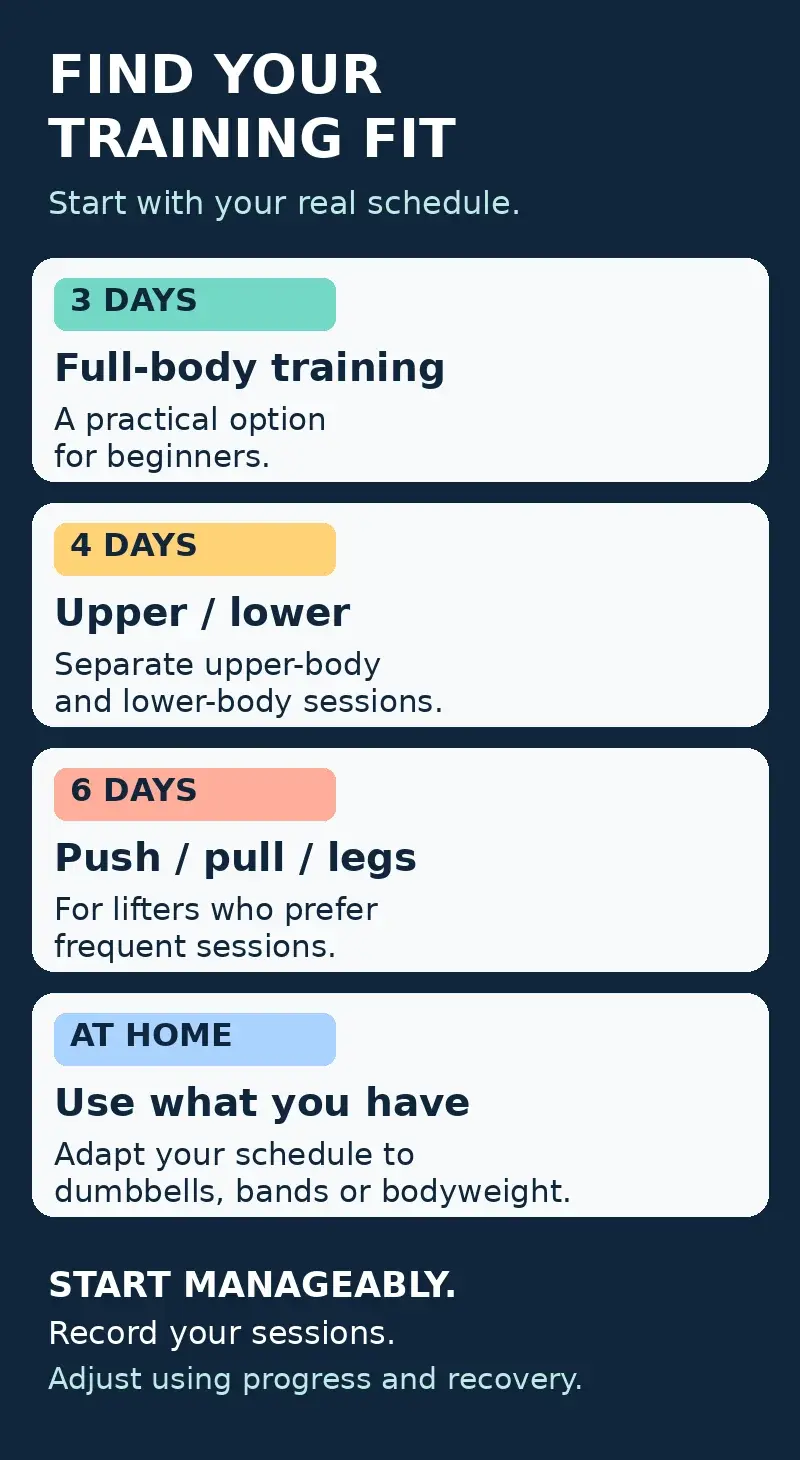
Infographic text:
- Three days available: consider full-body training.
- Four days available: consider upper/lower.
- Six days available and prefer frequent sessions: consider push/pull/legs.
- Training at home: adapt your schedule to dumbbells, bands or bodyweight.
- Start with a workable plan. Record your sessions. Adjust using progress and recovery.
Your Next Step: Choose, Record, Review
Pick one structure that fits an ordinary week, not your most motivated week. Write down the training days, exercises and progression method before starting. Keep a simple log of working sets, repetitions and resistance so your next session has a clear reference point.
ACSM recommends training the major muscle groups at least twice weekly and identifies roughly ten weekly sets per muscle group as a useful hypertrophy target. That is guidance to individualise, not a compulsory starting workload for every beginner.
Review attendance and performance regularly and allow for recovery. Keep useful exercises while adjusting workloads that are clearly unsuitable. You do not need to wait eight weeks to address pain, poor fit or an impossible schedule.
Support your training with practical meals using our foods-for-muscle-growth guide. For the wider framework, see our complete guide to muscle building.
Editorial note: This is a research-informed comparison of training approaches, not a firsthand trial of 13 complete programs. Exercise choices should suit your ability and any individual restrictions.