
You have been showing up for your workouts, but the mirror looks much the same. Your weight has barely moved, and yesterday’s bigger-looking arms have disappeared. Should you change your routine, eat more, or give it more time?
Before changing anything, check what you are measuring. A workout pump, a heavier weigh-in, and a stronger lift can each tell a different story. None proves muscle gain on its own.
To tell if your body is gaining muscle, look for a pattern over time: improving workout performance, consistent changes in measurements and photos, and body-weight trends that conform with your goal. This includes understanding how to tell if your body is gaining muscle, which can be useful clues, not a precise measurement of new muscle tissue.
You do not need an expensive scanner or an elaborate spreadsheet to start. A workout log, a flexible tape measure, and a routine can help you decide whether to keep going or investigate a stalled trend. Use the table below to choose what you will track, then follow the four-week checklist.
Table of contents: jump to a section
Muscle-Gain Tracking at a Glance
The schedule below is a practical starting point, not a scientific deadline for seeing results. Use the same steps each time and give the small changes time to show clear results.
How to Tell If Your Body Is Gaining Muscle
| What to track | Suggested schedule | Main limitation |
|---|---|---|
| Exercise performance | Every workout | Strength can improve without much size change |
| Waist and selected muscle measurements | Every four weeks | Tape measurements include more than muscle |
| Front, side and back photos | Every four weeks | Lighting and posture can disguise changes |
| Body weight | Several mornings weekly, if useful | Weight cannot separate muscle, fat and water |
| Fit of the same clothes | At monthly reviews | Fabric and washing affect the fit |
1. Your Workout Performance Is Improving
A training log shows whether you can do more than before under comparable conditions. Record the exercise, resistance, and repetitions for each working set in your workout journal.
For example, imagine completing three sets of eight dumbbell rows with the same weight. Several weeks later, you complete three sets of ten with similar control and effort. That is useful evidence of improved performance.
However, stronger does not automatically mean bigger. Technique, coordination, and other adaptations can also improve performance. Treat your log as one part of the picture, especially when you are new to an exercise.
To make comparisons useful:
- Keep the exercise setup and range of motion reasonably consistent.
- Note meaningful changes in rest time or equipment.
- Record actual repetitions, not just the number you planned.
- Compare several sessions rather than judging a single workout as unusually good or poor.
Adding weight while shortening the movement changes the task. It makes the numbers harder to compare, even if the heavier weight feels impressive.
If you need a routine you can repeat, explore these muscle-building training options. Choose a manageable approach before trying to track every possible exercise.
2. Your Measurements Show a Repeatable Pattern
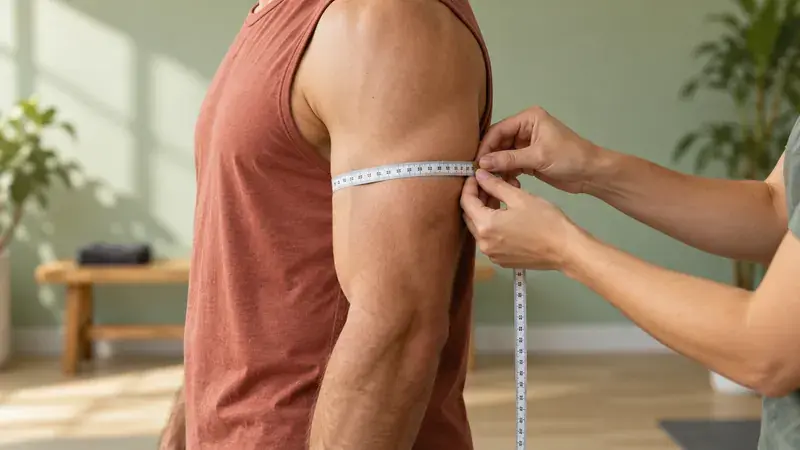
A flexible tape measure can help you notice changes that are difficult to see day to day. Start with your waist and two or three areas relevant to your goals, such as your upper arm, thigh, or chest.
You do not need to measure every body part. A smaller set of consistent records is more useful than a long list you abandon after a week.
Measure before training, in the same posture and at the same locations. Keep the tape level and snug without pressing into the skin. Decide whether a measurement will be relaxed or flexed, then continue with that choice.
Write down how you locate each measurement point. Take two readings, repositioning the tape between them. If they differ noticeably, check your placement and repeat rather than selecting the larger number.
Increasing limb measurements alongside a fairly stable waist can be consistent with muscle gain. But circumference includes muscle, fat and other tissues, and fluid changes can influence the result. A stable waist does not prove that every increase elsewhere is muscle.
Small differences may be measurement noise. Look for patterns throughout multiple reviews and compare them with your workout records and photos before changing your plan.
3. Your Progress Photos Show Changes Under Similar Conditions
Photos provide a visual record. They work best when you control the setup rather than searching for the most flattering angle.
Take front, side, and back photos about every four weeks. Use the same camera position, distance, clothing, pose, and lighting. Steady indoor lighting is easier to replicate than sunlight, which varies with the weather.
Take the photos before training so you are not comparing a post-workout pump with a relaxed appearance. If you use both relaxed and flexed poses, label them and compare like with like.
Look for changes across several photos rather than zooming in on one shadow or muscle outline. A leaner appearance may reflect fat loss, while a fuller appearance may reflect muscle, fluid, or both. Photos help show what changed, but cannot establish exactly what caused it.
Keep the images private unless you choose to share them. If taking body photos feels uncomfortable, skip them and use other tracking methods. The goal is a useful record, not another source of pressure.
4. Your Body-Weight Trend Makes Sense Alongside the Other Evidence
Body weight is useful context, but it is not a muscle meter. Meals, hydration, and changes in stored carbohydrate can move the number without representing new muscle tissue.
To track and record your weight, use the same scale on a firm, level surface. Try to follow the same pattern each time, such as after using the bathroom and before breakfast, wearing similar clothing.
Several readings over the week can give a clearer picture than a single isolated weigh-in. Add the readings together and divide by the number of measurements to calculate an average. Keep the schedule reasonably consistent from week to week.
Interpret that trend alongside your goal:
- During a gaining phase: rising weight provides context, but does not show how much of the increase is muscle.
- During possible body recomposition: weight may stay similar while measurements, appearance, and performance change.
- During fat loss, a falling weight with maintained performance can be encouraging, but it does not establish that muscle mass is unchanged.
Avoid treating a flat scale as proof that training is failing. Equally, do not assume that a rising scale proves your workouts are building muscle.
Daily weighing is optional. If it creates stress or distracts you from eating and training consistently, use a less frequent schedule or focus on the other records.
5. The Same Clothes Fit Differently
A familiar shirt or pair of trousers can provide an occasional clue. More room around the waist and a different fit through the shoulders or thighs may prompt you to check your other records.
Use the same garment, not two shirts labeled with the same size. Washing, drying, and stretched fabric can change the fit independently of your body.
Clothing is a supporting observation rather than a measurement method. Note what you notice at your monthly review, then look for agreement with your photos, tape measurements, and training log.
If your clothes fit the same, that alone is not a reason to abandon your routine. Small changes may not noticeably alter how a garment sits.
A Simple Four-Week Tracking Plan
Four weeks gives you a repeatable review point. It does not guarantee visible growth or enough change to draw a firm conclusion.
Before You Start: Record a Baseline
Write down your main goal and the training schedule you realistically expect to follow. Record your current performance on several regular exercises.
Take your chosen tape measurements and optional photos. If you use body weight, collect several comparable readings for a starting average. Keep everything in one notebook or document.
Also note pertinent context: returning after a break, changing equipment, starting a different routine, or having an unusually disrupted week. This makes later comparisons easier to interpret.
During the Month: Record, Then Get On With Training
Log your working sets and brief notes about technique or effort. Avoid repeatedly changing exercises to make the numbers look better.
Follow a repeatable plan that pushes your muscles and allows recovery. ACSM’s 2026 guidance recommends resistance training at least twice weekly for healthy adults, engaging the major muscle groups. Its review also found that frequency alone did not substantially change hypertrophy when total training volume was matched. More training days are not automatically better.[1]
Keep nutrition manageable. ISSN guidance places daily protein at approximately 1.4–2.0 grams per kilogram of body weight for most healthy exercising adults. For someone weighing 70 kilograms, that is about 98–140 grams.[2] Our foods-for-muscle-growth guide offers practical meal ideas.
At the Review: Compare the Whole Record
Repeat your measurements and optional photos under the original set of conditions. Review several workouts and your weight trend together.
Ask three questions: What changed? Did more than one method point in the same direction? Could different conditions explain the result?
If the pattern is uplifting and your routine is manageable, continue. If the evidence is unclear, collect another month of consistent records before assuming nothing is happening.
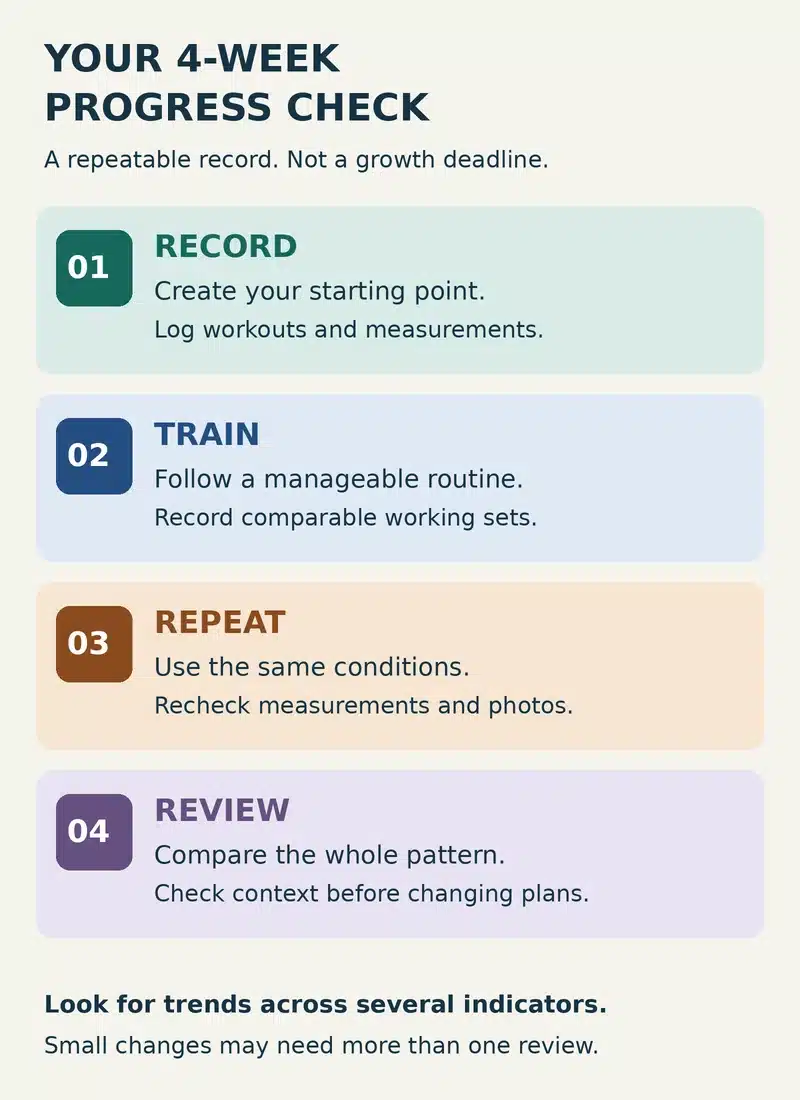
Tracking checklist: Record your starting point. Log comparable workouts. Repeat measurements and optional photos after four weeks. Review the pattern before changing the plan.
Common Signs That Can Mislead You
A Workout Pump or Muscle Soreness
A pump is a temporary change in muscle fullness, not proof of lasting growth. Keep post-workout photos separate from your regular progress record.
Soreness is not a score for workout quality. Do not use its presence or absence to decide whether you gained muscle. Your ability to sustain appropriate training matters more than chasing discomfort.[1]
A Smart Scale’s “Muscle Mass” Reading
Smart scales calculate body-composition estimates; they do not directly measure newly built muscle. A study of three consumer models found that body-weight readings were more accurate than their body-composition estimates. That finding does not establish the accuracy of every model, but it is a reason to avoid treating a small estimated change in muscle as fact.[3]
Use the weight trend if useful, and assess it alongside your other records.
Faster Weight Gain
Eating more does not guarantee that a larger share of gained weight will be muscle. In a small eight-week study of resistance-trained participants, faster weight gain was associated mainly with greater increases in skinfold thickness, without obvious additional growth across most measured muscles.[4]
Avoid making large increases in food simply because one measurement has not changed. First check the wider trend and whether your training and eating have been consistent.
What to Do When the Evidence Is Unclear
Begin by checking your records. Were the photos taken under similar lighting? Did you measure the same location? Have you changed exercises, effort, or technique?
Next, review consistency. Missed sessions, a demanding week, or an inconsistent meal routine can complicate comparisons. They do not automatically mean your entire approach needs replacing.
If several reviews show no noticeable progress, consider your training, nutrition, and recovery. Adjust one manageable factor, document the change, and reassess. Refrain from adding more sets when you are already struggling to recover.
For greater troubleshooting, use the complete guide to muscle building. If age or returning after a long break affects your starting point, see what to change when building muscle after 50.
Frequently Asked Questions
Can I Gain Muscle Without Gaining Weight?
Yes, muscle gain and fat loss can occur together. However, an unchanged scale alone does not show that this happened. Look for supporting trends in performance, measurements, and appearance, while accounting for any measurement error.
Does Getting Stronger Mean I Am Building Muscle?
Not necessarily. Strength also reflects technique, coordination, and familiarity with the movement. Improved performance is worth recording, but it should support your size-related observations rather than replace them.[1]
How Long Should I Wait Before Judging Progress?
Use a monthly review to organize your records, not to impose a deadline. Small changes may need several reviews to become clearer. A short period without visible change does not establish that your routine has failed.
Do I Need a Body Scan to Track Progress?
A scan is not required for this basic tracking routine. Home methods cannot tell you exactly how many kilograms of muscle you gained, but they can help you monitor patterns and identify questions to discuss with a certified specialist.
Your Next Step: Build a Record You Can Repeat
Choose a few regular exercises to log, two or three body areas to measure alongside your waist, and a monthly review date. Add weight averages and photos only if they are useful to you.
The aim is to replace daily guesswork with a consistent record. When several indicators move together over time, you have a stronger basis for deciding whether to maintain your plan or make a thoughtful adjustment. When they disagree, check the conditions and gather more information before overhauling your plan.
Sources
- ACSM Position Stand: Resistance Training Prescription for Muscle Function, Hypertrophy, and Physical Performance in Healthy Adults (2026).
- International Society of Sports Nutrition Position Stand: Protein and Exercise.
- Accuracy of Smart Scales on Weight and Body Composition: Observational Study.
- Effect of Small and Large Energy Surpluses on Strength, Muscle, and Skinfold Thickness in Resistance-Trained Individuals.