
You train regularly, try to eat well, and still wonder whether you are doing enough to build muscle. With so many workout splits, meal plans, supplements, and social media tips all competing for your attention, it is easy to lose sight of what matters.
The best muscle-building approach is not the most complicated routine. Design and use a repeatable system that helps you train each major muscle group, gradually increase the challenge, eat a balanced diet with enough nutritious food, and recover before your next workout.
This guide is for the busy lifter who can train three or four days per week but has stopped seeing clear progress. You do not need to rebuild your entire life around the gym. You need a plan that makes it easier to measure your effort.
The Muscle-Building Priorities at a Glance
| Priority | What to focus on | Simple starting point |
| Training | Challenging resistance exercises | Three full-body workouts per week |
| Progression | Gradually improve performance | Add a rep before adding weight |
| Weekly volume | Enough productive work | Begin with about 8–10 sets per muscle group |
| Protein | Consistent daily intake | Include protein in three or four meals |
| Calories | Enough food to support training | Add one practical meal or snack if needed |
| Recovery | Sleep and manageable fatigue | Keep at least one rest day between full-body sessions |
| Tracking | A few useful measurements | Record exercises, weight, reps, and body weight |
This is a starting framework, not a promise of a particular result. Your training history, age, schedule, food intake, health, and genetics can all affect your response.
Understanding the Basics of Building Muscle
Muscle growth is an adaptation to resistance training. When an exercise becomes challenging enough, your body has a reason to adapt—but that adaptation also depends on adequate food and recovery.
The American College of Sports Medicine’s 2026 position stand reviewed 137 systematic reviews involving more than 30,000 participants. It concluded that many forms of resistance training can be useful, while higher weekly training volume appears particularly important for muscle growth.
That means you do not need a perfect exercise, machine, repetition speed, or advanced training method. You need to perform productive work consistently and make sensible adjustments over time.
Training Creates the Reason to Adapt
Your muscles must experience enough resistance to make the final repetitions of a set challenging. The weight does not always need to be extremely heavy, but it should require concentration and good effort.
A properly performed set should end because the target muscles are becoming tired—not because your form has fallen apart or another joint has started hurting.
Progressive Overload Keeps the Plan Moving
Progressive overload means increasing the training challenge as your ability improves. This could involve:
- Completing more repetitions with the same weight
- Adding a small amount of weight
- Performing an additional set Improving control or range of motion
- Using better form with the same weight and repetitions
Progress does not have to happen during every workout. What matters is that your performance gradually moves forward over several weeks.
Recovery Allows You to Repeat Productive Training
More training is not automatically better. A program only works when you can recover well enough to perform the next session with reasonable energy and control.
Persistent joint discomfort, declining performance, poor sleep, and a loss of motivation can be signs that your workload needs to be reviewed.
Optional next step: If you prefer following a complete workout system instead of designing one yourself, review the Muscle Explosion program here. Compare its schedule and exercise requirements with the practical framework below before deciding.
Affiliate disclosure: If you purchase through an affiliate link, I may earn a commission at no additional cost to you.
Key Considerations Before Choosing a Routine
The best routine is one you can follow long enough to evaluate. Before choosing a program, consider your weekly schedule, training experience, available equipment, and ability to recover.
Which Training Split Fits Your Schedule?
| Training structure | Weekly schedule | Best suited to | Main concern |
| Full-body routine | 3 days | Busy beginners and early-intermediate lifters | Sessions require careful exercise selection |
| Upper/lower split | 4 days | Lifters wanting more work for each muscle | Requires another weekly gym visit |
| Push/pull/legs | 5-6 days | Experienced lifters who enjoy frequent training | Difficult for many busy people to maintain |
| One muscle per day | 5 days | Lifters who prefer focused sessions | A missed workout may leave a muscle untrained |
For the reader, this guide is designed to help. A three-day full-body routine is usually the most manageable place to begin. It gives you several opportunities to practice the main exercises without requiring daily gym visits.
For a deeper comparison, see how to choose the right bodybuilding program and training split.
How Much Training Do You Need?
The 2026 ACSM guidance identifies approximately 10 weekly sets per muscle group as a useful hypertrophy target, but this should not be treated as an exact requirement for every person.
If you are returning after a break, begin at the amount below. You can add sets later if you are recovering well but are no longer progressing.
Step-by-Step Muscle-Building Guide
Step 1: Set a Realistic Three-Day Schedule
Choose three training days that you can protect most weeks. Monday, Wednesday, and Friday work well, but any schedule with recovery time between sessions can work.
Avoid selecting days based on your ideal week. Build the schedule around the week you actually live.
Step 2: Build Each Workout Around Basic Movement Patterns
You do not need dozens of exercises. Each full-body session can include five or six movements:
- A squat or leg-press movement
- A hip-hinge or hamstring movement
- A horizontal or vertical press
- A row or pulldown A smaller shoulder, arm, calf, or core exercise
- An optional exercise for a muscle you want to emphasize
Machines, free weights, resistance bands, and bodyweight exercises can all be useful. The right choice is the one you can perform comfortably, control through an appropriate range of motion, and progress safely.
Sample Three-Day Full-Body Framework
| Day A | Day B | Day C |
| Goblet squat | Romanian deadlift | Leg press |
| Dumbbell bench press | Machine chest press | Incline dumbbell press |
| Seated cable row | Lat pulldown | Chest-supported row |
| Leg curl | Split squat | Hip thrust |
| Lateral raise | Biceps curl | Triceps pressdown |
| Plank | Cable crunch | Farmer’s carry |
This is a framework, not a prescription for every reader. Exercises can be replaced when equipment, mobility, experience, or physical limitations make another option more appropriate.
Program comparison: See what is included with Muscle Explosion if you want to compare a structured program with this do-it-yourself approach.
Step 3: Use a Simple Set and Repetition Plan
Begin with two or three working sets for most exercises. A moderate repetition range—such as 6–12 repetitions for larger movements and 10–15 for smaller exercises—is easy to track, although muscle can be trained across a wider range.
Choose a weight that lets you complete the set with controlled form. You should normally feel that you could perform another one to three good repetitions when you stop.
Training to complete muscular failure is not required for the average healthy adult to make progress, according to the updated ACSM review.
Step 4: Apply the Double-Progression Method
Double progression removes much of the guesswork from adding weight.
For and example: Suppose your target is three sets of 8–12 repetitions:
- Workout one: 10, 9, 8 repetitions
- Workout two: 10, 10, 9 repetitions
- Workout three: 11, 10, 10 repetitions
- Later workout: 12, 12, 12 repetitions
Once you reach the top of the range with good form, add the smallest practical amount of weight. Your repetitions may fall toward eight again, giving you room to progress.
Do not increase the weight when doing so causes you to shorten the movement, rush repetitions, or lose control.
Step 5: Make Protein and Calories Easier to Manage
You do not need to eat the same meal six times per day. Start by building three repeatable meals and one convenient snack.
Research and sports-nutrition guidance commonly place protein intake for exercising adults around 1.4–2.0 grams per kilogram of body weight per day. A large meta-analysis found no additional average increase in fat-free mass beyond approximately 1.6 grams per kilogram per day, although individual needs can vary.
People with kidney disease or another condition affected by protein intake should seek guidance from a qualified healthcare professional.
A Time-Saving Meal Framework
| Meal | Protein option | Easy carbohydrate | Produce or fat |
| Breakfast | Eggs, Greek yogurt, or cottage cheese | Oats or whole-grain toast | Fruit |
| Lunch | Chicken, tuna, tofu, or beans | Rice, potatoes, or a wrap | Frozen or pre-cut vegetables |
| Snack | Yogurt, milk, protein shake, or edamame | Banana or cereal | Nuts if more calories are needed |
| Dinner | Lean meat, fish, lentils, or tempeh | Pasta, rice, or potatoes | Salad or cooked vegetables |
Cook two proteins and one carbohydrate in larger portions once or twice per week. Keep frozen vegetables, canned beans, yogurt, eggs, and microwaveable rice available for days when the original meal plan falls apart.
You can also build your weekly menu around these foods for muscle recovery
If your body weight and gym performance have remained unchanged for several weeks, add one modest serving of food per day before complicating your diet.
Step 6: Treat Sleep as Part of the Program
A good program can still feel ineffective when sleep is repeatedly cut short. Research reviews suggest that consecutive nights of restricted sleep may reduce performance during multi-joint resistance exercises, although individual responses vary.
Use a consistent bedtime when possible. If your schedule temporarily limits recovery, consider reducing a few sets instead of forcing the same workload through a high-fatigue week.
Need more structure? Review the Muscle Explosion training approach and check whether its schedule is realistic for your available training days.
Step 7: Track Only the Information You Will Use
A simple notebook or phone note is enough. Record:
- Exercise
- Weight used
- Repetitions completed
- Number of working sets
- Any pain or unusual difficulty
- Weekly body weight, if relevant to your goal
Photos, tape measurements, and how clothing fits can provide additional context. Avoid judging progress by a single workout or a single scale reading.
Review your records every four weeks. Ask whether your repetitions, training weights, control, or measurements are moving in the intended direction.
Step 8: Troubleshoot a Plateau in the Right Order
When progress stalls, changing the entire routine should not be your first response.
| Check | Question to ask | Possible adjustment |
|---|---|---|
| Consistency | Have I completed most planned workouts? | Protect the schedule before changing the plan |
| Progression | Am I recording weights and repetitions? | Begin using a training log |
| Effort | Are my working sets genuinely challenging? | Finish sets closer to your current protein limit |
| Food | Has my body weight remained unchanged? | Add one repeatable meal or snack |
| protein | Do most meals contain a useful protein source? | Add protein to the weakest meal |
| Recovery | Am I carrying fatigue into every workout? | Reduce a few sets or add recovery time |
| Exercise selection | Does discomfort stop me from progressing? | Choose a more comfortable variation |
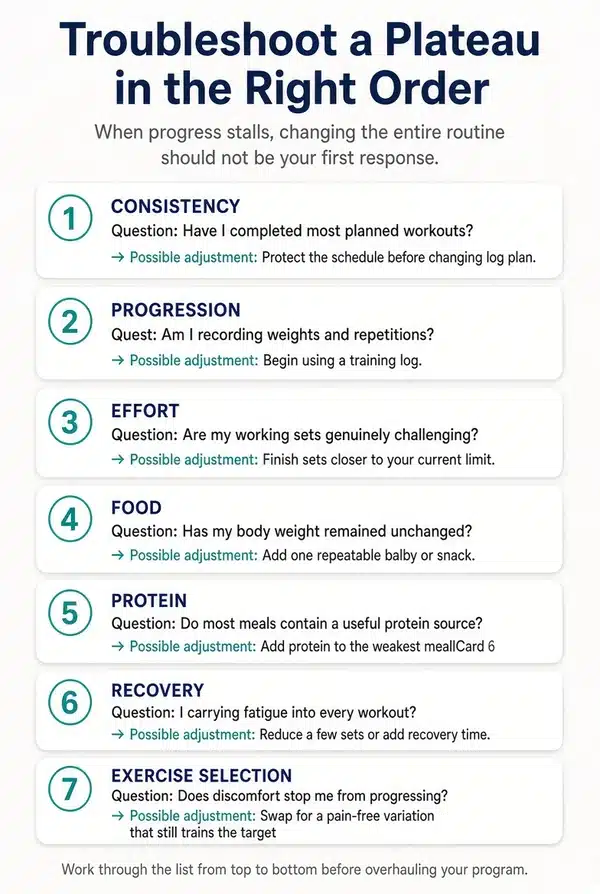
Change one or two variables at a time. If you change the exercises, split, sets, diet, and supplements simultaneously, you will not know what helped.
Expert Tips That Keep the Plan Simple
Keep Useful Exercises Longer
You do not need to “confuse” your muscles with a different workout every week. Keeping the main exercises consistent makes it easier to measure improvements.
Replace an exercise when it causes discomfort, does not fit your equipment, or repeatedly fails to train the intended muscle—not simply because it has become familiar.
Put Important Exercises First
Perform the exercises you most want to improve near the beginning of the workout, while you are less fatigued. This can be especially helpful when one muscle group has fallen behind.
Use Small Weight Increases
A large increase in training weight can turn a controlled exercise into a different movement. Small plates, adjustable dumbbells, or an extra repetition often provide smoother progress.
Use Supplements for Convenience, Not as the Foundation
A protein powder may help when regular food is inconvenient, but it cannot replace progressive training or an adequate overall diet. Pre-workouts, “muscle boosters,” and complicated supplement stacks are not required to begin.
Common Muscle-Building Mistakes
Doing More Work Without Measuring It
Adding exercises makes a workout longer, but it does not guarantee that the workout is better. Track a manageable number of movements and improve them gradually.
Changing Programs Too Quickly
Manage the number of movements and gradually improve them.
A difficult week does not prove that your routine has stopped working. Give a reasonable program enough consistent time to produce a measurable trend.
Adding Weight at the Expense of Form
Moving more weight only counts as useful progression when the target muscles still perform the work. Shortened repetitions and uncontrolled momentum can make the training log look better without improving the exercise.
Treating Soreness as the Goal
Soreness can occur after training, especially when an exercise or workload is new. It is not a dependable measurement of workout quality.
Use performance, consistency, recovery, and long-term measurements to judge the plan.
Ignoring Calories While Focusing Only on Protein
Protein is important, but it is not the entire diet. If you consistently eat too little, training performance and recovery may become harder to maintain.
Copying an Advanced Lifter’s Schedule
A six-day routine may look impressive but may be a poor fit for someone with only three available training days. Choose the smallest effective structure you can perform consistently.
Final program option: If planning every workout is the main reason you lose consistency, take a closer look at Muscle Explosion. Review the program details, refund terms, equipment needs, and weekly schedule before purchasing.
Frequently Asked Questions
How many days per week should I train to build muscle?
Three full-body workouts per week are a practical starting point for a busy lifter. A four-day upper/lower routine can also work if you can maintain the additional training day.
Do I have to train every set to failure?
No. Most sets can stop when you believe you have another one to three controlled repetitions available. Taking some smaller, lower-risk exercises closer to failure is an option, but it is not necessary on every set.
Can I build muscle at home?
Yes, provided your exercises create enough resistance and can be made progressively harder. Adjustable dumbbells, resistance bands, a bench, and bodyweight variations can support a simple home routine.
Do I need protein powder?
No. Protein powder is a convenience food, not a requirement. Use it when it helps you meet your food plan more easily, but do not assume it will compensate for inconsistent training.
What should I do if an exercise hurts?
Stop the movement rather than pushing through sharp or worsening pain. Check your setup, reduce the load, or choose a comfortable alternative. An appropriately qualified healthcare professional should assess persistent pain.
When should I change my routine?
Consider changing it when your schedule changes, an exercise causes ongoing discomfort, or several weeks of consistent training show no progress despite adequate effort, food, and recovery.
Conclusion
Muscle building does not require a perfect routine or a shelf full of supplements. For a busy lifter, the strongest starting point is usually three manageable workouts, repeatable meals, gradual progression, and enough recovery to return to the next session ready.
Begin with the smallest plan you can follow consistently. Record your work, review the trend every few weeks, and adjust only what your results tell you needs attention.
No responsible program can guarantee a particular amount or speed of muscle growth. A clear process, however, gives you a much better way to use your time and identify what may be holding you back.