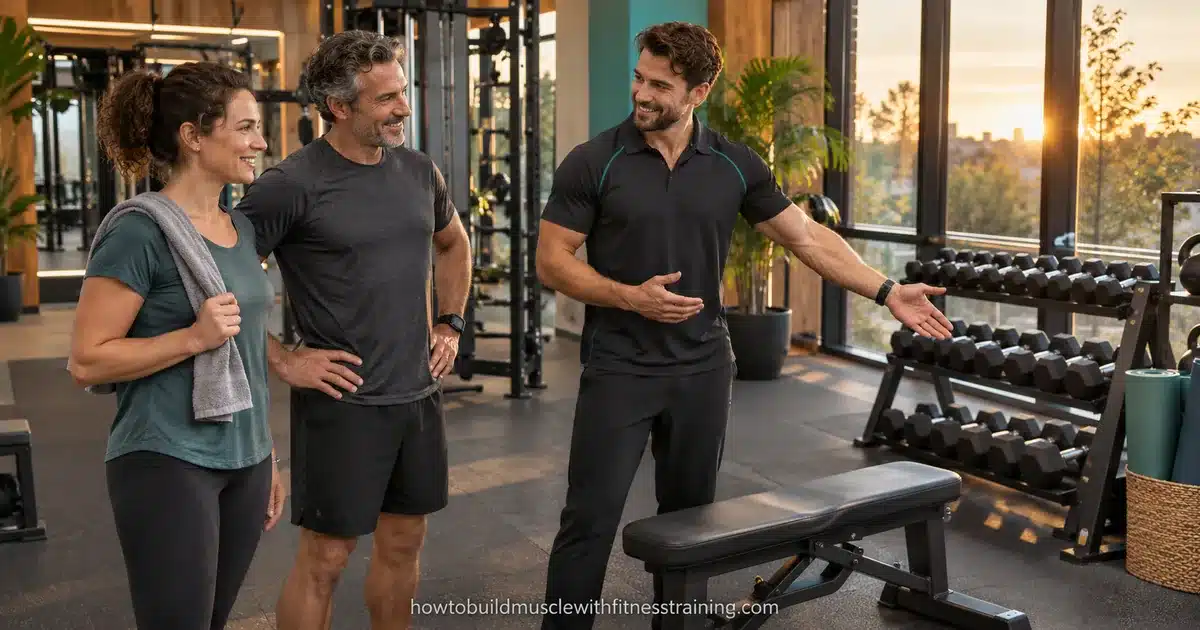
When I first walked into a gym, I spent like 20 minutes just wandering around trying to look busy. I had no clue what to do, so I copied what other people were doing and hoped for the best.
That lasted about two weeks before I quit.
The problem wasn’t that I was lazy or unmotivated. I just had zero structure. You need a plan you can actually stick to without feeling lost every time you step into the gym.
A solid strength training program for beginners should cover the major muscle groups, use exercises you can do safely, and leave room to adjust when life gets messy (because it will).
Quick note: This article contains affiliate links. If you buy something through one, I might earn a small commission at no extra cost to you.
Understanding the Basics
What strength training actually does
Strength training is basically asking your muscles to work against resistance. That could be barbells, dumbbells, machines, bands, cables, or just your body weight.
The benefits are pretty straightforward:
- You get stronger for everyday stuff (carrying groceries, moving furniture, picking up kids)
- Your muscles grow and become more resilient
- Your joints get better support
- Your bones get stronger from the load
- You feel more confident doing physical tasks
- Athletic performance improves if that’s your thing
The CDC says adults should do muscle-strengthening activities at least two days per week, hitting all major muscle groups. That includes legs, hips, back, abs, chest, shoulders, and arms.
You don’t need to train until you collapse or puke in a bucket. You just need enough effort that the final few reps feel challenging while you maintain control.
Sets, reps, and weight (the stuff everyone gets confused about)
A repetition (or rep) is one finished movement. A set is a group of reps before you rest.
For most beginner exercises, start with:
- 2-3 sets
- 6-12 reps
- 1-3 minutes rest between sets
- A weight that leaves about 1-3 good reps left in the tank
Beginners usually make one of two mistakes. They either go way too light so every set feels like nothing, or they go way too heavy, and their form falls apart.
Pick a weight where the last few reps are difficult, but you’re not twisting around or bouncing the weight to finish.
The CDC notes that a single set of 8-12 reps can work, but two or three sets might yield better results.
Full-body training vs split routines
A full-body routine trains your legs, pushing muscles, pulling muscles, and core in one session. This works well for beginners because you practice the important movements many times each week.
A split routine divides training by body part. Like chest and shoulders on Monday, legs on Wednesday, that kind of thing.
Splits can work, but they create a problem for new lifters: if you miss one day, that entire muscle group might get zero work that week.
Start with full-body training two or three days per week. You can mess around with split routines later if you want to train more often or need shorter sessions.
Key Considerations Before You Start
Pick exercises you can actually perform safely
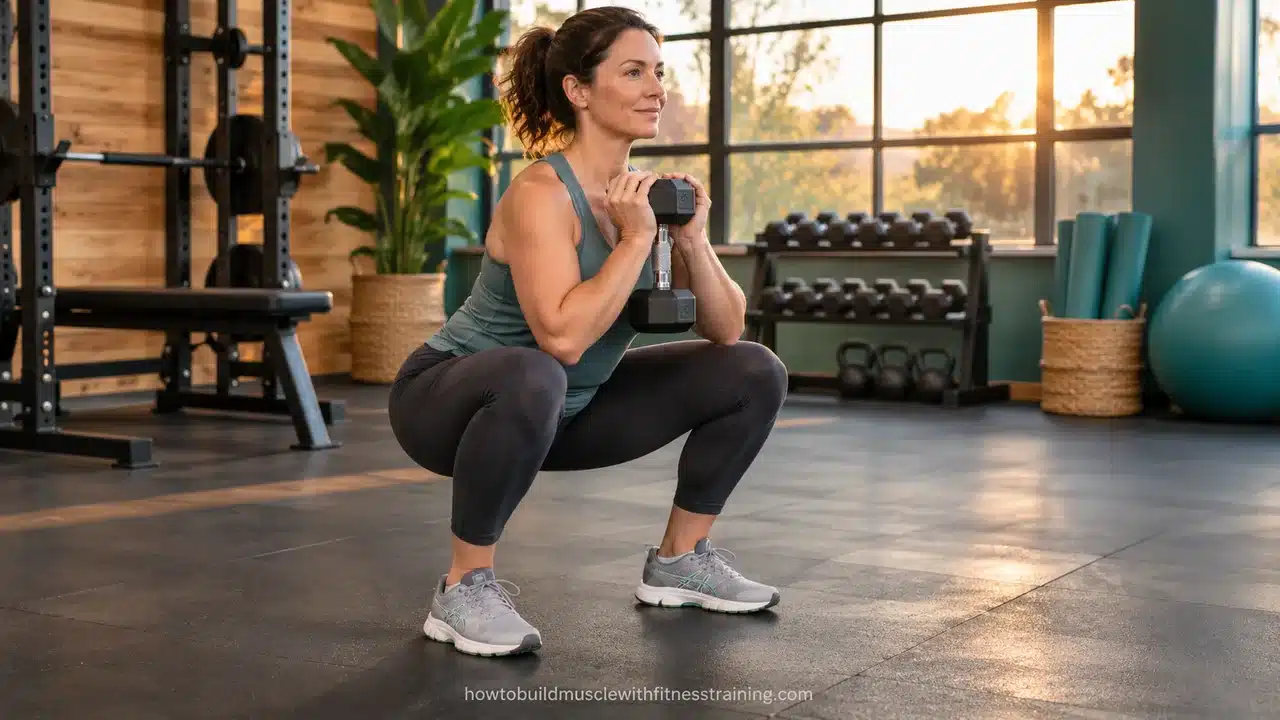
Your first exercise doesn’t need to be the most impressive one in the gym. A goblet squat might be way better than a barbell back squat if it helps you learn balance and depth without making you feel like you’re going to fall over.
Here are some beginner-friendly movement patterns:
| Movement pattern | Beginner-friendly examples |
|---|---|
| Squat | Goblet squat, leg press, box squat |
| Hinge | Romanian deadlift with dumbbells, hip thrust |
| Horizontal push | Push-up, machine chest press, dumbbell bench press |
| Horizontal pull | Seated cable row, chest-supported dumbbell row |
| Vertical push | Dumbbell shoulder press, machine shoulder press |
| Vertical pull | Lat pulldown, assisted pull-up |
| Core stability | Plank, dead bug, farmers carry |
Use machines if they make you feel more secure. Use free weights when you can control them.
Neither one is automatically better.
Choose a schedule you can actually repeat
Two solid weekly sessions beat an ambitious five-day plan that lasts ten days before you burn out.
Try:
- Monday and Thursday for two sessions
- Monday, Wednesday, and Friday for three sessions
- Two sessions during busy weeks, three when your schedule allows
The best schedule leaves at least one rest day between hard full-body workouts.
Track performance, not just body weight
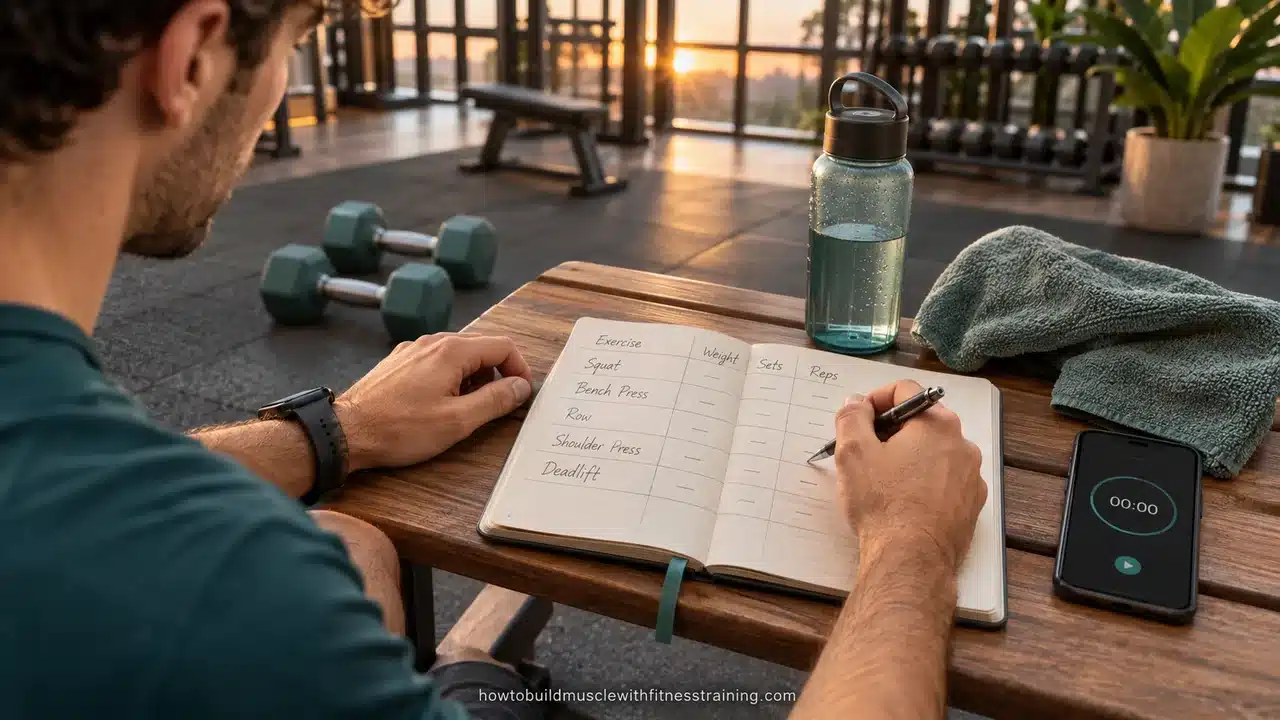
Body weight fluctuates due to food intake, water, hormones, sodium, and digestion. It doesn’t tell you the whole story.
Track:
- Exercise name
- Weight used
- Reps completed
- Sets performed
- Quick notes about technique and effort
A training log can show you’re progressing even when the scale hasn’t budged. Our guide to tracking muscle gain beyond the scale explains which changes to record.
I use a simple notebook for this, but there are some decent workout log apps if you prefer digital
A Simple 8-Week Beginner Plan
Train two or three times each week, alternating Workout A and Workout B. For two sessions, do A and B. For three sessions, use A/B/A one week and B/A/B the next, leaving a rest day between sessions.
Workout A
- Goblet squat – 3 sets of 8-12
- Dumbbell bench press or machine chest press – 3 sets of 8-12
- Seated cable row – 3 sets of 8-12
- Romanian deadlift with dumbbells – 2 sets of 8-10
- Plank – 3 sets of 20-40 seconds
Workout B
- Leg press or box squat – 3 sets of 8-12
- Lat pulldown – 3 sets of 8-12
- Dumbbell shoulder press – 2-3 sets of 8-12
- Hip thrust or glute bridge – 3 sets of 10-12
- Dead bug – 3 sets of 6-10 per side
Finish with optional light cardio if you feel like it. Ten to twenty minutes of walking or cycling is plenty.
You don’t need to turn every lifting session into a CrossFit workout.
How to warm up
Spend five to ten minutes doing easy movement to raise your body temperature; walking, cycling, or rowing all work well.
Then do a few lighter practice sets for your first major exercise.
For example:
- Empty machine or body weight for 10 reps
- Light dumbbells for 8 reps
- Moderate weight for 3-5 reps
- Working sets after that
Static stretching is optional. Controlled practice reps are usually more useful before lifting.
How to choose your starting weight
Pick a weight that lets you finish the lower end of the rep range with good technique. Stop the set if your posture changes or the movement gets jerky.
Your first week is partly an information-gathering week. You’re learning how the exercise feels, how quickly you recover, and how much weight you can handle.
Don’t treat it like you’re testing your max strength.
How to progress (this is where most people mess up)
Use something called double progression:
- Pick a rep range like 8-12
- Keep the same weight until you can hit 12 reps on every set with controlled form
- Increase the weight by the smallest available amount
- Return to the lower end of the range
- Build the reps back up again
So if you do dumbbell presses with 15 kg for 10, 9, and 8 reps, keep that weight next time. When you can do 12, 12, and 12, move up to 17.5 kg if that’s the next practical increase.
The American College of Sports Medicine’s 2009 progression position stand says you should increase load when you can exceed the intended workload by one or two reps, with increases usually falling around 2-10%.
Only increase one variable at a time. Adding weight, sets, exercises, and training days all together makes it impossible to figure out what caused you to feel like garbage.
How to Adjust the Plan When Progress Slows
A plateau doesn’t always mean the routine stopped working. Check the basics first.
If you miss sessions
Don’t try to cram two missed workouts into one brutal session. Just do the next planned workout and move on.
If three sessions feel hard to maintain, make two sessions your standard and treat the third as a bonus.
If your technique breaks down
Reduce the weight by 5-15% and rebuild. You can also temporarily shorten the range of motion if a particular position causes discomfort, but persistent pain requires professional assessment.
Muscle fatigue and effort are normal. Sharp, worsening, or joint-specific pain is a reason to stop that exercise.
If you stop adding weight
Use this order:
- Check if you’re sleeping and eating enough
- Confirm you’re recording every set
- Keep the same weight and aim for one additional rep
- Reduce one set for a week if fatigue is building up
- Replace an annoying exercise with a similar movement
- Take a lighter training week if several lifts decline together
A lighter week might involve reducing the weight, sets, or both by roughly 10-30%. Resume normal training once you feel recovered.
If workouts take too long
Keep the first three exercises as priorities. Cut optional isolation work before removing the main movement patterns.
You can also pair non-competing exercises to save time:
- Goblet squats with planks
- Chest presses with cable rows
- Hip thrusts with dead bugs
Rest properly for demanding sets though. Rushing every exercise can trash your performance and make technique less reliable.
Expert Tips That Actually Help Beginners Progress
Use a rating of perceived effort
You don’t need complicated percentages of your one-rep max. Just rate how difficult a set feels.
- Easy: You could do five or more additional reps
- Moderate: You could do three or four more
- Hard: You could do one or two more
- Maximum: You cannot finish another controlled rep
Most beginner sets should feel moderate to hard. Training to failure on every set creates unnecessary fatigue and can make consistency harder.
Focus on skill before intensity
Strength includes a technical component. Repeating the same movement with controlled positioning teaches your nervous system how to coordinate the task.
Keep the lowering phase controlled. Avoid bouncing weights, rushing through the range of motion, or changing your stance every session.
Use substitutions instead of quitting
A busy gym, limited equipment, or an uncomfortable joint doesn’t have to end the workout.
Examples:
- Barbell squat → leg press or goblet squat
- Barbell bench press → machine chest press or push-up
- Pull-up → lat pulldown
- Barbell deadlift → dumbbell Romanian deadlift
- Cable row → chest-supported dumbbell row
The movement pattern matters more than copying some specific influencer’s exercise list.
Build accountability into the plan
Motivation fluctuates. A fixed appointment is way more dependable.
Useful options:
- Training with a friend
- Booking a recurring class
- Joining a small group
- Sharing your weekly log with someone
- Using a calendar streak
- Setting a minimal session of only two exercises
Your minimal session might be one squat pattern and one push or pull exercise. Completing a short workout keeps the habit alive when a full session isn’t realistic.
Adjustable dumbbells are clutch if you train at home and don’t have space for a full rack
Common Beginner Mistakes
Changing the routine every week
A new program can’t show its value if you replace it before learning the exercises. Keep the main routine for at least six to eight weeks unless it causes pain or clearly doesn’t fit your schedule.
I used to do this constantly. I’d find a new routine every Monday and wonder why nothing changed.
Copying an advanced lifter’s volume
A bodybuilding routine designed around six weekly sessions might include way more exercises and sets than you need. Beginners can make progress with a modest amount of training because the initial adaptation is substantial.
You don’t need to do 20 sets for chest when you’re just starting out.
Treating soreness as the goal
Soreness isn’t a score. Severe soreness can mess with your next session and make you dread training.
Increase workload gradually. This is a strength training program for beginners, not a punishment.
Ignoring recovery
Muscles adapt during recovery, not while you’re doing the set. Aim for adequate sleep, regular meals, enough protein, and rest between demanding sessions.
Recovery isn’t lazy. Recovery is when you actually get stronger.
Chasing perfect form
Good technique means controlled, repeatable movement suited to your current ability. It doesn’t mean every rep must look identical to a professional athlete’s lift.
Your squat depth might improve over time. Your pressing path might change as you learn the movement.
That’s normal.
Testing one-rep maxes too soon
Maximal lifts add risk and provide little useful information for most beginners. Rep records with clean technique are way more practical.
Save the max testing for when you have more experience under your belt.
There are some solid beginner strength training books if you want more detail on programming and technique
Final Takeaway
A successful beginner plan has three features: it trains the major movement patterns, increases difficulty gradually, and fits your actual week.
Start with two full-body sessions. Do two or three sets per exercise.
Keep most sets between 6 and 12 reps.
Record your work, add reps before weight, and adjust the plan when recovery issues or scheduling problems arise.
Give the routine enough time to work. Consistency will produce more progress than constantly switching programs, and a basic plan completed for months will beat an advanced plan abandoned after two weeks.
The truth is that most people fail because they don’t stick with something long enough to see results, not because they chose the wrong beginner strength-training program.
Keep it simple, track your progress, and show up consistently. That’s the whole game.
For more help getting started, read our complete guide to muscle building for training, progression and recovery, or explore foods for muscle recovery.